Categories
1.5 Communication Development: Articulation

Articulation

The development of articulation1 follows a sequence that takes several years to complete. Some speech sounds, such as “l” “r” , “s” and “i“, are especially difficult to learn how to say, or to pronounce (see full Glossary) (Fig. 1) and some children do not master the ability to make these sounds correctly until  they are seven or eight years old. Other speech sounds (e.g., “th” as in “this” and “zh” as in “pleasure”) are developed later on, by age 8. In order to find out which speech sounds develop at which age, please look at the Speech Sound Development Chart.
Articulation

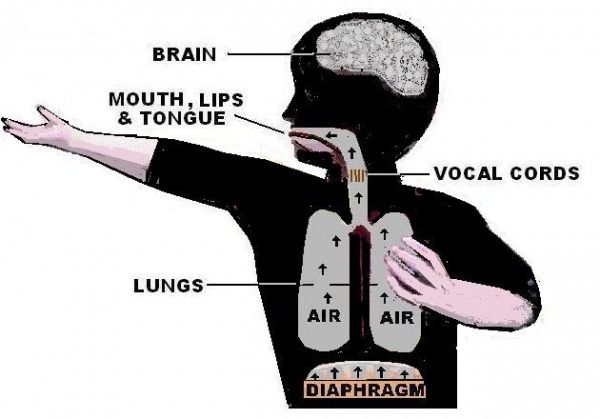
Figure 1. The illustration shows what needs to happen inside the child’s body for pronunciation or articulation to happen

Some signs of articulation difficulties include:

  • Understanding of the child’s speech by only those who know the child well, by age 4;
  • Taking a long time to speak or answer questions;
  • Showing frustration when speaking (e.g., crying);
  • Avoiding to join in or to speak in groups or any social situation and conversations (because of speech difficulties);
  • Confusing and substituting sounds after age 6 (e.g. “wabbit” for “rabbit”);
  • Missing word beginnings or endings of words (e.g. “kool” or “schoo” for “school”);
  • Missing parts of words, or syllables (see full Glossary) in longer words (e.g. “cacuta” for “calculator);
  • Saying certain speech sounds in some situations but not others (e.g. saying “s” in school but not “s” in bus): this is a serious red flag.

A child’s self-esteem2 (see full Glossary) may suffer when growing up with speech difficulties. That is because these difficulties are obvious and may draw other people’s attention to them. Children with speech delays need a little bit of extra time when asked questions, so that they can be calm as they respond to questions. This prevents the child from feeling he/she draws the attention of others. The earlier a child receives professional help to work on his or her speech difficulties, the more chances for them to succeed in their language skills.
1 see References
2. References on child self-esteem on Kids Health, available at http://kidshealth.org/parent/emotions/feelings/self_esteem.html.
Categories
1.5 Communication Development: Pragmatics

Pragmatics

Language experts use the term “pragmatic language1 to refer to how we use language for social reasons. That is, when we use language to communicate our thoughts and ideas to those around us – and is not simply making sounds.

Some children may not know how to use language socially. Some signs of pragmatic language difficulties may include:

  • Having little or no turn-taking skills;
  • Getting very close to others when speaking, almost face to face;
  • Having little or no eye contact with others, not even caregivers, siblings or peers when communicating with them (unless dictated by one’s culture);
  • Finding it difficult to understand and answer questions after age 6;
  • Not taking turns when speaking, as if speaking in ‘circles’ after age 3;
  • Giving brief and short answers to all questions, after age 5;
  • Jumping from one topic in a conversation to another with no transition;
  • Not keeping up with the topic of the conversation, or “going off on tangents”.

Children who cannot make their language “work” for them in these ways find this very frustrating. They will need as much professional support as children who cannot understand or speak, or with receptive or expressive language delays.

1 see References
Categories
1.5 Communication Development: How Development In Early Years Affects Development in the Elementary Years

How Development in Early Years Effects Development in Elementary Years

Children who have difficulties with language in the early childhood years1 will very likely continue to exhibit difficulties with language in the elementary years and beyond. If these difficulties are not addressed, they will get more serious and will have a negative effect on practically all aspects of the child’s life. This applies to all aspects of language: receptive, expressive, pragmatic and articulation. Children with language delays do not “outgrow” them. With appropriate support however, they may acquire and develop many of the basic skills.

Children with language delays by age 5 years, at they begin the elementary school years (and beyond) may exhibit the following behaviours:

Children with difficulties with receptive language:

  • May look as if they do not pay attention, because they may not understand what is being asked of them;
  • May only hold a small number of words in their vocabulary;
  • May continue to experience difficulties in social situations, because of their receptive language skills difficulties.

Children with difficulties with expressive language:

  • May continue to find it difficult to be part of groups and  other social situations, and avoid them completely;
  • May continue to feel that they are “different” from others (e.g., things that are easy for others are difficult for them, both in and out of school situations);
  • May struggle with learning how to read and write, and have trouble with subjects like socials, sciences and math that are language-based.

Children with difficulties with pragmatics :

  • May continue to avoid social situations, because it is hard for them to be a part of a conversation;
  • May be avoided or made fun of by other children, because of their  difficulties with language when sharing with others;
  • May be aware of their language difficulties, continue to feel ‘bad’ (see full Glossary) about themselves.

Children with difficulties with articulation:

  • May avoid social situations, because of difficulties with some speech sounds
  • May choose not to talk to avoid other children making fun of them.
  • May be aware of their speech difficulties, continue to feel ‘bad’ about themselves.

Children with language delays who show these behaviours need additional support at school; otherwise, these behaviours could become more complex between 5 and 12 years old. Knowing of how these language difficulties may effect a child is important in any of the four aspects of language. Not being successful in language and communication skills may have long lasting effects. These difficulties may prevent the child from being included in activities such as school plays, debates or any other meetings, or just ‘mingling’ with children and adults. As adolescents and young adults, any daily life situations that include language and communication become difficult, for example, talking to a bank-teller or contacting one’s doctor.

1 see References

Categories
1.6 Cognitive Development: Overview

Cognitive Development

A Brief Overview1

In the Typical Cognitive Development section of this course, we described how cognitive development involves the development of thinking or evaluation and coping, or ‘adaptation’ skills. Thinking or evaluation skills, such as “thinking outside the box2 (see full Glossary),” are related to the development of intelligence (see full Glossary). Coping skills involve the ability to adapt to changes in one’s environment.  Cognitive skills also look at creativity, the ability to learn new things, retain (see full Glossary) what one has learned, and how one applies information to new situations. Cognitive development also includes pre-academic and academic skills that children need in order to succeed at school. Examples might include the ability to sit quietly for certain periods of time, the ability to listen and follow instructions and the ability to perform paper and pencil tasks.

Some children do not develop these skills at par with their peers. They may develop some of these skills much later than others —or not develop them at all. In other words, atypical cognitive development involves difficulties with both the quality and quantity of certain skills (see full Glossary):

Severe cognitive delays often effect all other areas of development. Below are some signs of cognitive delays that can be observed in all areas of development between the preschool and school age years, around ages 3 – 5 years old.

In the domain of cognitive development:

  1. Children may experience serious difficulties in learning basic concepts (e.g. colors and shapes);
  2. Children may experience serious difficulties in learning advanced concepts (e.g. counting, reading and writing);
  3. Children may experience serious difficulties in generalizing what they learn from one situation to the next;
  4. Children may experience serious difficulties in adapting to changes in their environment and to new situations.

In the domain of social/emotional development:

  1. Children may trust others too easily and readily enabling others to take advantage of them;
  2. Children may not read visual or language cues as they their attempt to socialize with others.

In the domain of motor development:

  1. Children may exhibit delays in the development of their fine motor skills;
  2. Children may exhibit delays in the development of their gross motor skills

In the domain of communication development:

  1. Children may exhibit delays in the development of their receptive language skills;
  2. Children may exhibit delays in the development of their expressive language skills;
  3. Children may exhibit delays in the development of their pragmatic skills;
  4. Children may exhibit delays in the development of their articulation skills.

In the domain of adaptive skills:

During the preschool years:

  1. Children may be delayed in becoming toilet trained, and in extreme cases, may never be toilet trained.

During the elementary school years:

  1. Children may experience difficulties bathing and cleaning themselves properly;
  2. Children may experience difficulties with dressing and undressing.

During the high school years:

  1. Male adolescents may experience difficulties with knowing how and when to shave;
  2. Female adolescents may experience difficulties knowing how to handle their menstrual cycle.

Severe cognitive delays have been linked to developmental disabilities (also known as mental retardation and developmental challenges). Developmental disabilities involve global delays and affect all areas of development, including motor, language, social and emotional, and self-help skills.

1. see References
2. Source: University of Wahington, available at: http://faculty.washington.edu/ezent/imdt.htm
Categories
1.6 Cognitive Development: Thinking Skills

Thinking or Evaluation Skills

Children who show delays in the development of their cognitive skills1 need an evaluation. This evaluation helps caregivers and teachers understand what a child’s specific needs are, and to provide intervention as early as possible. Delays in cognitive development may result in delays in other developmental areas and are likely to affect the child’s work at school and his daily life activities as he/she grows older.

Some signs of significant cognitive delays in babies, toddlers and children are below.

Between Birth and Age 12 Months:

  • Babies may not develop object permanence; (see full Glossary)
  • Babies may not produce speech sounds and may not babble (see full Glossary);
  • Babies may not show interest in looking around their own environments;
  • Babies may not reach for objects.

At 12 Months and Older:

  • Babies and young children may not look at others;
  • Babies and toddlers may not engage in games and activities that need joint attention and joint action (see full Glossary);
  • Toddlers and young children may not explore their environments;
  • Toddlers and young children may not play appropriately with toys;
  • Toddlers and young children may not imitate others;
  • Toddlers and young children may not pretend that something is something else (for example: pretending that a spoon is a comb);

During preschool ages (2-3 year olds – 5 Year Olds)

  • Young children may no tuse imaginary play; that is, they will not pretend that they are someone else (for example, a superhero or a cat);
  • Young children may not show they understand basic language, or “qualitative” concepts (for example: tall/short, big/small);
  • Young children may not show they understand basic math, or “quantitative” concepts (for example: all, none, a little, a lot);
  • Young children may not showthey understand basic where or “spatial” concepts (for example: far/near, over/under);
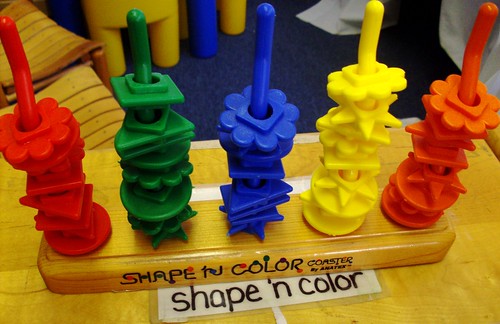
  • Young children may not group or separate toys, or put them into or other objects into categories (for example: ‘only the red blocks go in a container’) (see full Glossary); (Fig. 1)

categories

Fig. 1: Organizing items into categories
  • Young children may not match (see full Glossary) pegs, toys or other objects with same colour (for young preschool children); same colour and shape (for older preschool children); same colour, shape and size (for children in kindergarten and older);
  • Young children may not put together simple puzzles (for example: large 4-8 pieces); (Fig. 2)

assemble

Fig. 2: A 9-piece puzzle that has been assembled

Young children may not recognize a pattern (see full Glossary) and continue it (for example: red blue, red blue);

  • Young children may not tell others how old they are when asked;
  • Young children may not tell others if they are a boy or a girl when asked;
  • Young children may not answer “why” questions (for example: Why do we eat? Why do we sleep?) when asked;
  • Young children may not retell basic parts of a short story when asked;
  • Young children may not count (first to five, then to 10, then to 20 by age 6);
  • Young children may not match objects using one to one correspondence (see full Glossary) (Fig. 3);

one to one correspondence

Fig. 3: Counting little bears and matching by the corresponding number
  • Young children may not imagine or talk about future events (for example: having a birthday party).

Signs of cognitive delay are not always easy to recognize in babies and even toddlers, because they are more subtle than motor delays.  It is of great importance that caregivers and others working with babies, toddlers and young children are aware—and provided with information—of their cognitive milestones.

1. see References
Categories
1.6 Cognitive Development: Pre-Academic/Academic Skills

Pre-Academic/Academic Skills

It is very important to recognize and address the signs of delays in the pre-academic and academic (see full Glossary) areas in young children. Being aware of milestones (see full Glossary) and addressing any difficulties during the early years is likely to make a difference in the child’s learning and progress during his school years, and as he or she grows older. A child with these delays who does not receive help may be at risk when functioning within the school setting and in his/her daily activities.

Between 3 and 5 years old Some signs of pre-academic/academic delays may include the following examples.

If a young child:

  • Does not group or separate toys or other objects, or put them into  categories (see full Glossary); for example, ‘blueberries go in one plate and strawberries go in a different plate;’ (Fig. 1)

categories

Figure 1: An example of categories

  •  Does not match (see full Glossary) pegs, toys or other objects of the same colour (for young preschool children); of the same colour and shape (for older preschool children); of the same colour, shape and size (for children in Kindergarten and older);
  • Does not sort (for example: cannot tell which item goes with which: spoon goes with fork, shorts go with jacket);
  • Does not recognize a pattern and continue it (for example: red blue, red blue…); this is a very important concept in the development of mathematical skills;
  • Does not answer “why” questions (for example: Why do we eat? Why do we sleep?);
  • Does not understand “cause and effect” relations (for example: the reason we can’t play with this toy is because you broke it.);
  • Does not retell basic parts of a story;
  • Does not describe what he or she is doing;
  • Does not think about future events;
  • Does not predict “what will happen next”, (for example: Mom forgot to turn off the water. What do you think will happen?);
  • Does not count (Fig. 2: Counting toes);

counting toes

Figure 2: Counting toes

By age 6 years:

  • Does not tell “which one has more” (for example: a plate with three strawberries and a plate with five strawberries);
  • Does not perform simple addition activities (for example: If you have two pennies and I give you one more, how many will you have?);
  • Does not perform simple subtraction activities (for example: If you have three crayons and I take away one, how many will you have left?);
  • Does not recognize letters of the alphabet;
  • Does not recognize own name in print;
  • Does not read simple words;
  • Does not copy letters (from memory or an example);
  • Does not copy simple words (from memory or an example);
  • Does not copy own name (from memory or an example).
Categories
1.6 Cognitive Development: How Development in Early Years Affects Development in Elementary Years

How Development in the Early Years Affects Development in Elementary Years

The development of basic cognitive skills in the early years1 will lay the foundation for the development of more complex cognitive skills during the child’s elementary and middle school years. It is critical to recognize signs of cognitive and pre-academic/academic delays as early as possible.

Some children may show slight difficulties while in preschool or kindergarten related to attention, listening and following directions. These difficulties need attention; otherwise they may turn into complex problems in the later elementary grades as children engage in reading, writing and number activities. A few examples of these difficulties include the following:

  • Preschool children who experience difficulty sitting for certain periods of time (for example: about 5-10 minutes) while engaged in a game or activity may find it harder to engage in and complete activities during their school years. For example:
    • While at school, a child may experience difficulties sitting in class, in the lunch room or in the auditorium during 30-45 minute periods of time.
    • Outside of school, a child may experience similar difficulties when watching a movie at home or at the theatre, while travelling in the bus or car, or become very impatient if walking down the street or while visiting a mall or a doctor’s office
  • Preschool children who cannot follow directions may find it very hard to fully participate, as students, in- and out- of- school activities; for example:
    • At school a child may have difficulties following a teacher’s instructions and completing the activities in the classroom, the gym, while on a class trip, or while engaging in group games while on the playground.
    • Outside of school a child may have difficulties listening to and understanding his/her swimming coach, and/or be left out during parties because he/she cannot follow the games.
  • Children who find it hard grouping objects into categories during their preschool years, will find it difficult learning to read and write, and doing number work during their school years; for example:
    • In school a child may experience difficulties telling the difference between vowels and consonants or between odd and even numbers.
    • Outside of school, a child may experience difficulties putting away his/her toys and/or clothes on shelves or drawers in ways he/she can easily find them.
    1 see References
Categories
1.7 Motor Development: Overview

Motor Development

A Brief Overview1

As we have seen in the Typical Motor Development section of this course, the development of motor skills follows a predictable sequence for most children. If there is a delay in the development of either gross or fine motor skills, a child needs to be seen by a specialist, usually an occupational therapist or physiotherapist, as early as possible.

Delays in motor development may also signal the presence of a condition related to the central nervous system. Immediate consultation with a physician is recommended to rule out any major condition.

  • Motor skills are important because the development of other skills may depend on them. That is, delays in either gross or fine motor skills are likely to result in delays in other areas of development. Physical development may be affected in terms of muscle strength; this impacts the balance and control of the child’s body.
  • Delays in the development of gross motor skills may adversely affect the child’s social/emotional development as the child may not feel as competent as his/her classmates during physical education and other daily motor activities (such as running for the bus or playing basketball).
  • Delays in the development of fine motor skills may also adversely affect the child’s social/emotional development as the child may feel awkward because of the way he/she holds a pencil or uses a spoon.
  • When children have high muscle tone, their muscles are tense; this is referred to as hypertonia (see full Glossary)
  • When children have low muscle tone their muscles tend to be flabby; this is referred to as hypotonia (see full Glossary).

It is therefore important to be familiar with typical development milestones in the gross and fine motor domains, and to seek the help of a professional, if a delay is suspected.

motor development

Figure 1. Motor development
1. see References
Categories
1.7 Motor Development: Gross Motor Skills

Gross Motor Skills

Motor development1 begins with simple skills and moves to more complex skills. This is why it is described in terms of a hierarchical pattern (see full Glossary) (Fig. 1). Delays in the development of gross motor skills should be addressed as soon as possible. For instance, a child may not be able to run, if he/she does not learn to stand and walk first.

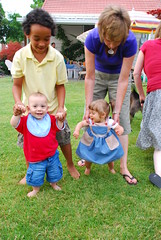
Figure 1: A child learning to walk. He needed to stand up alone first.

Some signs of gross motor delay include:

Between 3 and 12 months old:

  • Delay in opening hands;
  • Difficulties holding head up;
  • Difficulties sitting, with support or independently;
  • Difficulties standing.

Between 12 – 18 months old:

Between 18 – 36 months old:

1. see References
Categories
1.7 Motor Development: Fine Motor Skills

Fine Motor Skills

In the Typical Motor Development section of this course, we discussed how fine motor skills1 are necessary for a child’s ability to perform many skills, both in and outside of school. At school, a child’s ability to hold a pencil, crayon, paint brush, spoon and/or chopsticks properly relies heavily on his/her fine motor skills. The same holds true for outside school activities. Fine motor skills are needed to play with toys, eat at the dinner table and turn a light off. It is therefore very important to monitor the development of a child’s fine motor skills, and to seek the help of a professional (usually an occupational therapist), at the earliest signs of delay.

Standardized tests (see full Glossary) evaluating a child’s developmental skills rely on the child’s abilities to complete certain tasks, for example, doing puzzles. Many children may perform poorly on some tasks, because of fine motor—not cognitive—delays (Fig. 1).

fine motor delays

Fig. 1. This picture shows a kit with materials for a standardized test for young children (the Stanford-Binet).

The way a child controls the movements of his/her lips and tongue, or his/her oral/motor skills, is also a part of motor difficulties. Any difficulties in this area should also be addressed as soon as possible so the child will  be able to eat and speak correctly. Specialists who usually address oral/motor difficulties include speech and language pathologists and occupational therapists.

Early signs of delay in the development of fine motor skills include the following:

  • Baby has difficulty latching on to breast or bottle, during feeding;
  • Young baby’s hands are somewhat tight-fisted, and not open most of the time;
  • Baby has difficulty taking toys to mouth, or mouthing toys;
  • Toddler has difficulty using thumb and index finger, or using a pincer grasp.

holding a crayon

Fig. 2 The picture shows a child learning to use her thumb and index finger when in holding a crayon with a grip support device


1. see References

Spam prevention powered by Akismet