RESEARCH
Theory of Change
NOTE: Publications about the Theory of Change are forthcoming.
Preliminary work can be found here:
Lukes, L., Mazabel, S., Sherman, S.B., Pete, S., & Gilley, B. (2022, October). Developing an initial theory of change for the Earth Science Experiential and Indigenous Learning (EaSEIL) Project, a faculty and curriculum development project. The Geological Society of America, Denver (USA) and Online.
Facilitated Community of Practice (CoP) Model
NOTE: Publications about the Networked, Facilitated, and Multidisciplinary Community of Practice Model are forthcoming.
Summary of Annual Report Outcomes
Year 1 (April 2022 – April 2023)

Year 2 (April 2023 – April 2024)

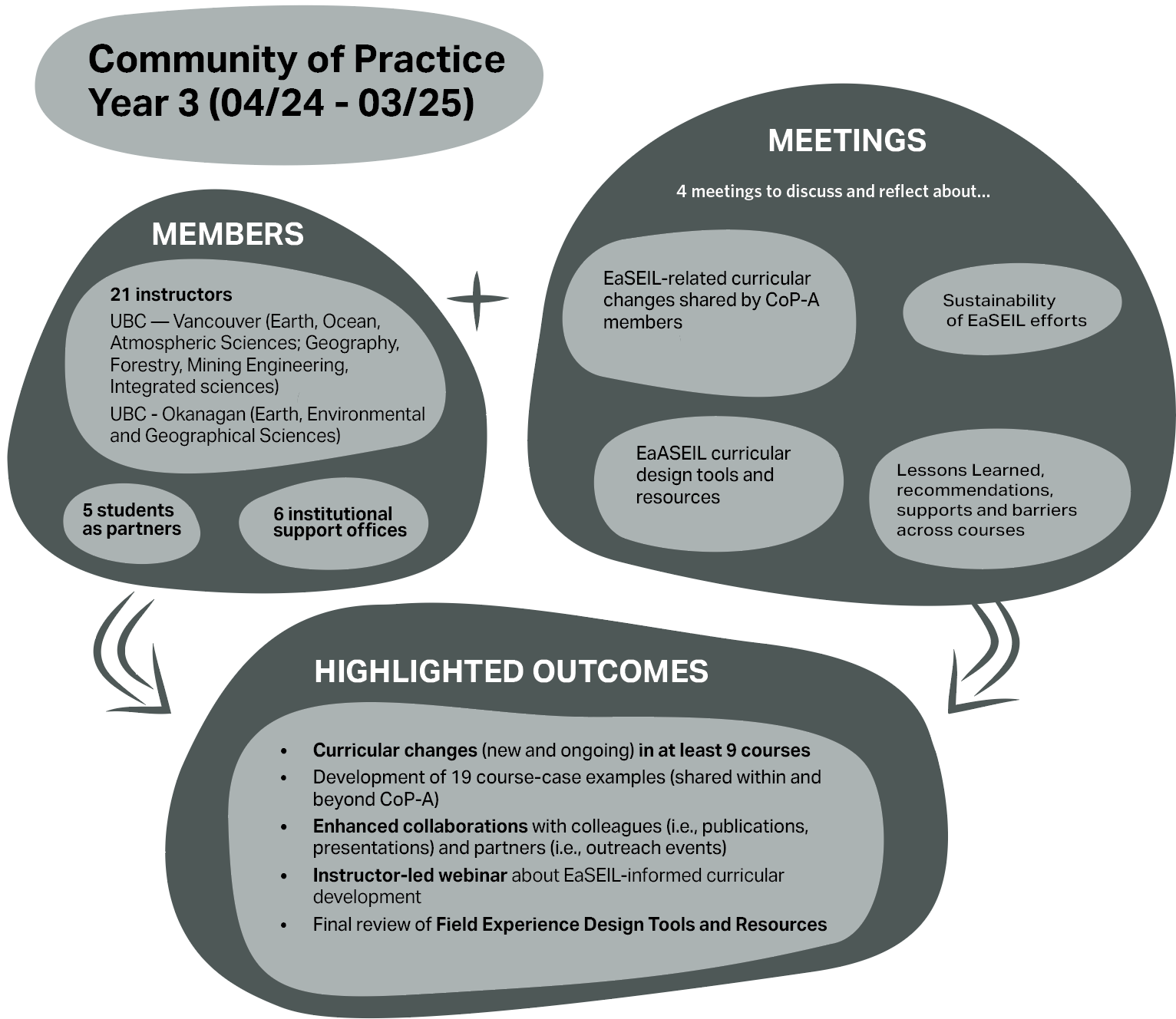
Year 3 (April 2024 – March 2025)
Student as Partners Models
Students’ voices, perspectives, experiences and contributions are integral to EaSEIL initiative. We are using a students as partners approach (Bovil et al., 2011) as an opportunity to learn with and from students to inform pedagogical change.
These partnerships take different shapes:
- Students partner with the EaSEIL leadership/faculty developers as leaders or co-developers for instructor resources (example).
- Students partner with EaSEIL leadership/instructors to co-develop and co-design curricular materials and resources ( example 1; example 2).
- Students partner in a consultant role bringing their experiences as students to inform instructor and faculty developer decision making ( example 1a; example 1b).
See additional resources for similar programming
Impacts of student as partners programs
In addition to the co-production with student partners, EaSEIL researches the impact of the students as partners model on student participants. Some publications about this work:
Lukes L., Rocha, L. (2025). Testing Students as Partners Theory: Science and Engineering Students’ Perspectives on a Students as Partner Consultant Model for Supporting an Instructor-Centered Curriculum Development Community of Practice. International Journal for Students as Partners [accepted for publication].
Rocha et al., (2023). Impact of an advisory role students as partners model in a field-based science learning curriculum development initiative. Poster presented at GSA Annual meeting, Pittsburgh, USA.
Lukes et al (2023). Designing a collaborative faculty-student mentoring model in a large, complex science curriculum development team project. New Directions for Teaching and Learning, 175, Special issue: Nurturing the faculty-student mentoring dynamic in higher Education, 61-70.