Conservation Integrated Field School (CONS 451)
Instructors involved in EaSEIL
Nolan Bett (Course coordinator and co-instructor, since 2020-2021)
Warren Cardinal McTeague (Lead instructor Grasslands Module, as of 2023)
Suzie Lavallee (Lead instructor Grasslands Module, through 2022)
Context: Course Description
Level: 4th year Natural Resources Conservation Program
Credits: 15
Term: WT1
Capacity: ~30-45 students
Additional fees (2024-2025): $ 2300 (transportation, meals, accommodation)
Instructional team: 1 course coordinator, 1 lead instructor per module (x4), 4 teaching assistants (change by module)
Additional instructional team members: Isla Myers-Smith, Tara Martin, Scott Hinch
Overarching Learning Goals
This capstone course (Natural Resources Conservation Program) integrates natural and social sciences in the context of conservation and focuses on alpine, grassland and aquatic ecosystems within British Columbia, Canada. It is structured in 3 modules, each with a lead instructor, ~3 weeks in the classroom (seminars, workshops, day trips, individual and group work) and 1-week field experience in different locations for each module:
- Alpine Module (Sep., camping at Manning Park, British Columbia, Canada)
- Grasslands module (Oct., UBC-Teck Geological Field Station, Syilx Lands, Oliver, British, Columbia, Canada)
- Aquatic module (Nov., Malcom Knapp Research Forest, Maple Ridge, British Columbia, Canada).
- There is a fourth 1-week mini module (seminar, lab activity, day field trip, assignment) focused on land use and planning.
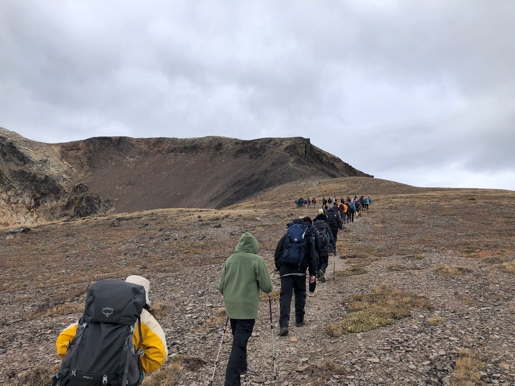
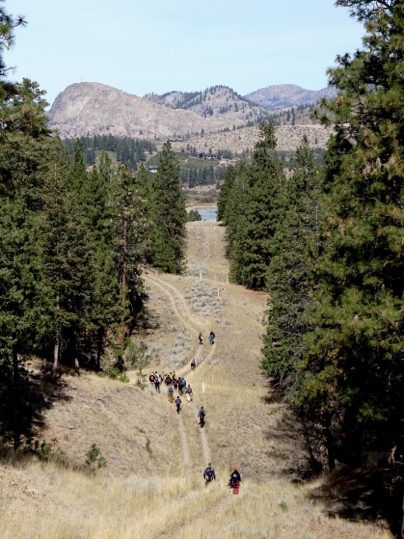

Photo Credits: Nolan Bett1, 2022; Yanlin Huang2, 2024
Typical Schedule and Activities (Overall Course)
Orientation session and communications
In-person (streamed, recorded) meeting held in the Spring to share the course outline (field trip days, cost, required gear/equipment) and about the overall experience (physical, cognitive, social, living). Students receive a follow-up email summarizing the meeting and the recording. Subsequent communications throughout the summer.
Classroom component (per module)
Seminar and workshops on subject matter; day trips (8 am to 4 pm); field and scientific methods: data collection/sampling techniques, data analysis and interpretation, report writing, and discussion/critical thinking activities. Students complete an intake survey (safety; academic/field work/subject strengths and weaknesses).
Field component (per module)
Visits to sites of interest and/or guest lectures with local experts. Students do group field work (e.g., outlining the habitat, awareness of cultural, historical, and contemporary aspects of land-use and conservation, data collection) towards a research project. Students receive a comprehensive course manual detailing classroom and field trip components (i.e., schedule, background, readings, evaluation and assignments):
Students submit an individual scientific report and complete a field assessment (oral or written exam). Individual modules include specific activities.
Evaluation
- Modules: 94%. Different assignments per module (Alpine Module, 24%; Grasslands Module, 31%; Aquatic Module, 31%; Land Use Mini-Module, 8%)
- Individual final integrative essay (3%) to critically reflect on the development as a scientist and conservationist through the course
- Volunteer practicum (3%): 3 days of work (24 h total) outside of class for a conservation organization or researcher. To be completed during the term up until 2 weeks after the course has finished.
- Optional assignments: TCPS 2 Core Certificate and UBC land acknowledgement module (bonus)
Typical Schedule and Activities (Grasslands Module 2024-2025)
Prior to Field Component
4 lecture sessions on campus (9am-4 pm); 1 field orientation meeting (virtual tour of the field station); relationship building activities; optional engagement in UBC’s Intergenerational March to commemorate National Day for Truth and Reconciliation.
Assessment: Individual critical thinking discussions and self-reflections: scientific report introduction section
Field Component (1 week,
8.30 am – 5 pm)
Day trips including visits to Cultural/Interpretive centres, 2 days of field work, guest lectures (few in the evening), individual and group work time. Place-based discussion activities. Optional activities (e.g., bird at dawn). Access to Mini-library: Indigenous voices Collection. Breakfast/Dinner at field station, packed lunch.
Assessment: Individual critical thinking discussions and self-reflections, bird ID exam, oral field exams, scientific report methods figures, field media journal.
After field Component
3 workshop sessions (1-2 hours each), 1 class session (9am- 4pm) and self-directed work on campus.
Assessment: Individual scientific report results section; scientific paper, critical thinking discussions and self-reflections; group herbarium plant collection. Student experience survey (bonus)
Curricular Development
Goals (G) and Motivation
G1: Re-design the grasslands module curriculum using Universal Design for Learning principles and Indigenous methodologies to foster relationship building, critical thinking, co-construction of knowledge and meaningful place-based learning (2023-2025)
- Expanded learning objectives by including reflecting on positionality in field work and land.
- Re-designed class activities and assignments to provide students with multiple ways to demonstrate mastery/understanding and alternative modes of expressing and connecting to one another: critical thinking activities, discussions and self-reflections about daily topics/guest lectures, field experience media journals (as of 2023-2024)

Source: Warren Cardinal-McTeague, EaSEIL Community of Practice Meeting, Jan. 25, 2024
G2: Integrate Indigenous knowledges in the grasslands ecosystem module as a key aspect of meaningful place-based learning


Visiting the Nk’Mip Desert Cultural Centre to learn about Syilx culture and Science, from their voice
(Photo credits: Warren Cardinal-McTeague, 2023)

Bob Gray –guest speaker and place-based discussion about fire burns
(Photo credits: Warren Cardinal-McTeague, 2023)
G3: Enhance student experience at the course level to reduce financial and physical accessibility barriers, and foster student wellbeing and relationship building
| Activities | 2022-2023 | 2023-2024 | 2024-2025 (ongoing)* |
|---|---|---|---|
| Prior to Field School | *G2: Reference to Indigenous communities local to field site, role in relation to conservation (in classroom component and field manual (expanded as of 2023-2024). Optional participation in Sncewips Heritage Museum Virtual Tour. G3: Community building activities through group projects |
||
| *G2: Optional participation in Intergenerational March to enhance awareness about Indigenous history; centering Indigenous perspectives and knowledges through critical thinking/discussion activities about Indigenous sovereignty, decolonization; optional engagement with UBC Land acknowledgement course. G3: Optional engagement in an Indigenous-authored board game night event (hosted by EaSEIL and Xwi7xwa Library, Sept. 2024) |
|||
| *G3: Virtual tour of field station to prepare students for living experience, incorporated relationship building activities (shared in orientation meeting, link on Canvas); Course level: used EaSEIL Safety practices tool to update safety protocols | |||
| G3 (course level): Reduced course fees, maintained accessible locations and offered alternative engagement in activities (e.g., full/partial steep hikes); gear on loan (based on student feedback in 2023-2024 survey) | |||
| During Field School | *G2: Visit to Indigenous (Nk’Mip Cultural Desert Centre). Embedded in course activities as a first day activity to learn directly from Syilx members about their land and history (as of 2023-2024). | ||
| *G2: Centering indigenous perspectives and knowledges through small group place-based discussion activities (some with Indigenous focus), media journaling; access to Mini Library: Indigenous Voices Collection; and guest speakers. Continued efforts to build relationships with local communities | |||
| *G3: Relationship building activities (e.g., optional birding at dawn, hike, winery visit). Course level: provided comprehensive “what to expect resources” to reduce novelty space | |||
*Grasslands Module
More about curricular development on the instructor’s voices:
Bett, N. & Cardinal-McTeague, W. (March 20, 2025) “Accessibility in Field-Based Learning and Indigenous Course Revision: Lessons from a Capstone Course in Natural Resources Conservation” [Talk].Webinar co-hosted by EaSEIL and National Association of Geoscience Teachers (NAGT) Pacific Northwest Section.
Impact
Students
Total number of students enrolled 2022-2025 (three course offerings): 121 undergraduate students.
- Ten students participated om the optional virtual tour of the Scnewips Heritage Museum (2022-2023)
- In the 2023-2024 course offering, the instructors gathered student perspectives about their experience in the course through surveys and focus groups as part of a UBC’s Students as Partners Grant. For a summary of findings you may watch this webinar.
- At the end of the 2024-2025 course offering, the instructors surveyed students (anonymously) about accessibility, wellbeing experience and some resources offered in the field school components of the course. More details in forthcoming publications/presentations.
Instructors’ Reflections
“The virtual field tour is an excellent resource for sharing with students. This was used by all the students in my course and nearly all found it helpful as it let them know what to expect prior to the field trip [Instructor Value and feedback Survey, 2025] … allows them to focus more on prepping for the material.” [Instructor reflective interview, May 2024]
“In the end of year evaluations there were several comments from students about enjoying the grasslands module in particular, as they felt it had a strong community-building component” [Instructor personal communication, May 22, 2024]
“I see very notable differences in terms of the interactions [students who take CONS 451] have [compared to students not in the field school]; how close they are to one another and certainly, even though [other students] are spending lots of time with each other in the classroom, it is not as much time as the field students do. They don’t form the relationships to the degree that they do in field school.” (Instructor reflective interview, Feb. 2023; edited for clarity)
“[Comments about the grasslands module] have been really positive, [students] appreciate the discussions. I think [students] seem to enjoy not just hearing about it from somebody else, but also speaking with one another about it too. I think that’s been really effective. And being able to do that and have these discussions when we’re at the field site … there’s certainly the general atmosphere that’s created when we’re at a site that has experienced recent prescribed burns, and they are hearing from somebody who’s talking about their experiences with cultural burns and then the students are discussing and they’re in this location. It adds an element that makes it hit a little bit harder and engages them a little bit more strongly.” [Instructor reflective interview, May 2025]
“My participation in EaSEIL encouraged me to consider issues relating to accessibility and inclusion in field courses, which led to some projects exploring this topic in my field course. We have integrated changes in the course that stemmed from this work, and the feedback from the students has been positive. The virtual tour of the Teck Field Station has also been a valuable tool for the students, as were the Indigenous Library and board games.” [Instructor Value and Feedback Survey, 2025]
Key Lessons Learned
- Building meaningful relationships with Indigenous communities local to field sites take time and effort. You may get started by visiting Indigenous Cultural centres or exploring other existing resources.
- Consider financial, socio-emotional and physical barriers when designing a field course. Focusing on enhancing inclusion and accessibility in field courses by preparing students to learn in the field and designing activities with multiple access points, is highly beneficial for instructors (fewer on-site surprises) and students (increased wellbeing and more positive experiences).
- Activities grounded on listening, discussing, and relationship building enhance student sense of belonging and foster Indigenous methodologies.