Site Investigation (EOSC 240)
Instructors involved in EaSEIL
Jason Yeung (Lead instructor as of 2023-2024)
Context: Course Description
Level: 2nd year
Credits: 3
Term: WT2
Capacity: 47 students
Additional fees: No
Instructional team members: 1 instructor, 1 teaching assistant
Introductory core course to site investigation for students in UBC’s geological engineering program. It consists of a lecture (2 hours once a week) followed by 2-hour lab (once a week) and includes mandatory field trips (during scheduled class/lab time) to various locations in Metro Vancouver, British Columbia, Canada. Topics include desk studies, field work, remote sensing, drilling and sampling techniques.
Note: The course is also open to 3rd/4th year and engineering ‘exchange’ students (space permitting)
Overarching Learning Goals
Students will work on their abilities to:
- Design site investigations tailored to project objectives and anticipated site conditions and constraints, based on common practices in the local geological engineering industry
- Contribute positive and productively in a small team setting
- Communicate engineering concepts and design to peers, professionals, and non-technical audiences
Activities Summary
- In-class lessons and lab activities (lessons and labs include occasional guest speakers)
- Local Field trips during both class and lab time with exercises graded as part of the lab component. Field trips are organized in collaboration with industry partners who assist with teaching, demonstrations, and touring. Field trips include a Q&A component where students can ask industry partners about their career journey and academic advice. Examples of field trips: sonic drilling, cone penetration testing, site visits to relevant industry projects within the community.
The instructor creates these field trips and associated activities to:- Provide concrete experiences as opportunities for students to experiment and reflect on the abstract and theoretical content covered in class, as part of experiential learning.
- Get an impression and appreciate a day of the life of engineers working on industry projects, and to demystify the professional engineer. Students are able to interact with industry professionals, drillers, and engineers during field trips and guest talks in the classrooms allowing them to experience what the work culture is like in industry.
- Inspire students to further engage and think about geological engineering outside of the classroom by seeing the impact geological engineering work plays in projects in the community and society.
- Expose students to the tunnelling industry to motivate and inspire students to consider tunnelling as there is a growing demand in Canada for engineers and expertise in this space.
Assessment: Weekly lab work; 1 midterm quiz; 1 final quiz; 1 team term project: open-ended engineering design exercise on a real industry project in collaboration with industry partners – students are in groups of four and communicate their design as final presentation to the class and industry partners; students complete a team behaviour peer evaluation
Curricular Development
Goals (G) and Motivation
G1: Offer students more field trips that expose them to a variety of industry sites and projects as well as to specific geoengineering techniques, methods, equipment, and skills.
Activities:
- New collaboration with Van Mars Drilling added in 2024 for a sonic drilling field demonstration.
- New field trips in 2025: Site visit to the Broadway Subway Project as part of the term project and a Musqueam Educational Tour – (organized with EaSEIL Support)
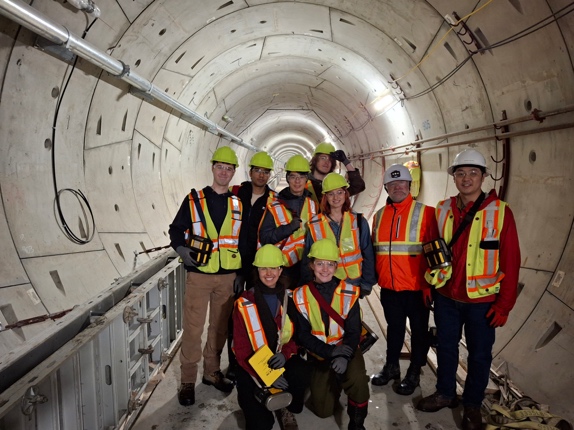
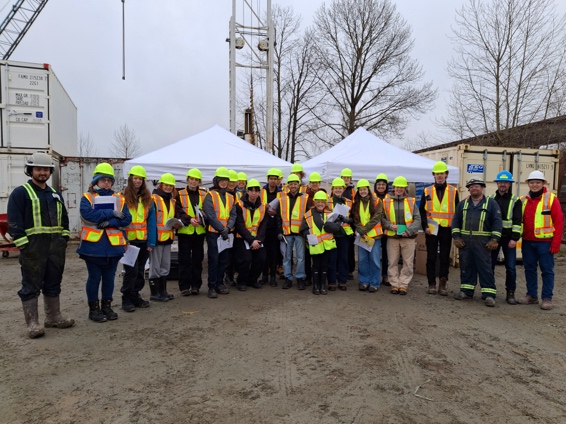

EOSC 240 Field Trips (2024-2025). Photos shared by Jason Yeung
G2. Prepare students for learning and being professionals in the field
Activities:
- Incorporated safety related practices such as field level hazard assessment and safety risk mitigation through new in-class/lab activity (as of 2023): Students review complete safety forms prior to the field trip and perform field level risk assessments as a group
- Developed a new industry partnership for students to connect with meaningful/current geoengineering projects (tunnelling) (in 2024-2025). Students had an additional field trip which was connected to the team project.
- Facilitated Q&A sessions at the end of field trips and guest talks for career, academic, and mentoring advice.
G3. Integrate Indigenous perspectives and context to support student appreciation and reflection on how these relate to their field of work
Activities:
- Students are required as part of desktop studies to identify Indigenous communities (native-land.ca) and archeological sites in the areas their term project is situated on (as of 2023-2024)
- Included a Musqueam Educational Tour (history, culture, traditions) complimented with a reflection exercise during the tour. Indigenous-related questions were added in the mid-term quiz as a form of assessment (as of 2024-2025).
- Prepared students to engage in the tour by scaffolding reflective questions in advance of the tour:

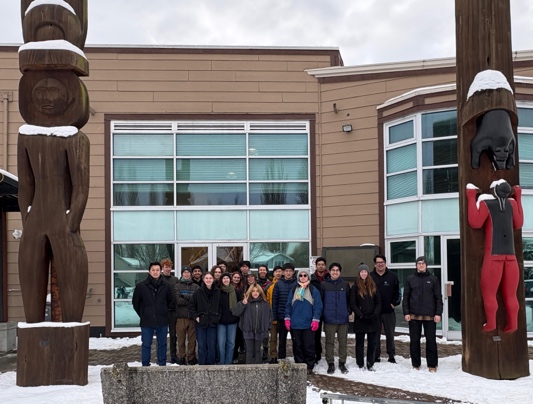
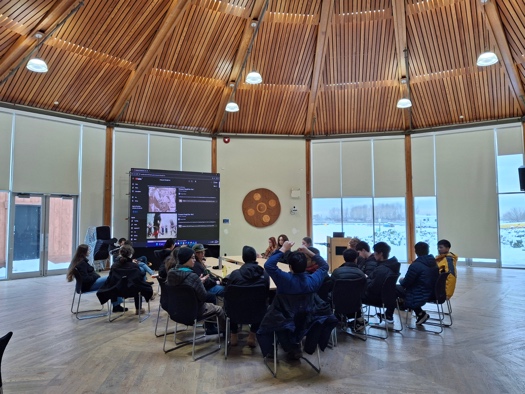
EOSC 240 at Musqueam Educational Tour (February 2025). Photo credits: Jason Yeung (2025)
Impact
Students
Total number of students enrolled in the course 2023-2025(two course offerings): 45 undergraduate students
Instructor’s Reflections
“I really wanted to bring students out to experience going underground being on the construction site of large project. It was validating to hear them saying was such a sensory experience and provided validation to me on them reflecting on the concrete experience and going through a cycle of Kolb’s experiential learning. Seeing and hearing their final presentation further validated them using the knowledge from that concrete experience to experiment and alter the final site investigations design. As an instructor, I get satisfaction out of observing students going through the experiential learning cycle.” (Instructor reflective interview, June 2025)
“EOSC 240 will be including [the Musqueam tour] as part of the course going forward. I’m looking forward to hearing second year students’ perspectives over the years and to reflect on any trends or patterns in perspectives… I’m personally looking forward to going to the tour each year for my own reflection and learning.” [Instructor in EaSEIL Community of Practice, March 13, 2025]
“[Be] transparent that you’re not an expert on [incorporating Indigenous-related content], and have it as an avenue to create discussion with students… In EOSC 240 [students heard directly from a community member in the Musqueam Educational tour], they could ask questions and have ownership of their experience. My role as educator is facilitating and creating that opportunity (Instructor reflective interview, June 2025)
“There were some reflections from students about their experiences [in the Musqueam Educational tour], of this how this experience was a seed for them to start thinking about these things [Indigenous history, culture, land] in contexts as they go through their career. That was my goal as an instructor, to plant that seed … and view learning about these topics as an ongoing learning journey since it’s constantly evolving. So just getting them included in the conversation and the growth of the topic.” (Instructor reflective interview, June 2025)
Key Lessons Learned
- You don’t have to be an expert to include Indigenous-related content in your classes and you can be transparent about it. Identify Indigenous -authored sources and create opportunities for discussion.
- Engage students in activities that contextualize potential career paths early on in their programs. It provides them with concrete experiences that allow informed decision making about courses and co-op choices.
- Fostering a sense of professional identity and practice can be done through short field trips and activities that invite students to engage with industry professionals and experience what it looks and feels like to be a geological engineer.
- Intentional course design using concepts from Kolb’s experiential learning cycle is satisfying to observe as an instructor and provides an engaging learning for students.
Other work by Jason Yeung:
Jason is currently the undergraduate advisor and curriculum committee chair for the Geological Engineering program. Jason’s approach to curriculum development involves feedback and collaboration from multiple sources such as industry partners and students.
A short summary of is recent work on student perspectives on field experience offerings in the program can be found here.