Categories
Uncategorized

Home is community

One evening of fall, I was walking from school to my house as the sun was falling asleep behind the unmoving rows of trees and the lake. It was a smooth silky symphony of reds and yellows calming into the dark. A dark shapes of cows and people on the field next to lake created a canvas paint look to the whole scene.  I was usually one of the last people to leave my elementary school. I spent a couple hours doing extracurriculars and another one or two doing my homework in the small school library. I could not take my homework home because there was always something going on in my house and it was loud and crowded. We had either a relative visiting from somewhere, or our neighbors’ kids making food and playing in the house. More often than not, we had people from church that gathered in my house after they finished their work day or whatever they did during the day. I had to help out entertaining them and praying and singing. Do not get me wrong, I loved doing all those things but I always prioritized  school, which meant that I had to stay behind in school.

As I was getting closer to my neighbour, I saw Aunt Mulu from far standing outside her front yard as she always did, gardening and surveying every person that passed by. Right across from her house was Tesfu, a university dropout who spent most of his days surrounding himself with teenagers and teaching them philosophy. He says he was too smart for school and that he is better off transferring his knowledge to the younger generation. There were kids running around; doing cartwheel; playing mancala on hole dug on the ground and pebbles collected from lake shore. I  said “hello” to everyone and stopped to chat with some of my classmates. The younger kids helped me catch up with I had missed while I stayed behind in school, what is happening in my house and any major news in the neighbourhood. I knew everyone by name, and everyone knew me.

As I approached Aunt Mulu’s house, she couldn’t help it smile her perfect twinkly smile. “How is my baby girl today? Did you show the boys what women can do?”. I smile and say “Yes, Aunt Mulu I am still the first in my class”.  That was how our conversation always started. She took a personal interest in my school performance and my becoming a doctor. Sometimes I thought she saw her lost dream of becoming a doctor in me.

She offered me to come inside for snack.

“Aunt Mulu I am okay, thank you!”.

“I made freshly baked bread and I have some honey my sister brought from her backyard. Come, I will make you your favorite snack.”

“Aunty, I really don’t want to interrupt your gardening.”

“Silly, come in. You know, you like my daughter.”

I went inside. She makes the best toasted honey-peanut butter sandwich. She is the only person I have ever seen make this recipe. She might have invented it.

I left her house around eight. Very late. As I was walking towards my house which was only two doors down, I saw my neighbours trying to unload something of a trunk. I run down and helped take it inside.

I finally got home a little past eight. The walk from school to my house should be less than fifteen minutes but it usually takes me more than thirty minutes with all the stops I make and sometimes even hours and it is dark before I got home – like today. I loved it. It is my favorite memory of my childhood.

When I think of home, it transcends beyond the bricks of the house I grew up in. The culture I grew up in very community oriented and open door. Home for me is where I feel connected to the places and people outside of my house. It is a place where I feel safe and accepted outside of my house. Your neighbour and community is home for your house. Home is community.
 

Categories
Uncategorized

How Evil Came into the World

I have a story to tell you. It is a great story. I think you might have heard it. I have heard this story many times as I traveled through the world and each place tells it different. It is the story of how the evil came to the world.

There was a small village on top a mountain in an island far away in the ocean. The village is full of different kind of animals and many colorful plants and trees. You see butterflies hopping from one flower to another. Birds and insects flying in the fresh air. Lions and monkeys playing and giggling. Elephants and sealions bathing together. Zebras and tigers walking through the long bush of grass and disappear in the sunset. It was a happy place.


No one in this island troubled anyone. They shared laughter and happiness.

They spend their days playing with each other and swimming in the lakes.

Every night, all the animals gather around a bonfire by lake and sing through out the night.

They lived peacefully with each other.


One day, a lion called Lolo and a tiger called Toto were taking a walk and laughing about something that had happened that morning. I am not sure what it was but that doesn’t matter. Toto is rolling on ground with laughter as Lolo was telling the story while laughing with tears. It was then that they saw a wild creature walking towards them.

They both stopped and looked carefully at this creature they had never seen before gets closer to them. The creature had two feet and erected body with two arms coming down from the top. Small head, small eyes, small jaw line. It was something they had never seen before.

“Hello”, said Toto. This new creature replied “Hello! What a beautiful day” as it got close to them. No one has ever come to this island, so Toto and Lolo did not even know what to say. Lolo said, “This is something I have never seen”. The new creature replied “What? You have never seen a human before”. They both replied “Nope.” Toto followed by saying “You are beautiful creature!”

The human told them he had been traveling on a boat for days and he found this island. He told the story of where he is from. He told them he had never seen a tiger and a lion hang out before and that they are enemies where he is from. They were confused. They asked “Why?”. Human says “A tiger and a lion eat the same kind of food: deer, zebra and other animals. They are always competing for food, so they are enemies”.

Lolo said “What! We do not eat other animals. They are our friends. We eat grass.” and Toto nodded. The human said, “You my friends, have never tested the warm blood of another animal and how delicious it is”.

Lolo and Toto looked at each other. They felt something they have never felt towards the other before. It was unexplainable. There was silence for long time. The human broke the awkward silence and said “Hey, you can be friends in this island. It looks like there is plenty of food. Ignore what I said.”

From that day, nothing was the same in the village. The lion and the tiger were no longer friends. They started feeding on animals weaker than them. Evil spread in the village. No one was friends any more.

For, once a story is told it becomes loose in the world. You cannot take a story back. In the end, you always have to be careful of the stories you tell, and perhaps more importantly – the stories you listen to.


Reflection


It was a fun exercise to tell this story to friends and family. I wrote the story before I started telling people, so I know it by heart. I told the story to my older brother, his wife, one of my friends and my neighbour’s daughter who is 5 years old.

I told the story differently to each person. It was not my intention to tell the story differently but each person listening to the store responded differently as I was telling them which then affected the way I told the story. My brother keeps interrupting me and asking me questions like why the lion and the zebra are friends. After explaining I ask him where I was and retell the story. It took the longest to tell him. His wife, on the other hand, waited for me to finish the story before she started explaining the meaning behind the story. Her take away was that, humans ruin everything (which is true) and our conversation got deeper and led us to discuss how humans are ruining the planet. My 5 years old friend loved the story. She said she wished the human didn’t go to the island.

This is the first time I ever wrote a made-up story. While I was writing the story, I was remembering an island in Norway that I watched on planet earth, part the Lion Kind and some stories I was told growing up. What sparked your imagination and story creation? Was this exercise the first time you wrote made-up stories, or have you done it before. If you write fiction stories, what is your creative process like?


Works Cited 

King, Thomas. The Truth About Stories: A Native Narrative. Toronto: House of Anansi Press, 2010. CBC Massey Lectures. Web. 21 Jan. 2020.

King, Thomas. “The 2003 CBC Massey Lectures, “The Truth about Stories: A Native Narrative.” CBC Radio. 2003. Web. 21 Jan. 2020. https://www.cbc.ca/radio/ideas/the-2003-cbc-massey-lectures-the-truth-about-stories-a-native-narrative-1.2946870

Categories
Uncategorized

Story & Literature in Today’s Technology

At the beginning of this lesson I pointed to the idea that technological advances in communication tools have been part of the impetus to rethink the divisive and hierarchical categorizing of literature and orality and suggested that this is happening for a number of reasons.  I’d like you to consider two aspects of digital literature: 1) social media tools that enable widespread publication, without publishers, and 2) Hypertext, which is the name for the text that lies beyond the text you are reading, until you click. How do you think these capabilities might be impacting literature and story?


As someone who is in technology profession and follows tech news and podcast regularly, I naturally gravitate to respond to the above question. Technology is transforming all aspects of life and literature and storytelling is no exception. In this blog I will be looking at the impact of social media and hypertext on storytelling and literature and I will initiate a discussion on the future of literature in the wake artificial intelligence in the comment section.

I believe that the internet has removed the middle person – which is the publisher- between the writers and the readers. Today, anyone with a computer and access to the internet can reach a wide audience and tell their story without third party involved. In an interview Andy Weir  did with CNBC, said before “The Martian” became a bestseller, he thought he’d failed as a writer. Weir attempted to publish his novels multiple times but rejected by publisher because he did not have the “wow” factor. Has not been for a blog post he started with basic website, his book wouldn’t have become a huge bestseller and adapted into a Hollywood movie. The internet, particularly social media, has given writers equal voice, discoverability and direct connection with the audience. One of the notion J. Edward Chamberlin highlights in The Writer’s Cafe, how stories inherently contradict and how important it is for these contradicting stories to coexist. Chamberlin says sometimes you do not need to have literal common ground, but contradicting storyteller can reconcile to respect each of the people’s stories.

How can reconciliation occur if the story is told from one side?   Miguel Douglas in this article explains  Eurocentrism has diminished much if not all of the impact that indigenous peoples have had in shaping the historical trajectory of the continent. The only way both sides get to hear the other’s stories and respect each other is if they both can tell their story. I believe technology gives both contradicting stories tellers a platform to tell their version. In my second year at UBC, I worked on a project with Blue Dot Movement – David Suzuki Foundation where two UBC students and I made a research based digital storytelling manual for Indigenous people to tell their stories with a focus on climate change. Through this project we trained Indigenous leaders and activities how they can tell digital stories with different resources such as blogs, podcasts, social media and offline digital tools. With online tools we provided them they were able to tell their stories and be part the Blue Dot movement. I believe technology has a power to empower individuals and gives everyone a voice.

On the other side, again, with literature being not the exception, the power of technology also comes with some negative ramifications. Cassandra Clarke, Author of ‘Star’s End’ and five other novels explains the impact of technology in this Forbs article — there are so many books and stories and poems available, and it can be overwhelming sorting through them. While the internet gives equal platform for writers, their works are unvetted and it create clutter of reading resources. This is worsened by the incorporation of hypertext in the digital literature which makes it difficult to read. A research published by The Journal published on Pols One found out that hyperlinks within the text are a distraction and therefore hinder comprehension of the text. I am sure you all have found yourself in a rabbit hole of hyperlink clicks to a point where you forgot what you were reading in the first place. While I think internet is a great place for making a lot of information available that wouldn’t have been otherwise, but, to Cassandra Clarke’s point, it can be an overwhelming for readers. One common term in the internet hyperlink is “link rot”, which is when a link originally added to a content is broken. As it is explained in this article, many sites have stopped using “www,” and even if their content remains the same, the original links may no longer work.   The problem with is if the link that was supposed to take to another website is broken, it might hinder some meaning to the original content.

Above, I covered the positive and negative impacts of internet in today’s literature. On that note, there is also another interesting technology that could significantly affect literature – that is artificial intelligence. There have been interesting researched emerging in recent years where machines can now learn literature and creative arts. While I believe that will be in a very long future, I would like to leave this interesting article and this video to start a discuss about it in the comment section. Can AI write a novel, a poem or even a news column? (here is another cool article from The New Yorker)


Work Cited

Briegas, Marta Torres. “Artificial Intelligence Has Made Its Way to Literature: BBVA.” NEWS BBVA, BBVA, 6 Nov. 2018, www.bbva.com/en/artificial-intelligence-made-way-literature/. Web 16 Jan. 2020

Clifford, Catherine “Before ‘The Martian’ Became a Bestseller, Its Author Thought He’d Failed as a Writer.” CNBC, CNBC, 11 Dec. 2017, www.cnbc.com/2017/12/11/before-the-martian-andy-weir-thought-hed-failed-as-a-writer.html. Web 16 Jan. 2020.

Chamberlin, Edward. “Interview with J. Edward Chamberlin”. Writer’s Café.  Web. 15 Jan. 2020.

Clarke, Cassandra “How Technology Is Changing the Literary World.” Forbes, Forbes Magazine, 14 July 2017, www.forbes.com/sites/quora/2017/07/13/how-technology-is-changing-the-literary-world/#5bc1c53c4fc3. Web 15 Jan. 2020.

Fitzsimmons, Gemma, et al. “The Impact of Hyperlinks on Reading Text.” PLOS ONE, Public Library of Science, journals.plos.org/plosone/article?id=10.1371/journal.pone.0210900. Web 14 Jan. 2020

Kille, Leighton Walter. “The Growing Problem of Internet ‘Link Rot’ and Best Practices for Media and Online Publishers.” Journalist’s Resource, 9 Feb. 2017, journalistsresource.org/studies/society/internet/website-linking-best-practices-media-online-publishers/. Web 14 Jan. 2020

YouTube, www.youtube.com/watch?v=WGt8MkeGpNA. Web Jan 17. 2020.


Categories
Uncategorized

Welcome to My Blog

Hello everyone! My name is Wongelawit Teka Zewde and I am in my last year at UBC studying Mathematical Science. This is the first time I am taking an English/literature course other than English 112 (which is a requirement for all science students) and running a blog. I am nervous but excited to improve my analytical thinking, writing and communication skills. Most importantly, I am looking forward to learning about the Canadian society and its complex history by analyzing colonial narratives and stories told about First Nations.


Why am I interested in this subject?

As an international student, I had very little knowledge about First Nations People before coming to Canada. After living here for five years, I have realized that there is fundamental gap between the historic incidents that took place and the stories told when it comes to First Nation’s history. Above all, I am deeply troubled by the fact that Canada is one of the most developed countries in the world but fails its First Nation basic human rights and downplay its history of colonization.  I believe, as Mandela Kuet  mentions in his article, as a newcomer to Canada I have the responsibility to learn the truth about the history and the currently situation of the First Nations. I believe learning the historic complexity the First Nations and as well as the country will help me understand my role here and be a better person in the community.


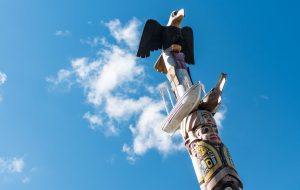
Reconciliation Pole, Vancouver

What I expect in the course?

I anticipate that this course will give me the tools to determine which stories about the First Nation are true and which stories are not and understanding of the connections between literature and colonist history. I expect to unpack the complex history of the First Nations and the effect it has in today’s Canada. Truth and Reconciliation Commission was formed to create dialogue where the truths of their experiences were honored and kept safe for future generations. I believe at the end of this course, I will be equipped to analyze finds of this kind of movements and be a part of it.

Spam prevention powered by Akismet