Social media can be used as an outlet for many things; It can be used as a way for companies to interact with consumers, for individuals to keep up with their friends and any celebrities that they may chose to want to know more about, and even to take pictures of their food for the world to see on Instagram.
I want to focus this discussion on the recent problems that the NFL has faced in regards to the backlash over it’s so-called “replacement referees”. For those of you who have been living under a rock recently, the NFL and the referees entered into a lockout last June after they could not come to terms on a new deal moving forward. The NFL subsequently hired “replacement referees” to fill in for the regular referees, to show the real referees that they were not worth what they had been valuing themselves at.
What happened next was pure chaos, with fans from across the world coming together to voice their displeasure for these new referees, using social media as their main outlets.
This uproar spread like wildfire over the internet, as the replacement referees began to botch calls regularly throughout the first 3 games of the season. Eventually, the pressure was too much for the NFL and they were forced to give the regular referees what they were seeking in order to get them back onto the field. Without social media playing it’s part, I do not believe that the NFL would have given in so quickly, forfeiting any leverage that they had against the regular referees.
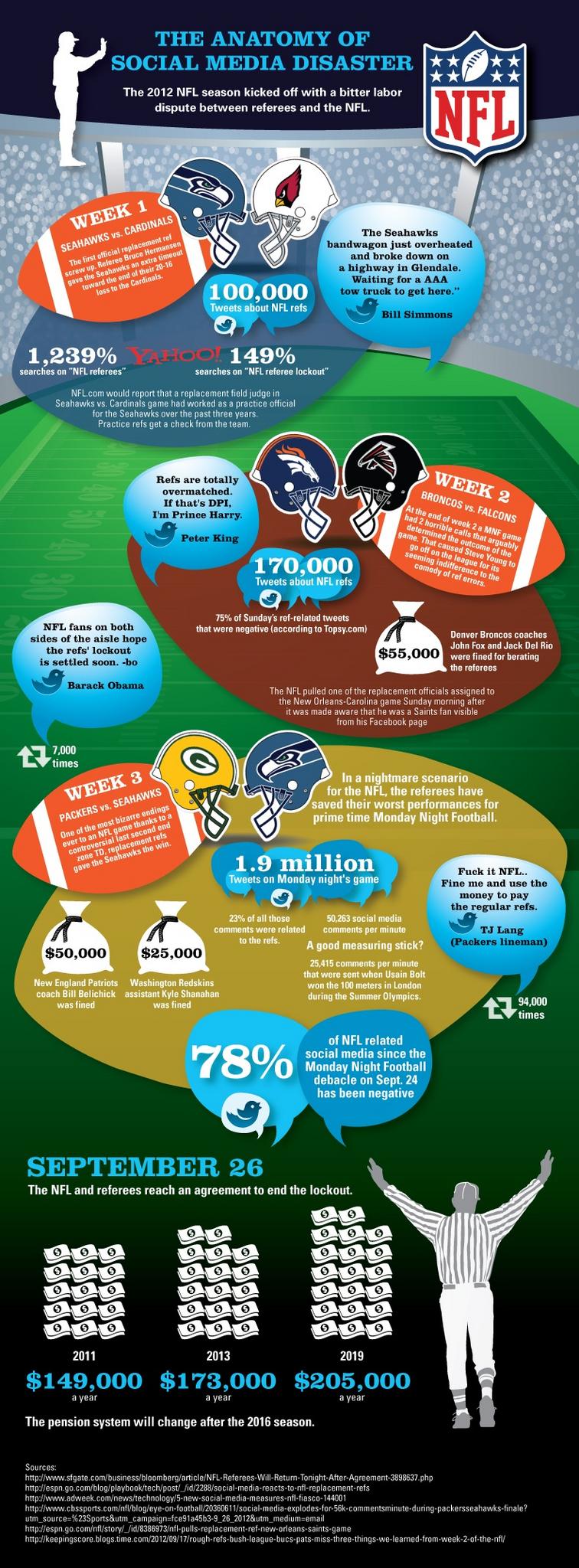
The tipping point came in last Monday night’s game where a terrible call was made on the final play of the game that won the game for the Seattle Seahawks. The social media world collectively came together in anger, as is evident by the chart below, showing an enormous spike to over 400,000 mentions of “NFL Refs” right after the game ended.

No brand or corporation wants to find themselves in a social media crisis, and when your brand is a multi-billion dollar one like the NFL, this is even more apparent. The chart below shows the “proportions of opinions” from 9/5/12 to 9/27/12; as you can see, the reaction on social media changed from passive to aggressive after the game last Monday, with 23% of all mentions stating that the real refs need to come back, and another 15% using humor as a way to insult the referees, making a mockery of the league.

T.J Lang of the Green Bay Packers was the first of many players to voice his displeasure after that Monday night game. His tweet below, which has become the 2nd most re-tweeted tweet in history (not to mention one of the most expensive tweets in history once fines are handed down to him by the NFL), was one of the many ways that social media has been used to voice the displeasure of the fans all across the world.

Social Media is very powerful tool for companies to use, however, in instances like this one, social media has worked against the NFL. It was fairly easy to tell that the replacement referees were not doing a good enough job, but social media allowed this conversation to pick up in ways that never would have been possible. People everywhere were able to see the uproar from various figures around them in order to realize just how bad this officiating was. This also provided people with a median to voice their displeasure over the situation, something that eventually gave the real refs the upper hand and eventually forced the NFL to concede. 10 years ago I do not believe this would have been the case. I believe that it would have taken much longer than 3 games for the NFL to feel the pressure, and to me, this can be attributed in large part to the role of social media.
Here’s to hoping that this strategy carries over to hockey, and sooner than later the NHL will be forced to come to terms.
Update: Here’s a great infographic on the Social Media Disaster that was the NFL Referee lockout via Darren Rovell’s Twitter