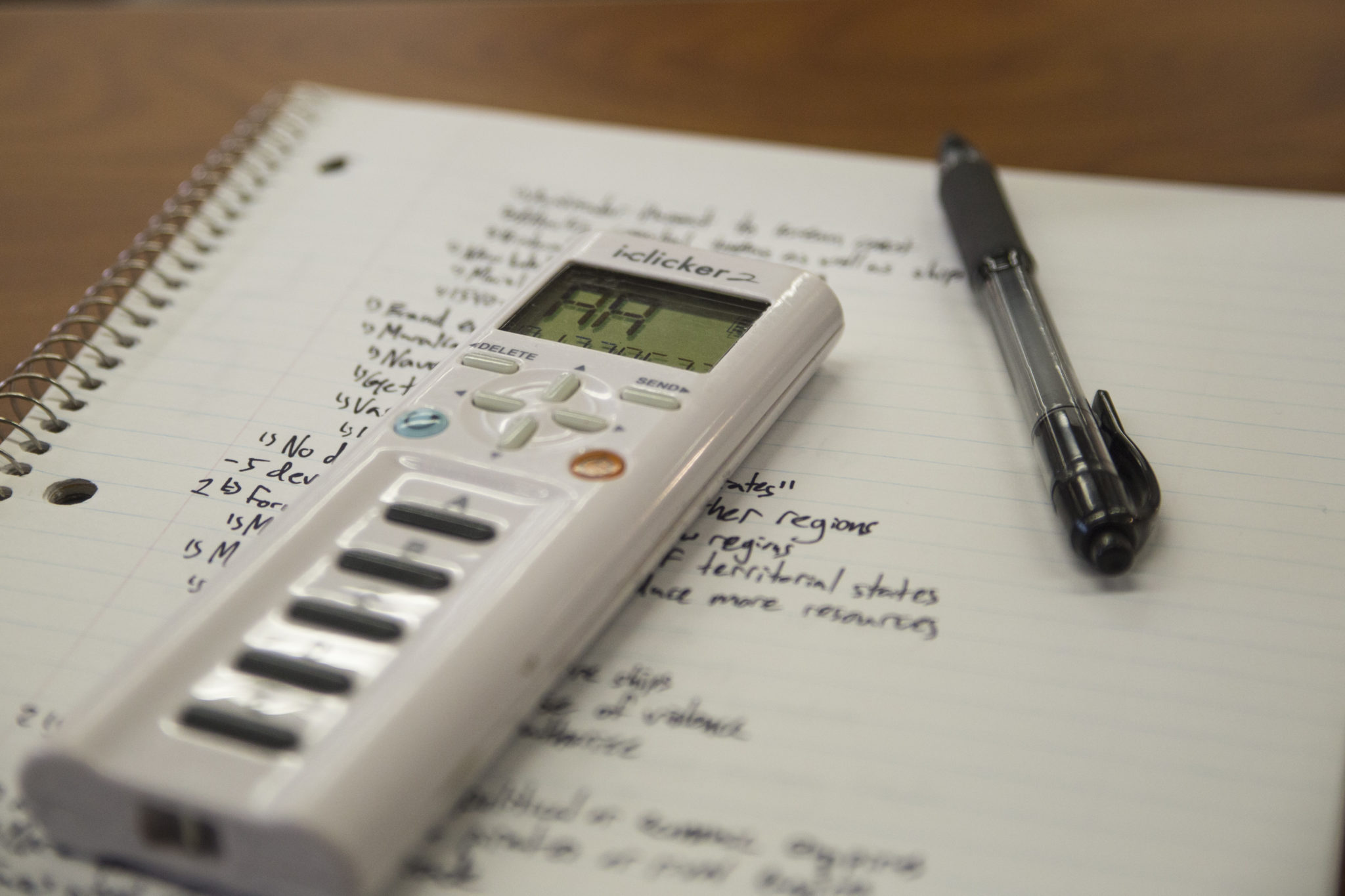

Technology:
iClicker is a unique form of open mobile learning that uses remotes, cellular phones/tablets to collect instant responses from students for the purpose of assessment.
How it Works:
Educators can pose questions to their students from within a classroom or through video conferencing applications. Students can then use their device along with their unique log in information to choose an answer that is then collected instantly as results. This allows teachers to view and show instant feedback from students within classes to check their understanding of a topic. iClicker allows interactions from large class sizes, saves responses for grade collection and can be used for distance learning. It also has a low demand on bandwidth, and the iClicker Cloud is FIPPA compliant.
Audience:
I have witnessed iClickers being used for secondary school classes to assist with learning but also to prepare students for post-secondary education where these devices are more commonly used.
iClicker is also being quite commonly used within courses at UBC as a form of assessment: https://lthub.ubc.ca/guides/iclicker-cloud-instructor-guide/)
Reflection:
I have been distance teaching for the past year and I would definitely love to have access to this technology to use with my students. Zoom does allow for polls but it does not save or track the information to better serve the educator. There is also the value of making this paperless and easier to track compared to handwritten assessments that can take much longer to review.
I would include this as open mobile learning as it gives us the ability to view everyone’s thinking within a class without having to physically be there.
For more information visiting the official website for iClicker or check out their youtube channel:
https://www.youtube.com/user/iclickerofficial/videos

The one thing that really surprises me is that so many post secondary institutions have not moved into the iClicker route. I could really see this technology being helpful to remote areas have limited wifi and have moved to remote learning due to emergency teaching.
Disclosure: I work for Pearson.
In the Higher Education market there is another, web-based solution that uses active-learning principles for adult learners that does not require students to purchase a physical clicker device. College and university students have phones, tablets, laptops, or desktop computers, and Learning Catalytics can deliver so much more than simple polling questions.
https://www.pearson.com/us/higher-education/products-services-teaching/learning-engagement-tools/learning-catalytics.html
It is not the technology that matters but the pedagogy behind active learning, and Harvard University professor Eric Mazur is one of the creators of Learning Catalytics and a change agent for active learning, peer instruction, and interactive teaching. Student engagement and collaborative learning are built into the learning application. Regular clickers do not deliver the same individual or team-based learning opportunities as Learning Catalytics can in synchronous or asynchronous formats.
I am not aware of K-12 users in Canada, but FIPPA compliance is understood for that market.
Thanks Ben, I like the variation that Learning Catalytics has on getting more from the class for interaction (Can it be used for distance learning as well?).
iClicker does allow you to use smart phones, tablets and computers so it is not necessary to purchase a clicker device. I inquired with the teachers that I observed using iClicker and the main purpose was to see if the class was understanding concepts or not for grade 11, 12 and IB courses being run at the school. They also had the school purchase a class set of remotes as some students do not have mobile phones to use (I also think it is relevant to mention that many of the science teachers at the school relied on multiple choice scantron assessments for the same purpose).
“It is not the technology that matters but the pedagogy behind active learning” I totally agree! In this situation technology is a part of the pedagogy as it helps with formative assessments to allow the educator to see what has or has not been learned from readings, lessons…etc
Synchronous and Asynchronous, individual and group learning are all available with Learning Catalytics. Whether it is used in class or for homework, teachers can easily see how well students grasp a concept and how well prepared they are to move on in the lesson.
I remember using these in University! The amount of students who forgot them at home and lost participation marks because of it was atrocious though. There are many benefits to using them as students have to register their devices, but the extent of issues that students faced using them far outnumbered the benefits in my classes. Many teachers started switching to programs that could be access on a mobile device or laptop instead, such as Kahoot. At the end of the quiz, they would take a screen shot of the participants and use that for participation marks. They are a very useful technology, but the User Experience and forgetful nature of many university students made them a difficult technology to integrate.
I agree with you Elixa, the other piece was the inconsistent use of iClickers throughout my University Career. I used it once during my first year, and again during my last. During which time, no tutorial was given that you needed to re-register the iClicker in order for your participation to be marked correctly. I unfortunately lost 10% that way. I believe that iClickers can absolutely be a useful tool, but perhaps an application on a phone may be better, which could gather the same data, and University Students would be less likely to forget them at home. Furthermore, because our phones make it much clearer (because it can provide us with more information) so it will hopefully be clearer if we are connected/registered correctly to the class platform, or not.