Categories
linking assignments

Link #6: Twine Task – Jessica Presta

Jessica’s Twine Task

My team has informed me that I have made the wrong call… too many times!

I was really engaged in Jessica’s cardiac arrest scenario game even though I know nothing about that field. I even made some connections to Miall & Dobson (2001). While going through her game I thought that this must require a large map of screens in Twine. I was correct, it was a lot larger than my 15 screens that was essentially a circle with a few diverging lines. Jessica’s game is a wen-like choose your own adventure with multiple choices on each screen of life or death scenarios. There was the added element of sound, such as a steady pulse to really add some pressure to the experience. Miall & Dobson talk about visual and aural imagery of advertisements, and it applies here too, “to evoke feelings that alter the self-concept of the viewer” (Section 2, para. 6) Jessica mentioned that creating a virtual pathway through the game was quite challenging, though not on the same level, I had to give it some thought too. Jessica’s game is along the lines of Miall & Dobson’s hypertext fiction. “All links in the simulation did not have strong semantic or logical connections to the subsequent material” (Section 4, para. 4). With each slide, the user, a nurse in training, has to understand the data the received from the patient vitals and make the right call to progress.

Miall & Dobson question “to what extent does hypertext change the nature of reading?” (Section 1, para. 2). This made me think of the book House of Leaves by Mark Danielewski. It was an interesting experience for me to read because looking back it is hyper textual in nature. There were footnotes and references in the middle of the prose and I often didn’t know what to do and got lost. Admittedly, I didn’t finish the book because it was a lot of work to remember. Miall & Dobson, quoting Charney, say that reading hypertexts imposes a greater demand on short-term or working memory (Section 3, para. 5). In their study, they concluded that hypertext “as a vehicle for the experience of literary reading itself, [it] appears to promote processes of attention that inhibit the engagement and absorption that are its most characteristic aspects” (Section 4, para. 28).

References

Categories
linking assignments

Link #5: Speculative Futures – Liana Ranallo

Liana’s Speculative Futures Task

Wow! I absolutely loved Liana’s work on this task the video of both dystopian and utopian futures were very engaging. I also have to mention her vocal performance where she used tones and inflections to contrast the two possible futures.

Using the video format was very captivating because it allowed for the viewer to be briefly in that futuristic world. The visuals aided in seeing the dark bleak dystopian future contrasted by the bright heavenly future. The music also provides contrast of both worlds, dark timbres with most pitches being used in the lower register for dystopian, and bright timbres and middle to higher ranged pitches being used for utopian. Is there a key? Hard to say, I would say the harmonies are ambiguous  on purpose to create an ambience. Overall, video is a very efficient way to convey ideas and feelings for this assignment because a large amount of information is expressed using that medium. Comparing it to my task of attempting to write a narrative which was a lot of work. A writer has to convey those contrasting ideas and feeling using only text. Visuals and aural dimensions aid in world building.

I couldn’t help but think of Apple’s advertisement for the Macintosh back in 1984, see below:

The monitoring devices that Liana speaks of are already here since research in artificial intelligence in education is being more active. Yu & Lu (2021) survey research in education using artificial intelligence. “Smart watches are used to monitor the behaviours of students in the classroom (raising hands, taking notes, etc.) to effectively predict and intervene in students’ learning” (p. 175). They also mention research in the use of “facial recognition technology to investigate the emotional state of learners in the learning process” (p. 175). Furthermore, they speak of the adoption of neuroscience and eventual human-machine integration that are still in their infancy.

This task was fascinating because it allowed us to be creative using the current state of our world and technology to speculate on our future.

Reference

  • Yu, S, & Lu, Y. (2021). Introduction to artificial intelligence in education. Springer.
Categories
linking assignments

Link #4: Network Assignment Using Golden Record Curation Quiz Data – Elvio Castelli

Elvio’s Network Assignment Using Golden Record Curation Quiz Data Task

I connected with Elvio’s assignment because we were thinking along the same lines: we have this data, we see a large cluster of connections, and we want to know why. We also both sought outside sources to help make sense of the data, Elvio used Google’s Page Rank System and I used Google Trends. Furthermore, we both looked into the reasoning that our peers used to make their 10 choices for the Golden Record Curation. I am not only curious about why people chose that music, but I was curious as why some pieces of composers were more popular than others. In my task (9.2), I looked at the Beethoven and Bach having the most targets. I want to know more!

In order to do this task we needed to be familiar with network theory; to know our edges and nodes. I wanted to explore network theory so I dug a little deeper. I found Borgatti & Halgin’s paper, On Network Theory (2011), and they say:

“The choice of nodes should not generally be regarded as an empirical question. Rather, it should be dictated by the research question and one’s explanatory theory” (p. 1169).

By looking at the sources (people) and targets (songs), I wanted to find empirical evidence as to why. Google Trends for which composers were searched more often. Looking through my classmates tasks for reasoning. I was looking to make inferences, but I couldn’t. What we were doing in this assignment was just looking at our network to see that a “pattern of ties in a network yields a particular structure, and nodes occupy positions within that structure” (p. 1169). I feel that I have been making a mountain out of molehill in this case. I was on the right track though, the “thing to note about network theory is that the core concept of the field – the network – is not only a sociological construct but also a mathematical object” (p. 1174). I wanted to know the qualitative because I already had the quantitative. That being said, there is more here for me to discover because I haven’t had the opportunity to explore the concept of flow between two nodes.

To conclude, this task was an excellent opportunity to see and use data. It allowed me to see what choices my peers made and to explore possibilities as to why by using network theory.

References

Categories
linking assignments

Link #3: Golden Record Curation – Zoe Armstrong

Zoe’s Golden Record Curation Task

I connected to Zoe’s task because, being a musician, I thought it was clever of Zoe to use software to analyze the music. Using the DJ software Serato, which allows for analyzation of key and beats per minute (BPM), can give a music enthusiast access to information that a high level musician gets after years of experience and study. Key and tempo (BPM) are excellent ways making musical connections. One activity that is taught to conductors is to make a chart of pieces identifying keys, meter and tempo to help study and memorize a piece.

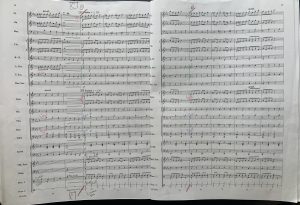
This is the point where I regret getting rid of my old binders from university. They sat around for 10 years, and I never thought that I would need my study charts until now! Thankfully, I still have some of my concert band scores which will do. In the chart, I would have information such as key, tempo, and texture (layers of musical instruments in a particular section of music. Below, you can see section C (at measure 50) with a forward slash at the top and a backward slash at the bottom. The slashes indicates a 4 measure phrase, and there are 5 more phrases after this with a few bars of cadence to conclude the piece. There are also colour coded note, a red FL for flutes, green ALT for alto saxophone, and blue TBN for trombone. The colours are to denote that instruments position in the texture. Red for melody, green for inner voices (harmony; notes that make music major or minor), and blue for the bass line. In chart form, this information makes the whole piece easy to “see” and make connections. This is a very short arrangement at 72 measures, but looking at a whole work, like the opera The Marriage of Figaro, looking at the key will help understand which character or piece of plot is centred. For example, Figaro’s music will always be in G major, so when that is seen in the chart it will help the interpreter make connections with before and after that scene.

Back to the assignment. What I find interesting about Zoe’s analysis is that she found that five pieces from around the world are either in the same key, or a closely related key. Closely related keys have many notes in common. In this case, the keys of D and A, they share all the same notes except A has G# where D has a G natural.

D: D E F# G A B C#
A: A B C# D E F# G#

The pieces in D are:

  • India, raga, “Jaat Kahan Ho,” sung by Surshri Kesar Bai Kerkar
  • Australia, Aborigine songs, “Morning Star” and “Devil Bird,” recorded by Sandra LeBrun Holmes.

The pieces in A are:

  • Java, court gamelan, “Kinds of Flowers,” recorded by Robert Brown
  • Senegal, percussion, recorded by Charles Duvelle
  • Japan, shakuhachi, “Tsuru No Sugomori” (“Crane’s Nest,”) performed by Goro Yamaguchi.

I find it interesting that the non western pieces have the connection of being in the same key, or a closely related key. I am not sure what to make of it, or if it is just a coincidence.

One more point to look at is Zoe’s analysis regarding tempo and the feeling of the piece. We both spoke about Bach and Stravinsky. My connection with both was a steady pulse, I didn’t talk about tempo. Zoe mentioned that the Bach piece was at 70bpm and was “peaceful and hopeful,” compared to Stravinsky’s 137bpm (almost double that of Bach’s) and that it was “intense” and “represents some chaos.” Bach’s Gavotte is based on a French folk dance so the tempo is implied that it should be fun and lighthearted. Looking at the score for Rite of Spring, Stravinsky only gives a BPM, 126 for an eighth note, and no tempo marking, which would be allegro (fast, quick). That means the recording on the record is fast by 10bpm, making it feel a bit more agitated. Tempo has a big effect on musical feel for the player and for the listener.

Categories
linking assignments

Link #2: What’s in your bag? – Kelcie Vouk

Kelcie’s What’s on my kitchen table? Task

I made a connection with Kelcie’s task when I read “many of the objects speak to who we are as people…interspersed with passion work…and connections to important people and places.” I only realized how significant the objects in my bag are once I did this task. Those Italian text books represent me passing on my knowledge of that language and culture because of all the past experiences I had being raised in an Italian household, studying it in high school and university, learning it thoroughly for opera, and using the language while studying music in Italy. Reflecting on this, I made a connection to one of the New London Groups components of pedagogy, situated practice. That Italian books draw from my personal life-worlds of being in the communities of educators, musicians, and of my familial heritage; “their boundaries become more evidently complex and overlapping” (New London Group, 1996).

While working on this Linking Assignment I can’t help but think of the design of Task 1. I feel that it is exemplary of designs of meaning. In this case, we are looking at artefacts that we carry on our persons everyday, and each of those artifacts connect to the “complex systems of people, environments, technology, beliefs, and texts” (p. 73). I look at these artefacts now with a deeper more significant meaning.

References

  • Cazden, C., Cope, B., Kalantzis, M., Luke, A., Luke, C., Nakata, M., & New London Group. (1999;1996;). A pedagogy of multiliteracies designing social futures. In B. Cope, & M. Kalantzis (Eds.), Harvard educational review (pp. 19-46). Routledge. https://doi.org/10.4324/9780203979402-6
Categories
linking assignments

Link #1: Manual Scripts – Sage Capogreco

Sage’s Manual Scripts Task

Sage and I had a similar experience regarding manual scripts. One point I resonated with was how a manual script “forces me to reflect before putting pen to paper.” Sage talks about making an annotation to move a chunk of text and this reminded me of outlining. In high school, I was taught to create an outline before writing an essay. That way, I can have a clear flight path for my written work; the reflection before putting pen to paper. For me, I have stopped using the method of creating a proper outline for my writing. For large works of writing, I’ll create an Apple Note, and I’ll put my thoughts and ideas down, then I would cut and paste to the section where I want that idea to go. Or, I just start typing and see where things go, then cut, paste, and revise. After I have the work mostly complete in Apple Notes I’ll then copy the text to Apple Pages, Microsoft Word, or to the blog.

Another point regarding annotating, I didn’t realize how much more effective annotations can be in a digital form. My classmates and I are constantly collaborating through a shared Google Doc. Since we are usually working on the document at different times annotating gives us the opportunity to give insight of our ideas to others. For example, I can convey an idea but maybe I don’t articulate it as effectively as I want, then I would leave an annotation (a comment in Google Docs) for a classmates input for revision. Kalir & Garcia (2019) say that annotations makes your thinking visible and allows others to see how one responds to ideas. Digital annotation is a powerful tool for the user and for collaborating with others.

The digital script wins over the manual script for professional and academic writing. It provides flexibility, an ease of use, and affords more productivity.

References

  • Kalir, R., & Garcia, A. (2019). Chapter 1. In Annotation (0 ed.). Retrieved from https://mitpressonpubpub.mitpress.mit.edu/pub/926svib6

Spam prevention powered by Akismet