Categories
tasks

[12.2] Speculative Futures

“Literature makes us work so much harder because readers need to construct everything about the fictional world in their imagination” (Dunne & Raby, 2013, p. 75).

I tried very hard to craft two short stories for this assignment, but since this was my first attempt at creative writing, it didn’t go so well. Maybe one day I’ll write my “For sale: baby shoes, never worn.” For this task, I will start with my inspirations for the stories that are tied to the module, I’ll give a brief synopsis of both stories, and then at the bottom I will have my world building notes.

In Yuval Harari’s book Homo Deus, he gives the reader a potential look into the future of personal AI assistants. Using Microsoft’s Cortana he writes how peoples personal assistants could communicate by scheduling meetings and times to socialize. Also, if one wears a device like an Apple Watch or FitBit, those devices can monitor one’s vital statistics and may advise the user to delay a meeting due to stress by reading a high heart rate. We are getting close to this. A personal story here, I once had a job where my commute was one hour and a half in heavy traffic. At the time I was wearing a Fit Bit and I noticed that my heart rate was significantly higher while commuting home. It was one of the main deciding factors in leaving that position for one that was closer to home. Harari’s (2017b) quote, “we will probably have an AI family doctor on our smartphone” (p. 325) is almost here!

Shannon Vallor talks about the task-specific AI that helps us with our everyday lives, and she makes a distinction with Artificial General Intelligence. This is the theoretical, and fictional, intelligence that is at the level of the human mind. We use these task-specific AI’s to help choose a movie to watch, predict our text, they can add events to our calendars.

Harari’s look into the future and Vallor’s discussion of AI is what inspired me with these utopian and dystopian narratives. Either one can be a what-if scenario to the other, and to the future in general. Since Vallor’s definition of an AGI is too far away I attempted write how a task-specific AI would impact a story. We have two main characters – see the character profiles below: Amanda Brenner, and Paris Masterson. For their faces I used an AI face generation website This Person Does Not Exist. 15 years from now, in 2037, both of these characters are are high school seniors, independent, intelligent, and are high achievers. They use their AI assistants to help plan their day, do research, and communicate. The narratives involve the two characters on the same day, that involves a bridge building competition and a scholarship for their tuition to a high level university.

Utopian

The day starts with Amanda waking up on time, journalling with pen and paper, and spending breakfast with her family. It’s the day before their bridge building competition, Amanda’s AI assistant helped her create the bridge, by providing calculations and helping research the design. She needs the scholarship money because her parents can only help her so much to pay the tuition. The AI assistant also helps her with her busy schedule by chunking out time for studies and reminders for commitments such as a lessons and practices. During the school day, Amanda encounters Paris Masterson, her academic and athletic rival. Paris just always seems to win and she makes sure that Amanda knows it. That evening, Amanda fulfils all her commitments, and puts the finishing touches on the bridge. The next day she has a successful competition with her bridge holding the most weight and winning a scholarship to put towards her tuition.

Dystopian

The day starts with Amanda’s alarm going off late, only leaving her enough time to grab her school bag and she barely gets out the door on time to catch the bus. She wonders why her alarm didn’t go off, and asks her AI assistant why it didn’t go off, the AI replies that Amanda set it for 8am, but Amanda was sure it was set for 7am. As the day progresses, her AI assistant, just gives her wrong information, such as a wrong definition of a word in English class, and continues to give her the wrong schedule. Amanda was sure that her AI assistant schedule was correct as of a few days before. She’s also not receiving messages from friends. An encounter with Paris was strange when Paris asked how her day was going, or is she heard from a mutual friend. Which is strange, because Paris never asks Amanda anything. That night when Amanda is giving the finishing touches to her bridge she had second thoughts to what her AI assistant was suggesting. The next day, Amanda’s bridge collapses under a light weight, and Paris wins the competition and scholarship. Amanda goes home disappointed and doesn’t know that Paris’ AI assistant has been sabotaging her.

References

  • Dunne, A. & Raby, F. (2013). Speculative Everything: Design, Fiction, and Social Dreaming. Cambridge: The MIT Press. Retrieved August 30, 2019, from Project MUSE database.
  • Harari, Y. N. (2017a). Homo deus: A brief history of tomorrow (First U.S. ed.). Harper, an imprint of HarperCollins Publishers.
  • Hariri, Y. N. (2017b). Reboot for the AI revolution. Nature International Weekly Journal of Science, 550(7676), 324-327.
  • Santa Clara University. (2018, November 6). Lessons from the AI Mirror Shannon Vallor. YouTube.

World Building Content

Story Setting

  • Wednesday, May 20th, 2037
  • Burnaby, British Columbia
  • Soccer season is wrapping up, but qualifying for BC Summer Games is approaching
  • Provincial track meets are approaching
  • Flute recitals, and band festivals are in full swing
  • The annual Bridge Building competition is a day away, and scholarships are on the line

Character Bios

Profile Data

  • Name: Paris Masterson
  • Age: 18
  • Born: January 4, 2020
  • Daughter of: Samantha (high Profile Lawyer) and Jeffrey Masterson (Successful Entrepreneur)
  • Brothers and Sisters: Only child
  • Education: 12th grade, Burnaby North Secondary

Physical Description

  • Light brown hair; grey/brown eyes
  • Height: 5’9”
  • Athletic build

Personality

  • Studious, takes school very seriously
  • Ambitious, wants to get into the top schools
  • Competitive, national level track and field, captain of the volleyball and soccer team

Attributes

  • Very independent and self-reliant
  • Competitive to a fault
  • Can always find time to complete tasks

Habits

  • Starts every morning with a 3km run at 7am
  • Arrives at school early
  • Spends weekday evenings at practicing and studying, in bed at 11pm

Manner

  • Often comes across as cold, but warms up with time
  • Intense during sport, especially during practice before a big game or event
  • Easily frustrated while participating in group projects at school
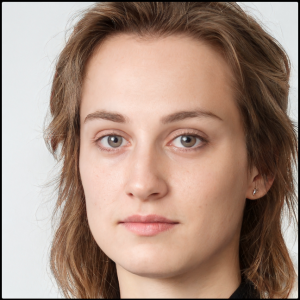
Paris Masterson. An AI generated face from https://this-person-does-not-exist.com/en

Profile Data

  • Name: Amanda Brenner
  • Age: 17
  • Born: June 12, 2020
  • Daughter of: Irene (Stay-at-home mom, former teacher) and Steven (General Contractor, carpenter)
  • Brothers and Sisters: Joshua, 15; Samantha, 12
  • Education: 12th grade, Burnaby North Secondary

Physical Description

  • Dark brown hair; green/brown eyes
  • Height: 5’6”
  • Athletic build

Personality

  • Studious, takes school very seriously
  • Ambitious, wants to get into the top schools
  • Compassionate, Amanda often considers other

Attributes

  • Strong work ethic
  • Works well with others
  • Very well organized, and a good manager of time

Habits

  • Starts every morning with tea and journalling at 7am
  • Arrives at school early
  • Spends weekday evenings at studying for school, practicing flute, and plays soccer, in bed at 10pm
  • Volunteers as a children’s soccer coach

Manner

  • Very warm and welcoming
  • Works hard during school and during practice for soccer and flute
  • Considers her teammates and classmates
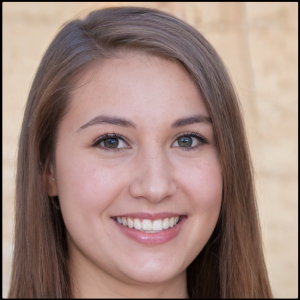
Amanda Brenner. An AI generated face from https://this-person-does-not-exist.com/en

First Draft of the Utopian Short Story

At 7am Amanda’s room shined yellow like the sun to wake her up. It was a typical rainy Vancouver day. “I thought May was supposed to be sunny a month” she thought as she looked out her window. Her hot water kettle goes off, pours the water in the tea pot for some earl grey tea, and takes out her Moleskine journal and fountain pen. Not many people her age use pen and paper anymore, but she likes to keep it traditional. After she gets her thoughts in order, she looks to her phone. 

“Hey Siri, what’s on for today?”

“Good morning, Amanda. You have Flex period from 8:40 to 9:10, followed by, Physics, English Literature, Senior Concert Band, and Drama. You’ve submitted your Physics homework on Teams, your English Literature paper is due Friday, so I have scheduled time tonight and tomorrow for you to complete that, nothing for Senior Concert Band, and for Drama, I have sent Shakespeare’s The Tempest to read and listen to on Teams. I have set up Do Not Disturb from 3pm to pm. You have a flute lesson on Zoom from 4pm to 5pm, dinner, then soccer from 7pm to 8pm. I have set up Do Not Disturb from 8:30 to 10:00 to do your homework.”

“Thanks, Siri. Ugh. I’m already tired just thinking about this day.”

Amanda walks down to the kitchen to make her toast with Nutella and sliced strawberries.

“Morning mom, morning dad, morning nerds.”

“Hey! That’s not nice!” said Samantha, her younger sister.

“We’re the nerds?! You’re the one who journals every morning. Dear diary, I am sad…” said Joshua.

“Ok kids, that’s enough, it’s barely 8 o’clock, how about we have a nice start to our day.” Said Amanda’s mom.

“Where’s dad?” Asked Amanda.

“He had to leave for work early today. He’ll be home for dinner. He’s grilling tonight. Quick, get your things ready for school.”

——————

Amanda’s phone flashes at the start of Physics class and the notification said she got 19/20 on her Physics homework. Looking around her class she sees sleepy faces, a group of boys doodling on the white board, and then her phone flashes again.

“Hi class, I’m sick today so my lesson will be sent to your assistants. You all did well on your bridge design homework, though I can tell that some of you have too much help from your assistants. We’re making truss bridges not cable stay bridges people! Have a good day. – Mr. Harvey”

The draft ends here. Thanks for reading!
Categories
tasks

[11.3] Algorithms of Predictive Text

Click on the tweet below to see the full thread.

For this task, I had an expectation of stringing a set of words to form a coherent thought, but after typing the prompt the predictive text led me to nonsensical options. At one point, I was given options in either Spanish or Italian. In this case, predictive text did not express how I would express myself. There likely isn’t enough data to properly predict what I would usually say.

Stoop & van den Bosch (n.d) give a clear explanation on how predictive texts work:

“To be able to make useful predictions, a text predictor needs as much knowledge about language as possible, often done by machine learning […] This works by looking at the last few words you wrote and comparing these to all groups of words seen during the training phase. It outputs the best guess of what followed groups of similar words in the past.”

In their article, they discuss how the algorithm called k Nearest Neighbours predicts texts using Twitter. The algorithm will look at all the past tweets and will create a database and will then use an approach called context-sensitive prediction which depends on similar groups of words being available, list of words frequently used by the author, and limiting the pool of words available based on words already used. The algorithm also models “friends” on Twitter which takes into account conversations, mentions, and a similar accounts. The authors mention how the algorithm will create accurate predictive texts of Lady Gaga and Justin Timberlake because they are likely to tweet about similar things and overlapping topics.

When I finished writing this task in Twitter I couldn’t help but think of Reddit’s r/subredditsimulator. In this subreddit, only bots post and comment to each other, but each bot is a representation of their assigned subreddit. “It’s not a perfect recreation of Reddit, but an adequate caricature of its worst tendencies” (Khalid, 2019). It can also be funny, sarcastic, mean-spirited, helpful, reflective, and it can also uncannily echo the real internet (Khalid, 2019).

r/subredditsimulator uses OpenAI’s GPT-2 language model. “GPT-2 is trained with a simple objective: predict the next word, given all of the previous words within some text” (OpenAI, 2019). GPT-2 was trained on 40GB of internet text, a data set of 8 million web pages, which allows it to answer questions, summarize, and translate. In a paper by OpenAI, GPT-2 was able to answer questions like “who wrote the book Origin of Species?” or “who is the quarterback of the Green Bay packers?” It answered them correctly with a high degree of probability, over 80%. The answers are Charles Darwin, and Aaron Rogers. Though, the questions it got wrong, had closely associated answers. Largest state in the us by landmass? It answered California, it’s Alaska, but California is the largest state by population. Good guess! Another one was who plays ser Davos in Game of Thrones? GPT-2 answered Peter Dinklage, but it’s Liam Cunningham. Peter Dinklage is a good guess, because he is strongly associated with Game of Throne, in my opinion. Using factoid-style question answering is how OpenAI tests what information is contained in the language model (Radford et al., n.d.). Take a look at Janelle Shane’s twitter thread below for an example of r/subredditsimulator.

Bringing it back to our task, the predictive text option on the iPhone is to help the user type a bit quicker to send that message out faster. This is an example of the virtual assistants that Shannon Vallor speaks of “to aid our daily performance[…]to carry out tasks under our direction” (Santa Clara University, 2018). For that reason, it works well, but to string a set of words to form a coherent thought it doesn’t work so well.

References

Categories
tasks

[9.2] Network Assignment Using Golden Record Curation Quiz Data

When Beethoven was alive, I don’t think he knew that his music would broadcasted across space via radio waves and a golden disc. This networking task demonstrates that Beethoven is the most popular composer on Voyager’s Golden Disc, or is he?

I first took at look at Group B.  Specifically, the targets (pieces of music) with the most sources (people) connected to them were Beethoven’s 5th, Johnny B. Goode, and Melancholy Blues. 7 sources were connected to all 3 targets; 6 sources were connected to 2 of the 3 targets; and 3 sources were connected to 1 of the 3 targets. Only 1 source of all 16 sources connected to the target with the least amount of sources, Pygmy Girls’ Initiation Song.

My hunch for this is that Beethoven, Chuck Berry, and Louis Armstrong are important musical figures in our culture. Beethoven’s da da da dum is in our collective consciousness from children shows, TV, movies, and almost every music class will incorporate that piece into the curriculum. Chuck Berry and Louis Armstrong are amongst a few of the musicians who laid the ground work for pop music. Both of those pieces use the 12 bar blues musical form and the following chords in this pattern:

||: I   | I   | I   | I  | IV | IV | I   | I  | V   | IV| I   | V:||

Any combination of these chords with the addition of the iv chord will give you almost every pop song on the radio. A little divertimento, take a look at this video by Axis of Awesome to hear these chords.

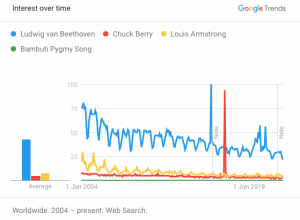
Back to the Task. I thought I would try Google Trends to compare the most popular pieces in Group B with the least popular. Beethoven is clearly the most popular Google search, but it was a challenge figuring out how to search the trend for the Pygmy Girls’ Initiation Song. I would get a 0 for each combination. Bambuti Pygmy Song is what it is called on Spotify.

I then took a look at Group A, my group, to see the connections in communities. To no surprise, the piece that connected all four sources was Beethoven’s 5th. 9 targets connected 3 of the 4 sources, and 6 of those 9 targets were of the Western music tradition. Only one of the community sources gives reasoning as to why they included Beethoven, which corroborates my hunch, popularity in culture. It’s ingrained in western culture. All four sources in my group were also connected by blues based music too: Chuck Berry, Louis Armstrong, and Blind Willy Johnson.

In analyzing these networks I found myself having trouble making inferences. I have the data on my screen and I see the connections, but I feel that I was lacking the qualitative data to make those inferences. That is the reason why I analyzed these networks using data from the quiz, and Google Trends; this showed Beethovens popularity. In Group A, 12 of 17 sources had Beethoven’s 5th as a target, and in Group B, 13 of 18. Well over 50% of sources connected to Beethoven’s 5th in their network. If I include Beethoven’s other piece Quartet No. 13, that brings his total in Group A to 15, and 15 in Group B as well. Totalling 30 sources for Beethoven.

Thank you for reading, but wait…

I’ll be BACH.

Bach had three pieces on the Golden Disc: Brandenburg Concerto, Partita for Violin, and Prelude & Fugue. The totals in Group A was 11 sources, and 20 sources in Group B Bach. Bringing his total to 31! Just edging out Beethoven by 1. Though none of Bach pieces had more sources than Beethoven’s 5th, Bach had more targets, and Group B gave 10 sources to the Brandenburg Concerto compared to 6 sources in Group A. Using Google Trends again, Beethoven wins over Bach.

To conclude, I have posted the networks of Beethoven and Bach below.

Beethoven Group A 15 sources from 2 targets.
Beethoven Group B 15 sources from 2 targets.
Bach Group A 11 sources and 3 targets.
Bach Group B 20 sources and 3 targets.


Categories
tasks

[8.2] Golden Record Curation

My strategy to curate was to find pieces that contain an obvious example of the universality of musical elements tempo, dynamics, harmony, melody, and texture. Obviously, all the pieces on voyager contain them, but I tried to pick the ones where those elements were most present and where I could make connections between those pieces composed all around the world. Some common elements that are present are the use of ostinato patterns (repeated rhythms and pitch), chant, call and response musical phrases, and representations of nature. Listen for the steady even pulse and subdivision of rhythm in Western music, and how complex the rhythms can get in Senegal and Zaire maintaining that pulse and adding some groove.

  1. Bach, Brandenburg Concerto No. 2 in F. First Movement, Munich Bach Orchestra, Karl Richter, conductor. I chose Bach as the number one piece of music because of Bach’s impact and what it represents. Upon listening, us humans are transported to Baroque period Europe with people wearing powdered wigs. However, this piece is more than that, because it demonstrates logic aurally. Speaking in musical terms, Bach synthesized musical harmony through his compositions. Harmonies that were first observed by Pythagoras (interval ratios, harmony of the spheres). Bach’s synthesized functional harmony gives logic and reason for musical composition. Musical harmony progresses from tonic to subdominant to dominant and finally resolving back to the tonic. This can happen in the span of bar, phrase, movement, to an entire piece of music. Every music student studies Bach’s harmonies the same way that the student in the classroom studies math. Furthermore, Bach’s use of rhythm in this piece demonstrates a steady pulse with it’s subdivisions (think fractions) of quarter notes, eighth notes, and sixteenth notes.
  2. Mozart, The Magic Flute, Queen of the Night aria, no. 14. Edda Moser, soprano. Bavarian State Opera, Munich, Wolfgang Sawallisch, conductor. Mozart comes next on the list because it carries on the musical tradition of Bach and it makes the human and emotional more transparent. Our musical logic here becomes more creative by adding contrast: pushing and pulling the tempo, forti and piani, thin and thick instrumental texture. It also demonstrates the extremes of the human voice, and a human’s athletic ability aurally. Also, the universe should hear the beautiful voice of Edda Moser, one of the greats.
  3. Beethoven, Fifth Symphony, First Movement, the Philharmonia Orchestra, Otto Klemperer, conductor. Haydn composed 104 symphonies, Mozart composed 41, and Beethoven wrote 9, but he made them count. His greatest was composed while he was going deaf. Beethoven’s Fifth Symphony is likely the most well known symphonic work because it’s impact is heard in all types of media: commercials, television, film. The da da da dum is in our collective conscious. Furthermore, compared to Mozart where emotions begin to surface, Beethoven brings it to a boil. Furthermore, where Mozart started to add contrast with rhythm, dynamics, and texture, Beethoven accentuates those and adds more crunching chromaticism – the use of notes outside of a key.
  4. Stravinsky, Rite of Spring, Sacrificial Dance, Columbia Symphony Orchestra, Igor Stravinsky, conductor. Stravinsky, pushes all of the boundaries of musical elements composed by the three previous composers. Stravinsky’s concept of the ballet Rite of Spring is to invoke a prehistoric primal pagan ritual. Stravinsky uses bitonality, two keys at the same time, with constant meters changes, and contrasting duple and triple meters. Stravinsky uses clusters of notes for a percussive effect. Furthermore, even though the rhythms and harmonies are complex there is still a steady pulse as well as pleasing melodies. If Beethoven brought emotions to a boil, Stravinsky boiled them over.This work caused a lot of controversy during the premiere in 1913. Audiences’ whose musical taste includes Tchaikovsky’s Nutcracker were not expecting this! In a way, I wonder if this work was a sign of things to come, World War One, was a year away.
  5. Navajo Indians, Night Chant, recorded by Willard Rhodes. This is an example of a chant. One can here the steady pulse of a shaker throughout. Also, there is a call and response to their chanting: the call being the chant in the middle and lower part of the voice, and the response being  in high pitch and sung in falsetto.
  6. Senegal, percussion, recorded by Charles Duvelle. This piece from Senegal demonstrates complex rhythms played by multiple drums, but there is still a prominent steady pulse. If one listens closely the rhythm of the high pitched drums start to produce a melody. The addition of the person chanting transforms the music into a trance like experience.
  7. Zaire, Pygmy girls’ initiation song, recorded by Colin Turnbull. This Pygmy song, which is completely sung, has four parts. Two groups singing ostinato patterns as a foundation, and a lead chanter giving a call, and another chanter responding. This has a similar trance like experience like the piece from Senegal which is caused by a steady repetition.
  8. Japan, shakuhachi, “Tsuru No Sugomori” (“Crane’s Nest,”) performed by Goro Yamaguchi. This piece performed on a traditional Japanese flute demonstrates the ability of a simple instrument being able to play complicated and creative music to represent nature. One instrument presents the life cycle of a crane and uses playing techniques, like fluttering tonguing, to represent flapping wings (International Shakuhachi Society, 2022).
  9. Java, court gamelan, “Kinds of Flowers,” recorded by Robert Brown. This piece includes elements from the previous four pieces: call and response solo and group chant (Navajo and Zaire) steady percussive beats played by pitched percussion which creates a melody (Senegal), and a musical representation of nature (Japan), flowers in this case. The gamelan percussion instruments also use ostinato patterns which use steady beats to underlay the piece. Also, notice how there is use of contrasting musical elements of slow and fast tempi, contrast of loud and soft dynamics, thin and thick musical texture. It is important to note that this music has its own tuning system which differs from the 12 equally tempered western tuning system.
  10. “Dark Was the Night,” written and performed by Blind Willie Johnson. I close with this piece because the blues is the foundation of North American popular music. Furthermore, the blues take elements from some of the world music previously listed: steady bass line, pedal tone on D, of an open guitar string, melodic playing up the fretboard, and Blind Willie Johnson humming a call and response with his voice and the guitar.

Reference

Categories
tasks

[7.5] Mode Bending

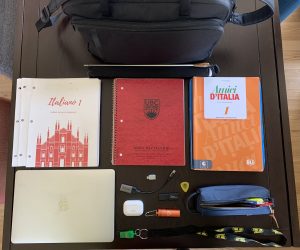
a photo of. bag, books, laptop, a whistle, and adaptors

The ETEC 540 Podcast with Mark Pepe
The 2022 edition of What’s in my bag?

For this weeks task, I decided to create a podcast in the style of the tech reviewer and lifestyle YouTuber Justine Tse. He has many videos about the tech contents in bags: What’s in my School Tech Backpack being an example. 

My goal was to share the significance of the contents in my bag as a YouTuber would review tech. I would like to tie this in with the New London Groups idea of Transformative Practice. I chose to recreate the discourse of an academic assignment into a YouTube tech review by taking on the identity of a tech YouTuber. I did this by changing the delivery of linguistic design, speaking energetically and attempting to emulate some of Justin Tse’s vocal mannerisms. I could have simply read what I wrote, added some music before and after, upload it and call it a podcast. But we are redesigning the original task. I wanted to keep the essence of the original by stating the significance for the Italian books, for example, but to bend the mode I had to change the medium from text to podcast; intertextuality.

This was a fun task that gave me to opportunity to role-play being a YouTuber and podcaster. I found it interesting that I had to consider the script and text when delivering the same message on two different mediums.

References

Categories
tasks

[6.4] An Emoji Story

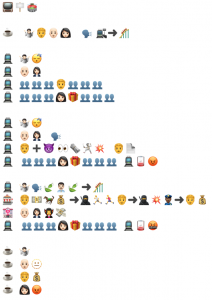
I thought the best way to explain the plot of this TV episode was to express ideas, though I tried using syllables just for the name of the TV show.

I started with a syllabic visuals for the title of the show because I thought that would be the best way to understand the ideas conveyed. If one knows the title they should, hopefully, be able to connect to the four human emojis. I tried my best to use emojis that represent their look and somewhat convey their personality.

My strategy to base this assignment was to browse the series by episode and pick one that had a straightforward plot. Just so happened that the next episode in the list made a good candidate. It started with the four main characters at a coffee shop and their discussion on the use of the subway, then they go their separate ways, and the episode concludes with them back in the coffee shop. I used emojis to establish their place then followed by emojis conveying their situation and or feeling. 

Bolter (2001) says, “MOOs may be stories, but they are not sophisticated fictions” (p. 75). I had to break down the scenes to their most basic structure: who and where, or who and what they are feeling. Using just emoji’s it is not possible insert the nuances of the story. Furthermore, Kress speaks of “mode” and “medium,” changing the mode of a story while also changing the medium of the story is quite challenging for the same reasons as above. Changing the mode and medium of video, which has moving pictures and audio, to a static emoji is going to degrade the amount of detail in the story.

I’m looking forward to deciphering everyone else’s emoji story.

Spoiler Alert!  This is an emoji story of Seinfeld Season 3 Episode 14, “The Subway”. I tried two variations for the title sign + wheat (field) or sign + stadium (field) and I chose the later.

References

  • Bolter, J. D. (2001). Writing space: Computers, hypertext, and the remediation of print (2nd ed.). Mahwah, N.J: Lawrence Erlbaum Associates. doi:10.4324/9781410600110
  • Kress (2005), Gains and losses: New forms of texts, knowledge, and learning. Computers and Composition, Vol. 2(1), 5-22.
Categories
tasks

[5.4] Twine

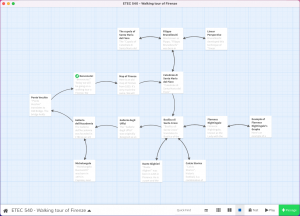
A screenshot of my map for this Twine project.

I created a walking tour of the city of Florence, Italy. Firenze, in Italian. It is also my favourite city in the world. I used Twine to create a walking tour of a few points of interest as well as introducing some of its famous inhabitants.

I went to Florence to study Italian and to visit the place where my favourite art was created, it’s the birth place of opera. While at language school, we would go on a passeggiata (a leisurely walk with friends and or family, usually in the evening) through a historic neighbourhood. The passeggiata is what I had in mind when creating this creating this Twine (note: this is a second, and expanded, iteration of something that I used in ETEC 524). I picked five points of interest, and for four of them I connected historical figures and events to those locations. In the virtual tour, you can side step back and forth to a person from a location, but not back and forth from location to location. I did so to only allow forward motion on the tour.

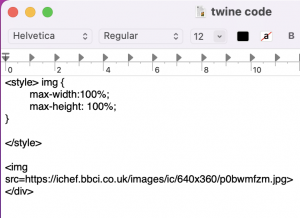
Twine uses visual space to help organize connections within your story and it uses text in two ways. Bolter (2001) says, “we tend to conceive of hypertext spatially: the links constitute a path through a virtual space and the reader becomes a visitor or traveller in that space” (p. 29). Twine allows you to see the connections between screens spatially, along with their directions, when creating a story. To view the connections on a map spatially made it easy to organize. Furthermore, Galloway (2004) says, “natural languages such as English of Latin only have a legible state, code has both a legible state and an executable state” (p. 166). I find it interesting that to use Twine one needs just a basic level of coding knowledge to put together their story. To create these stories on Twine we are required to write text that acts as prose and as an instruction to our web browser (hyperlinking forward, back, to the side; linking images and possibly other media). I found the code to insert images online and I copied and pasted them to a basic text editor. That way it’s easy to insert into the Twine screen editor.

Screenshot the code for inserting an image.

This task reminded me of Dr. Vannevar Bush’s Memex machine, and the demonstration video, but rather using sets of buttons and levers we use some text and symbols to code our journey.

Use the widget below to go on the virtual tour of Florence that I created. Enjoy!

References

  • Bolter, J.D. (2001). Writing Space: Computers, hypertext, and the remediation of print. Mahway, NJ: Lawrence Erlbaum Associates, pp. 77-98.
  • Bush, V. (1945). As we may think. The Atlantic Monthly, 176(1), 101-108.
  • Galloway, A.R. (2004). Protocol: How control exists after decentralization. MIT Press.
Categories
tasks

[4.4] Manual Scripts

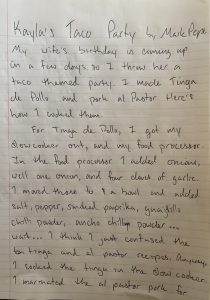
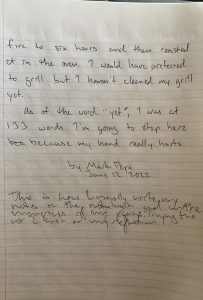
I have to admit that I did not reach the expected 500 word limit because my hand started to cramp. That goes to show that I definitely do not write by hand nearly enough, or long enough. When I do, it’s to jot down notes into my notebook, or in the margins of my printed typed work. These are usually lesson and unit plans.

Essentially, I did find this task difficult in a few ways. One was tension in my hand, and the second I will call a cognitive workout. When writing, I found that I was pressing hard into the page and holding on to my pen tightly. This may have been because when I usually jot down my notes I am writing in a mix of cursive and printing. To compare, I added a few lines of how I usually write below my official entry. I needed to write in a clean manner for the diary entry so that others could read, but I don’t write like that which is why it was a struggle. All this printing brought back memories of high school English essays, and short reflection paragraphs in university. In the past, I embraced typing as soon whenever I could.

This diary entry was also a cognitive workout for me because I had to really think ahead while I was writing my entry. Though I never ended up thinking that far ahead. Rather than think of the whole sentence, I would just think of the next word to write. Usually, when I type a sentence I’ll take a look to see if it works, or sometimes I’ll just type a few paragraphs just to get my idea out on to the screen, and then I would revise after. Since writing on paper doesn’t afford that option I would end up just changing what I wanted to say so that it matched the word that I had just wrote. For example, the point where I confused the recipes for Tinga de Pollo and al Pastor (which is where I wrote ”…wait…”) I changed my mind from writing my original idea of the process of making those dishes to just wrapping up the idea and moving on. Why did I do that? Because I did not want to crumple up a piece of paper and start again. Furthermore, I would just scribble out the penmanship errors that I made. Unlike the printing press, where one would have to disassemble an entire stamp if there was a mistake. No thanks! 

I prefer to type than to write by hand, the reason is that the document is never in a final state. It is malleable and can be ever changing. I can delete and undo. Certain word processors will allow me to view and edit versions from a few days before. I don’t have to rip out a piece of paper from the note book and throw it in the recycling bin.

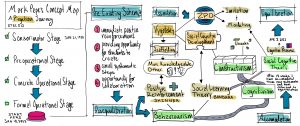
That being said, I do find some handwritten work visually appealing which has also helped me learn and make connections.  To conclude, I have added some past work of mine below. Here, we have a concept map that I created for ETEC 524 using ProCreate on my iPad. Like typing, I was able to erase, redo, and even add a grid to keep things symmetrical. Not only did I have a lot of fun being able to get creative, but that creativity and the writing down those concepts really ingrained those connections.

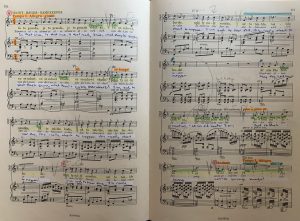
This is a photo of a few pages of an opera score from a show I did a few years back, Dvorak’s Rusalka. For a while, I was in the habit of colour coding musical directions as a way of check marking that piece of content off the learn list. Also, there are three languages, Czech, German, and a poetic English translation that I wrote; not sure what I taped over to write though. Then various pencil marking for direction, breaths, and phrases are written during rehearsal and coaching. Writing down the translations, making coloured highlights for musical directions, and other pencil marking help me learn the opera deeply.


Categories
tasks

[3.4] Task 3: Voice to Text Task

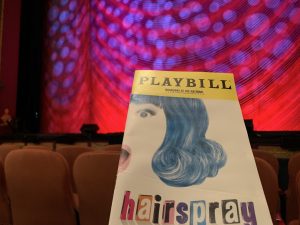
Photo of a concert program in a theatre.
Broadway Across America’s Hairspray at the National Theatre in Washington, DC.

For this assignment, I used the dictation feature in Apple Notes. I am telling a brief story of a weekend trip to Washington, DC to visit my friend and watch the musical Hairspray.

About a month ago I went to Washington DC I went to visit my friend Peter who is a guitar player for the touring company Broadway across America the show he is in is hairspray the trip started with me going to the airport for my flight to Toronto that started that was supposed to depart just past midnight that was delayed by over an hour I finally take my overnight flight by the time I arrive in Toronto the I missed my flight to DC so then I got rerouted to Montreal and then to Washington DC arrive there at about three in the afternoon and this whole trip was arranged by me and my friends friend Addison so we surprised Peter when I arrived at the hotel he was so shocked and so surprised he was so happy when I arrived I settled in and then we went for dinner at this place called circa by George Washington University it was actually pretty cool staying there because George Washington University was having their graduation ceremony so he saw a lot of graduates walking around with her cap and gown it was really cool and then we went to the theatre and I watched the very first very first I watched my first show of of hairspray it was fantastic it was so good I couldn’t believe how well trained those singers and those musicians were the show was really really tight and it’s not an easy show to perform so that night we walked back from the theatre to our hotel and we got to walk by the the the national monument the Lincoln Memorial and then the next morning we went for breakfast at this I can’t member the name of it but done it’s really cool breakfast the place and I noticed the the bartender was making was making Caesars so I asked the bartender on my cake can I have a Cesar and he just looked at me funny and then I remembered of my old they’re not cold Caesars in America they’re called bloody Mary’s so I ordered a bloody Mary it was delicious had a really good breakfast also had grits for the first time then we took a walk around DC we took a really good look at the Lincoln Memorial then took her a good look at the at the national monument and then there were also many protests going on this is the same week as Roe versus Wade was was in the headlines so it was really interesting being in Washington DC the home of democracy and seeing democracy in action pretty neat and I watched one more performance of of hairspray that night was absolutely fantastic then the next day we went for breakfast one more time and me Peter and his friend Addison we had a really good breakfast I had grits for the second time these grits were way better than the one before but this place they specialize in making their own pop tarts they weren’t bad I got the s’more‘s but I probably should’ve gotten the strawberry instead of dry and then after that just before I was gonna leave I just took another tour of the national mall and then I wanted to go to the capital building but there was there was a big event going on so I couldn’t get in and then I flew home and that was my trip to Washington DC. The end

Let’s look at how my spoken text deviated from the conventions of written English through spelling, capitalization, punctuation, and grammar. Spelling was fairly accurate, thought there were a few words in the text that I did not say but was what the dictation feature notated. Here are some examples, “so I asked the bartender on my cake” and then a little later “they’re not cold Ceasars in America.” Not sure what I said for “on my cake,”  but I could have pronounced the word “called” better rather than my utterance that sounded like “cold.” There weren’t any spelling errors, just some cases of mis-dictation, or mispronunciation on my part. For capitalization, the dictation feature did a good job of automatically capitalizing the names of people, places, and points of interest. Had I known how to add a period while dictating there would have been capitals at the beginning of sentences. Punctuation was picked up by the app for the marking of contractions and possessive nouns. Though on one occasion it didn’t pick up on a possessive noun, “my friends friend,” rather than ‘”my friend’s friend.” Interestingly it notated “s’more’s.” However, there were no commas, or periods; until I added that period at the end by saying “period.”. Regarding grammar, my text looked like strings of clauses and phrases. It turned out to be a poorly executed recreation of James Joyce’s stream of consciousness. Words were often repeated, and I found that this happened when I stopped to think about what I was saying. Also, there were too many words to convey a point, it could have been more concise. As explained, there were plenty of mistakes and things that were wrong, but the story that was told was right.

Boroditsky (2011) says “the way we think influences the way we speak” (p. 65). I previously mentioned stream of consciousness, scripting would have put those thoughts and ideas in order. Like I am doing right now with this task, I have deleted words, changed words, and reordered sentences and paragraphs. If the story was scripted, it would have been more concise. There would would have been more details conveyed with a fewer amount of words. The story would have been linear and there would have been an opportunity weave intricate details and nuance. Gnanadeskin (2011) says “writing is generally more deliberate than speaking, so finished written pieces are much more carefully crafted than a typical spoken sentence (p. 5)

How is oral story telling different from written story telling?

I always thought a well written story would be just as interesting if it was spoken. I recently had a conversation with someone about an assignment I did with my Italian classes. I had the students recite, with text in hand, the first six lines of Canto 1 of Dante’s Inferno. I was asked, “isn’t that old Italian? Would it not be hard to read and understand?” I replied, yes, it is old Italian but it is easy to be read out loud and sounds beautiful. The famous Italian actor and director Roberto Benigni is famous for reciting cantos from La Divina Commedia across Italy. See the video below for an example.

Haas (2013) says that “for Plato… material implements and artifacts of writing are a psychological crutch” (p. 8). As musician, I often feel that I use the musical score as a crutch even though I have the text and music memorized. Just a quick glance makes me feel comforted in being able to convey those musical ideas. Though when I see a performer using music I do wish it wasn’t there because then I would see a true representation of their craft. Though, I must say, that I too am guilty of that. Listening to Orson Well’s perform Julius Caesar is a more authentic representation of the text, and more entertaining.

Oral story telling would have to be captivating. The retelling of my trip to Washington is far from captivating, it’s just a step or two above nonsensical rambling. Ong (2002) says that “speech is inseparable from our consciousness” (p. 9), so to conclude, I am left with the questions, how did orators think about what they are speaking? If it was not written down, how were their thoughts organized? Did they rehearse their speeches? Were they orated exactly the same every time? The more I think about it, the more questions I have.

References


Categories
tasks

[1.7] Task 1: What’s in your bag?

Hi everyone, my name is Mark Pepe. I was born and raised in Vancouver, British Columbia. I have been teaching elementary music for the past seven years, but this year I have begun teaching modern languages in high school.

I am currently teaching Italian, I also taught French last year, and one unit in every text book always wants to know what in our bag, dans ma sac il-y-à” or nello mio zaino ci sono.” I finally get to answer this question! In this Herschel messenger bag there is:

a photo of. bag, books, laptop, a whistle, and adaptors

  • Apple MacBook Pro
  • AirPods Pro
  • Whistle
  • Vater musicians ear plugs
  • Pencil case with pencils, pens, highlighters, pencil sharpener
  • HDMI to USB-C adapter
  • USB-A to USB-C adapter
  • USB drive
  • Guitar pick
  • Amici d’Italia Teachers edition 1 and 2
  • Amici d’Italia Italiano 1 to 3 student work books 
  • UBC notebook
  • Conductors baton
  • Not shown, but there’s usually an opera piano vocal score

Let’s start with the actual text books that I have in my bag, Amici d’Italia Teachers Edition and Italiano 1 – 3 student workbook. These text books which contain the “authoritative” rules of how to read, write, speak, and listen to the Italian language. They also represent my Italian upbringing, a culture that I love, my passion for language, twenty years of studying and performing Italian opera, and my career as an educator. Teaching those courses bring everything together. Burnaby North Secondary, where I work, is the only school in the district to offer that course because of the large Italian community in the neighbourhood.

To digress for a moment, I want to share the lesson I taught last week; I like to include cultural presentations of history, music, and such. Dante Alighieri, the author of La Divina Commedia, wrote in vulgare, the vulgar street language of medieval Florence. Usually, latin would be used for published works. The language that Dante used was then used by Bocaccio and Petrarch in their works like the Decameron and Canzoniere. This vulgar street language of Florence eventually became the official Italian language once Italy unified.

My MacBook and my AirPods are important “text technologies” in my bag that facilitate communication. For personal use, I use these to for work, listen to podcasts, listen to audiobooks, and watch videos. For work, I send and receive assignments, grade student work to log in an Excel spreadsheet, and listen and watch student dialogues and monologues. I thought of Postman (1992) with his point of the seemingly harmless practice of assigning marks and grades. Also, I feel like a computer technology winner, I could log my grades in a paper log book, but the magic of Formulas in Excel allow me to calculate grades instantly. 

The earplugs and the baton indicate that on top of written and oral language I also have musical literacy. I bring these around for the days when I am a teacher-on-call. I could be conducting concert bands, jazz bands, or elementary music (which is why the earplugs are very important!). 

The conductor’s baton represents someone who has an extensive musical education and experience. One usually sees a maestro waving the baton in front of an orchestra. Scholes (1992) writes about the etymology of canon, and giving one of its many meanings, the French use it as “the word for the law and sacred texts” (p. 140). A true maestro, there aren’t many, knows the musical canon very thoroughly, and the orchestra looks to the maestro for a musical interpretation that true to the sacred text, or law, of the orchestral score. The conductor’s baton is a signifier that the one who holds it is on their path to becoming a maestro, or already is one.

The narrative produced by the image of my bag contents does coincide with what I outwardly project, I think. Those text books show my passion for language and education, the MacBook and AirPods show my love for technology, but the whistle is out of place. That’s for when I have to be a teacher-on-call for P.E. class!

25 years ago, this bag would have a Sony Discman with over ear headphones, clothing for soccer and football practice, a script or musical score for drama class, and no text books because those just would have been left in my locker. My priorities at the time were sports and drama class.

I feel that an archeologist would not be surprised to find my laptop, earbuds, and adaptors, but they would probably be surprised by the UBC notebook. Even though I keep all my work materials on my laptop, I still use a notebook for my lesson plans. Writing helps me sort out my thoughts, and give me the ability to quickly jot down a note immediately.

This was an excellent task that allowed me to think about how I use the contents of my bag. There really is a lot of meaning behind the objects that we carry with us.

References

  • Postman, N. (1992). Technopoly: The surrender of culture to technology (1st ed.). Knopf.
  • Scholes, R. (1992). Canonicity and Textuality. In Introduction to Scholarship in Modern Languages and Literatures, 2nd edition. Ed. Joseph Gibaldi. New York: Modern Languages Association of America.

Spam prevention powered by Akismet