Categories
web analytics

Web Analytics

Have you inserted the code from Google Analytics into your blog yet?  Do you have any idea of how to interpret the data you see when you look at the results?  I’m no expert at web analytics, however, I’m a marketer and I ask a lot of questions.  Questions about what customers want, where they come from, what they’re looking at and what they’re interested in.  Some of this is exactly what web analytics can tell you.

One of the best places to start learning about web analytics is Avinash Kaushik’s blog.  Kaushik makes a great point, first off, that you really need to have a clear goal as to why you even have a website in the first place.  Are you wasting money by just having something ‘up there’?  What  are your business goals and are they being complimented by what you’re doing with the webiste?  Let’s assume so.

1.  Look at the website itself, silly! I love his first point.  Before you dive into actually anlyzing the numbers, click around on the website.  Get a feel for the company, the flow, the brand, any comments, the shopping cart.  Bonus if you go visit the competition.

2. Traffic Sources Report :  look here first.  40 – 50% search engine traffic  is what you should be getting.  20 – 30% referring sites.  Dig in and see where your customers are coming from.

3. Visitor loyalty:   look now at how often and how recent your customers have come to your website.

4. Which pages are lousy? Look at your report to determine where people arent’ spending any time compared to your site average.  Now look at that page.  Why?

5. Which pages are making you money? Or getting lots of visits.  Can you replicate this strategy on your low traffic pages.

Lots to think about when you start reading those Google Analytics reports.  Go to the link above and get the details from Kaushik.
Categories
advertising blogs Digital media social media

Kids in the Haul

Haul videos.  Have you heard of this trend?  Young adults, mostly girls, come home from the mall, lay their loot out and film it for upload to Youtube.  Haul videos.  Ever driven by a pickup in the Prairies and seen the deer horns hanging out the back?  Anthropological, kind of, isn’t it?  Don’t gasp.  We  do it in the car on the way home.  Look in the bag at our new runners or new hoodie and admire our purchase.  Run up to our room and put it on, admiring our new, cooler, redefined self in the mirror.  Filming and posting is an extension of our online existence.  This is a great mix of Gen Y’s faves: shopping and tech.

Is there any value here for consumers or is this just voyeuristic or narcissism run rampant?  Turns out that there is value.  The vloggers (read video bloggers) don’t just film high end loot hauls but talk about bargain basement shopping and deals, pointing consumers to sources and offering tips.  Some of the best haulers have inked sponsorships and advertising deals.  With millions of views, and perceived authenticity from the vlogger by  consumers,  manufacturers want in on this game.  (Endorsements and free merchandise must be disclosed.) Some girls are making big bucks. Is this the next big thing?  Really, whether it is or isn’t, it’s a trend that companies are putting some bucks behind as more consumers tune into this alternative channel of product information.

Categories
Digital media social media

Visualize your LinkedIn

YouTube Preview Image

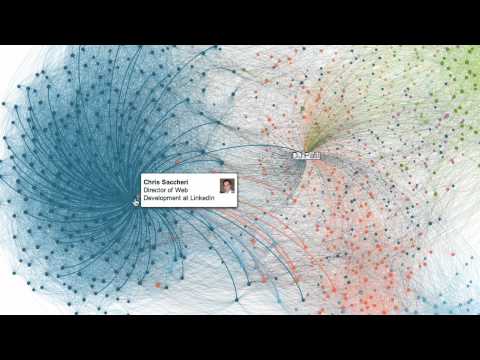
LinkedIn, the professional connections tool that many of us use to stay in touch with current and former colleagues has added a cool new add on:  InMap.  Showing a cloud of all of your professional contacts, LinkedIn brings itself from a somewhat linear online networking tool up closer to the ranks of Facebook.  And the map is way cool.

InMap shows a colour coded map of your contacts (colours based on how you know them) and also maps your  relationships to them… and to each other.  I think that’s the interesting part.  You know who you know but it’s interesting to who knows each other and how.  Yeah, I know this was there before but it was a little hard to follow. Now, visual and virtual.  Cool.

So, what does this offer consumers of LinkedIn.  More value?  Yes.  Certainly fodder for cocktail party conversations “Hey, I saw on LinkedIn that you know Brad Pitt.  He’s my sister-in-law’s dog walker’s cousin.” Beyond that, however, having a visual perspective on how big and broad and varied your network is, courtesy of LinkedIn, takes the site more into the realm of social networking.  Kind of more Facebook for professionals.  Sounds useful.

Categories
Digital media distribution

.mobi (not the other guy)

How frustrating is it to have to scroll through pages on your Smartphone to get to the content you want when a retailer is advertising something to you? Irritating and stupid. The marketer in me gets annoyed when retailers I like just send me emails with product offers and I have to fight my way through a bunch of screens to figure out what it’s for. Sure, I hear you. I know I can click on the website button or sometimes (like in J Crew’s case) there’s a supposed ‘mobile phone friendly version of this email’.

Better now: there’s .mobi. The mobi standard is the first attempt to set a standard for what a mobile site should look like. The standards are designed for easier viewing on the smaller screens of Blackberrys and iPhones. Screens are designed to be viewed as wider rather than narrower so you don’t have to scroll down. Options to purchase stuff are fewer, using drop down lists. Users will NOT be overwhelmed with data: something that costs users money on cell phones.

But is .mobi even necessary? Maybe not. Businesses can use the .mobi standards and create better consumer-friendly smartphone sites. Many companies are just adding an ‘m’ to their site and creating a smartphone friendly version e.g., m.google.com. In the long run, however, apps are the way that most businesses will go. The .mobi standard is just a stepping stone to help businesses build their way to a more smartphone-friendly way to access their website…and ultimately, sell their stuff.  It’s just another channel for accessing product.

Bus 101 Winds Up

It was an exciting term in Bus 101 with 600 Sauder 1st year students in 4 sections having an opportunity to see all aspects of Commerce integrated.  Paul Cubbon, Jeff Kroeker, Rob Jackes and I taught this highly engaging, active course together.  Paul designed the course and he and Jeff ran it as a pilot last spring.  The students had no texts or exams.  Every class’ preparation was delivered via the website, with students prepping Harvard Business School or newspaper articles.  In each 125 student class, we clicked and tweeted.  The intention  was to give the new Commerce entrants a ‘once over lightly’ of all the different aspects of Commerce, showing them the tension and integration between topics.  How do marketing decisions affect human resources management?  Does sustainability have a role in finance?

The Bus 101 students learned  a lot about Commerce in their first term at b-school and got comfortable with a host of real world business tools like Twitter, clickers, blogs and business plans. Take a look at what UBC Public Affairs has to say.

Categories
social media viral marketing

(RED) or Dead

Had a great discussion yesterday about the launch of product (RED), forcing us to think back to 4 years ago when this brand and business/charitable model were a whole new concept for raising money for a cause.  Look what showed up today:  YouTube Preview Image

In this campaign, to support World AIDS Day on Dec. 1, digitally savvy celebs have stopped posting on Facebook and Tweeting until $1,000,000 is raised.  The campaign, called Digital Death, encourages consumers to buy back these celebs digital lives by texting to Buylife.org.  There was so much traffic that the website went down.

There were many other prongs to the campaign too:  (RED) products are available year round from Nike, GAP, Starbucks and Armani.

Starbucks has an exceptionally cool advent calendar (okay, who doesn’t love those), with a World AIDS Day contribution of $.05 for every view of a new Killers video.  Great.  Innovative.

Frequent use.  Small, regular payments.  All of the things that we talked about that (RED) was trying to do following the initial launch of the campaign:  keep you coming back.  Keep up that Customer Lifetime Value.

Today’s the day:  World AIDS Day.  Get yourself to a Starbucks today.  5 cents from every drink goes to fight AIDS in Africa.

Spam prevention powered by Akismet