Using Derrida and Deconstruction in Today’s Everyday Life

One of the main reasons that I find reading Derrida’s work useful is that I find it to be a useful tool/way of thinking in navigating the many messages that we are confronted with in today’s world on a daily basis. At no previous time have we had the capacity to be bombarded with so many messages as we do today; just as I am writing this blog post I can hear CNN’s Outfront program in the background; the ticker tape at the bottom of the screen succinctly summarizes complex news stories from all around the world in phrases of just a few words; and I am just a few computer mouse clicks from a myriad of Internet sources should I want to find out about pretty much anything in the world (albeit the quality of such potential sources is also of a very varying spectrum). This is why I think the practice of deconstruction is very valuable in today’s world as well; listening to a president’s speech or any other text for that matter is an exercise that is greatly enhanced if you are able to deconstruct it and identify the implications of signification that exist in speech (especially speech that is of a political nature).

I also find Derrida’s notion of ‘difference’ both interesting and useful; I like the clarification on page 258 of  ‘difference’ as the “simultaneous movement of temporal deferment and spatial difference” and the explanation that “ideas and things are like signs in language; there are no identities, only differences”. I also agree with the view that truth will always be incomplete as if all things are produced as identities by their differences from other things, then a complete determination of identity would require an endless inventory of relations to other terms in a potentially infinite network of differences. A little discouraging, perhaps, to think of truth as always incomplete, but I also think that it’s important to keep in mind that just because it may be incomplete, this does not equate truth to never existing – it cannot be simply something that we discard because it can never be completely captured. Perhaps it would be best to think of something that we have to strive to approximate as best as possible, while knowing that it does function as always incomplete. This is also a notion that I believe to be very important to keep in mind as we approach the many discourses that we are exposed to on a daily basis.
Categories
Derrida

My synthesis of Derrida: we are nothing

I have to confess that reading Derrida’s texts was very tough. But, after finished the reading process, the idea that keeps tingling in my mind is that, in synthesis, we can say that there is no Signified, only an infinite group of Signifiers. If am not wrong (won’t surprise if I am), Derrida creates the word “differance” to demonstrate that in language (and, I think, in life) we can never expect to reach a definite and concrete meaning. On the contrary, the “meaning” is given by the differences that a word, for example, have in relations to others. So, we only have “traces” that this process of differentiation left behind (here we can’t also talk about present, because it is always evocated from a past and evokes a future). This has a parallel to Saussure’s idea that a sign is defined by his difference with others. But, for Derrida, the idea of sign “is essentially theological” (309). He recognize that “perhaps it will never end” (309), but also consider that “its historical closure is, however, outlined” (309).

The discourse of Derrida is clearly against the metaphysic, because this tradition consider the existence of an ulterior and definite Signified. From this point, some categories of value are created (good/bad, superior/inferior, etc.), like in the case of speech and writing that Derrida points out. So, the sign, for him, is related with this metaphysical conception, because when we close it with a signified we give it a definite and concrete meaning. But, according to Derrida, the “meaning”, in fact, is a bunch of “traces” of the “differance”.

As I said, this is my synthesis of the ideas of Derrida. I am not completely sure about it, but it is what I understood (maybe is a “differance” from the “differance” of Derrida). But, I also was thinking of how we could apply this discourse to the daily life. I specifically was thinking in the political system. Applying Derrida’s ideas could be very revolutionary. We can say that traditionally, political and economic ideologies presented themselves as a closed Sign, so they have a concrete meaning that gives them a center. But, if this “metaphysical” idea of power is deconstructed, we can say that they don’t really have a signified that is beyond and true, so its authority is false. They are a “text”. In that sense, we can question every political ideology (and every ideology, in general) and not pretend to consider one as carrier of the “truth”.

To finish this post, I would also like to mention that while I was reading I also remembered a biblical phrase pronounced by God to Moses: “I Am that I Am” (I actually remembered it in Spanish: “Yo Soy el que Soy”). According to the ideas of Derrida, He would be the only one capable of defining himself by himself in a continuous present. We, the mortals, created by the “differance”, don’t have –as we would like to have- an ulterior meaning. So, we are basically nothing (nothing concrete, at least).

Ignorance is bliss?

It was quite unnerving to read Baudrillard I found, especially his notion of the “hyperreal” (366) which would lend itself well to explorations of films such as The Matrix. Baudrillard claims that symbols and signs have come to replace reality and meaning within our current society, and that human experience is now a ‘simulation’ of reality. I find his claims resonate entirely with a film I saw by Chris Marker entitled Sans Soleil. The film addresses issues concerning memory and what our memories actually consist of and whether the death of ‘real’ memory has come about because of the invention of new technologies such as film and the photograph. In the film, the narrator recounts:

“Brooding at the end of the world on my island of Sal in the company of my prancing dogs I remember that month of January in Tokyo, or rather I remember the images I filmed of the month of January in Tokyo. They have substituted themselves for my memory. They are my memory. I wonder how people remember things who don’t film, don’t photograph, don’t tape. How has mankind managed to remember? I know: it wrote the Bible. The new Bible will be an eternal magnetic tape of a time that will have to reread itself constantly just to know it existed.”

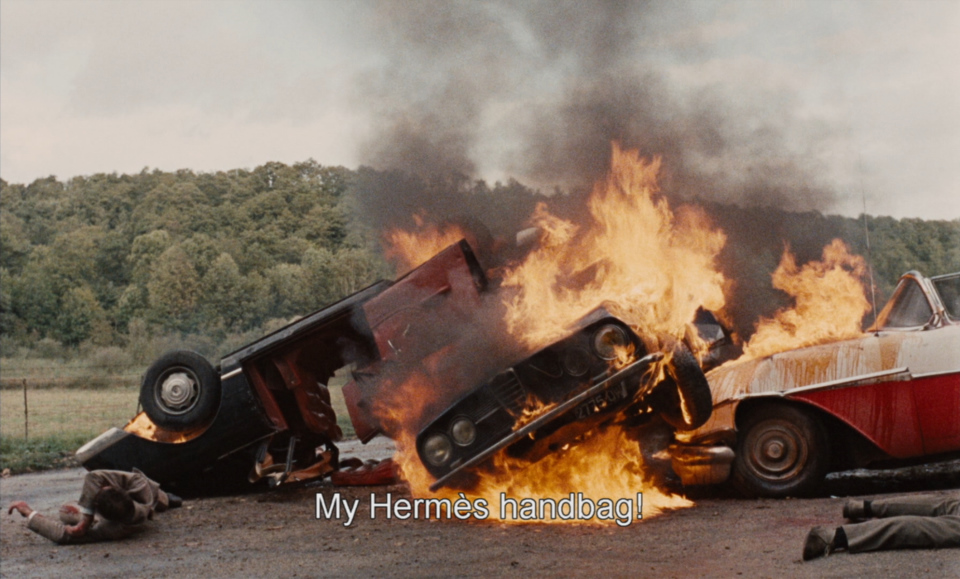
I think Baudrillard’s ideas relate entirely to the reader of the twenty-first century as we live in a society where so much emphasis is placed upon the importance of the aesthetic, and we tend to live so vicariously through film or image that our perception of the boundaries of our own reality can often become blurred and we find ourselves living a sort ‘simulation’ of ‘real’ life via a montage of borrowed realities from the media. We “consume signs of status” (365) such as cars and the latest technologies. Baudrillard’s idea of the automobile as the single gadget of solitude (360) also reminds me of another film; Weekend by Jean-Luc Godard, which is about a road trip undertaken by a couple who, on the way experience never ending traffic jams and car accidents. The road is often strewn with wreckages and bodies which they merely pass by, unnoticed and unfazed by the sight.  At one point one of the protagonists asks another driver if this is a film or real life, and when he replies that it is a film, he doesn’t believe him. This illuminates the idea that the media of the twenty first century has constructed a perceived reality and distorted the consumer’s perception of it.

I would like to finish with another line from Sans Soleil, which also always chills me as I think it reflects how intrusive and powerful the media has become, perhaps even without society realizing. The narrator is talking of the comic book heroes painted on the walls in Japan: “And the giant faces with eyes that weigh down on the comic book readers, pictures bigger than people, voyeurizing the voyeurs.”

Ignorance is bliss?

It was quite unnerving to read Baudrillard I found, especially his notion of the “hyperreal” (366) which would lend itself well to explorations of films such as The Matrix. Baudrillard claims that symbols and signs have come to replace reality and meaning within our current society, and that human experience is now a ‘simulation’ of reality. I find his claims resonate entirely with a film I saw by Chris Marker entitled Sans Soleil. The film addresses issues concerning memory and what our memories actually consist of and whether the death of ‘real’ memory has come about because of the invention of new technologies such as film and the photograph. In the film, the narrator recounts:

“Brooding at the end of the world on my island of Sal in the company of my prancing dogs I remember that month of January in Tokyo, or rather I remember the images I filmed of the month of January in Tokyo. They have substituted themselves for my memory. They are my memory. I wonder how people remember things who don’t film, don’t photograph, don’t tape. How has mankind managed to remember? I know: it wrote the Bible. The new Bible will be an eternal magnetic tape of a time that will have to reread itself constantly just to know it existed.”

I think Baudrillard’s ideas relate entirely to the reader of the twenty-first century as we live in a society where so much emphasis is placed upon the importance of the aesthetic, and we tend to live so vicariously through film or image that our perception of the boundaries of our own reality can often become blurred and we find ourselves living a sort ‘simulation’ of ‘real’ life via a montage of borrowed realities from the media. We “consume signs of status” (365) such as cars and the latest technologies. Baudrillard’s idea of the automobile as the single gadget of solitude (360) also reminds me of another film; Weekend by Jean-Luc Godard, which is about a road trip undertaken by a couple who, on the way experience never ending traffic jams and car accidents. The road is often strewn with wreckages and bodies which they merely pass by, unnoticed and unfazed by the sight.  At one point one of the protagonists asks another driver if this is a film or real life, and when he replies that it is a film, he doesn’t believe him. This illuminates the idea that the media of the twenty first century has constructed a perceived reality and distorted the consumer’s perception of it.

I would like to finish with another line from Sans Soleil, which also always chills me as I think it reflects how intrusive and powerful the media has become, perhaps even without society realizing. The narrator is talking of the comic book heroes painted on the walls in Japan: “And the giant faces with eyes that weigh down on the comic book readers, pictures bigger than people, voyeurizing the voyeurs.”

Post-Structuralism

I found the excerpt of Derrida’s essay, Differance, fascinating; not only for the level of complexity (I had to read it 3 times and I’m still struggling), but for the subversive ideas of reversing hierarchies that are entrenched in the history of thought within the metaphysical tradition.

His attempt of de-centering violent hierarchical binary oppositions, and his critique of the privilege given to one variable over another, such as presence/absence, good/evil, speech/writing, etc.  Specifically in this latter relation, Derrida demonstrates that contrary to the traditional approach of considering speech pure, more immediate to thought than writing as this latter as an obstruction to the process of portraying it, writing is a species of speech (Selden, Widdowson and Broker, 168). Both, speech and writing share the same structure of signifiers not always connected with signifieds, and are permeated by differance.

I wonder if the new opposition between metaphysics and deconstruction in the way we understand the world represents another hierarchical opposition that Derrida precisely tried to avoid.

I also found Johnson’s proposal of reading the silence very interesting (Rivkin and Ryan, 346-347) as an alternative to the usual way of reading texts. How we do that when we have social structures internalized (Foucault) that might prevent us from seeing the absence? Are there ways to escape, perhaps, looking at Lyotard and his skepticism toward the meta-narratives or Barthes with his idea of text that generates and subverts meaning? but again how to escape from fixed structures that shape our thought and enable ourselves to go beyond these limits?

Post-Structuralism

I found the excerpt of Derrida’s essay, Differance, fascinating; not only for the level of complexity (I had to read it 3 times and I’m still struggling), but for the subversive ideas of reversing hierarchies that are entrenched in the history of thought within the metaphysical tradition.

His attempt of de-centering violent hierarchical binary oppositions, and his critique of the privilege given to one variable over another, such as presence/absence, good/evil, speech/writing, etc.  Specifically in this latter relation, Derrida demonstrates that contrary to the traditional approach of considering speech pure, more immediate to thought than writing as this latter as an obstruction to the process of portraying it, writing is a species of speech (Selden, Widdowson and Broker, 168). Both, speech and writing share the same structure of signifiers not always connected with signifieds, and are permeated by differance.

I wonder if the new opposition between metaphysics and deconstruction in the way we understand the world represents another hierarchical opposition that Derrida precisely tried to avoid.

I also found Johnson’s proposal of reading the silence very interesting (Rivkin and Ryan, 346-347) as an alternative to the usual way of reading texts. How we do that when we have social structures internalized (Foucault) that might prevent us from seeing the absence? Are there ways to escape, perhaps, looking at Lyotard and his skepticism toward the meta-narratives or Barthes with his idea of text that generates and subverts meaning? but again how to escape from fixed structures that shape our thought and enable ourselves to go beyond these limits?

Categories
Derrida

Derrida, the Mission Impossible… This message will self-destruct in five seconds!

Eggs, milk and the impossibility of reading Derrida

After several hours of reading the first pages of “Differance” by Jacques Derrida on English, and do not understand a word about he was trying to say, I decided to look for the text in Spanish, so I can easily could find what he was trying to define. I found a translation. After more than two hours of reading “Diferencia” by Jacques Derrida on Spanish, and not be able to pass the page five, I thought that there was something wrong with my brain.

I look for “Derrida for dummies” and I found there some concepts that I could catch. I read Barbara Johnson’s “Writing” essay and finally I could understand some of the ideas that Derrida explains in a very complicated way. At least, it was very complicated for me.

I had to take a break. I went to the store for buying eggs and milk. While I was walking down the street, feeling the cold wind that this Sunday blowed, I could not stop thinking about what happened with Derrida’s readings. It was impossible to understand? Why is so complicated for me? I arrived to some conclusions.

  • I remember when I taught a basic reading course for undergraduate students in Colombia, there was this structured model of basic steps for reading: 1) Read the first time and try to identify all the words that you do not know and look for them on the dictionary; 2) Underline the main ideas in the second reading; 3)Try to select the most important ideas or concepts and make a list with them; 4) Try to establish an hypothesis about what the text is trying to say; 5) Make a small synopsis of the text. Well, I think that my problem with Derrida text is around the step 1 and 2. On the one hand, the vocabulary on the text is closely related to philosophy (for instance arche, ousia, parousia Greek or Latin expressions that are used by philosophers). On the other hand, it seems that syntax is working but for me is not:

 Already we had to note that differance is not, does not exist, and is not any sort of being-present (on). And we will have to point out that everything that is not, and,consequently, that is has neither existence nor essence. It belongs to no category of being, present or absent. And yet what is thus denoted as differance is not theological, not even in the most negative order of negative theology (Derrida 282).

I know probably the majority of the class got the idea but, honestly, I have read this quotation over and over and I can not find what is he trying to say.

  • If the language that Derrida is using is closer to the philosophy, I think he is writing for a particular reader. Yes, this is arguable and I hope to read your arguments later, however I think Derrida’s discourse is only for students and scholars that know many of his references and can jump easily from the step 1 to the second on the “reading steps”. I wonder if the world of the ideas is only for privileged readers, like me, which have the time to produce questions like these, or if this world is for everyone.
  • The idea of deconstruction, what I understood in Johnson analysis, is complex and profound. Its main purpose, like she demonstrated analyzing the poem “Meditation 6” by Edward Taylor, is to look deep in the text and see “how the logic of writing -it is also a logic that can only really exist in writing” (345). Then she add: “When one writes, one writes more than (or less than, or other than) one thinks. The reader’s task is to read what is written rather than simply attempt to intuit what might have been meant” (346). This idea reminds me Foucault, when he said that

“We must question those ready-made synthesis, those groupings that we normally accept before any examination, those links whose validity is recognized from the outset. We must oust those forms and obscure forces by which we usually link to discourse of one man with that other; they must be driven out from the darkness in which they reign” (90-91)

In that order of ideas, deconstruction should question discourses that we as readers have already accepted, and see within them how writing develops those discourse. It is a political idea, I guess. But the idea of questioning  the world in Derrida is only for philosophers? Is the same in Foucault? I wonder if this two authors are in the same quest.

  •  The last reflection is around education and pedagogy. Maybe this is not the most adequate place for doing it, but I just want to express what the impossibility of reading Derrida let me.  While I was walking to the store, I started to wonder if sometimes, as a teacher, my discourse is as confusing as Derrida’s is for me. I know, his purpose is different than mine, but he and I are surrounded by “readers”. Students in my class are trying to learn an idiom, his readers are trying to find what the deconstruction is, are developing a language system. Am I that confusing? Maybe I am. Perhaps I have to check if my discourse is dark and looking for some privileges readers who comprehend it. I have to think about it.

I bought the eggs and milk. I came back and started to write down these ideas. Now that I am reading them again, I concluded that the impossibility of reading Derrida maybe deconstructed me.

Eggs, milk and the impossibility of reading Derrida

After several hours of reading the first pages of “Differance” by Jacques Derrida on English, and do not understand a word about he was trying to say, I decided to look for the text in Spanish, so I can easily could find what he was trying to define. I found a translation. After more than two hours of reading “Diferencia” by Jacques Derrida on Spanish, and not be able to pass the page five, I thought that there was something wrong with my brain.

I look for “Derrida for dummies” and I found there some concepts that I could catch. I read Barbara Johnson’s “Writing” essay and finally I could understand some of the ideas that Derrida explains in a very complicated way. At least, it was very complicated for me.

I had to take a break. I went to the store for buying eggs and milk. While I was walking down the street, feeling the cold wind that this Sunday blowed, I could not stop thinking about what happened with Derrida’s readings. It was impossible to understand? Why is so complicated for me? I arrived to some conclusions.

  • I remember when I taught a basic reading course for undergraduate students in Colombia, there was this structured model of basic steps for reading: 1) Read the first time and try to identify all the words that you do not know and look for them on the dictionary; 2) Underline the main ideas in the second reading; 3)Try to select the most important ideas or concepts and make a list with them; 4) Try to establish an hypothesis about what the text is trying to say; 5) Make a small synopsis of the text. Well, I think that my problem with Derrida text is around the step 1 and 2. On the one hand, the vocabulary on the text is closely related to philosophy (for instance arche, ousia, parousia Greek or Latin expressions that are used by philosophers). On the other hand, it seems that syntax is working but for me is not:

 Already we had to note that differance is not, does not exist, and is not any sort of being-present (on). And we will have to point out that everything that is not, and,consequently, that is has neither existence nor essence. It belongs to no category of being, present or absent. And yet what is thus denoted as differance is not theological, not even in the most negative order of negative theology (Derrida 282).

I know probably the majority of the class got the idea but, honestly, I have read this quotation over and over and I can not find what is he trying to say.

  • If the language that Derrida is using is closer to the philosophy, I think he is writing for a particular reader. Yes, this is arguable and I hope to read your arguments later, however I think Derrida’s discourse is only for students and scholars that know many of his references and can jump easily from the step 1 to the second on the “reading steps”. I wonder if the world of the ideas is only for privileged readers, like me, which have the time to produce questions like these, or if this world is for everyone.
  • The idea of deconstruction, what I understood in Johnson analysis, is complex and profound. Its main purpose, like she demonstrated analyzing the poem “Meditation 6” by Edward Taylor, is to look deep in the text and see “how the logic of writing -it is also a logic that can only really exist in writing” (345). Then she add: “When one writes, one writes more than (or less than, or other than) one thinks. The reader’s task is to read what is written rather than simply attempt to intuit what might have been meant” (346). This idea reminds me Foucault, when he said that

“We must question those ready-made synthesis, those groupings that we normally accept before any examination, those links whose validity is recognized from the outset. We must oust those forms and obscure forces by which we usually link to discourse of one man with that other; they must be driven out from the darkness in which they reign” (90-91)

In that order of ideas, deconstruction should question discourses that we as readers have already accepted, and see within them how writing develops those discourse. It is a political idea, I guess. But the idea of questioning  the world in Derrida is only for philosophers? Is the same in Foucault? I wonder if this two authors are in the same quest.

  •  The last reflection is around education and pedagogy. Maybe this is not the most adequate place for doing it, but I just want to express what the impossibility of reading Derrida let me.  While I was walking to the store, I started to wonder if sometimes, as a teacher, my discourse is as confusing as Derrida’s is for me. I know, his purpose is different than mine, but he and I are surrounded by “readers”. Students in my class are trying to learn an idiom, his readers are trying to find what the deconstruction is, are developing a language system. Am I that confusing? Maybe I am. Perhaps I have to check if my discourse is dark and looking for some privileges readers who comprehend it. I have to think about it.

I bought the eggs and milk. I came back and started to write down these ideas. Now that I am reading them again, I concluded that the impossibility of reading Derrida maybe deconstructed me.

Oh to dream….


Near the end of Derrida's Of Grammatology, he delved a bit into Rousseau's idea of dreams ending  with a quote (on page 330) from Rousseau’s Book of Nature :
  
            “…the dreams of a bad night are given to us as philosophy. You will say I too am a dreamer; I admit it, but I do what others fail to do, I give my dreams as dreams, and leave the reader to discover whether there is anything in them which may prove useful to those who are awake. (76)”

The dreams of a bad night…. those are normally the ones people remember, right? They are clear, vivid, and don’t leave your side. I personally feel that dreams tend to linger on and perhaps Rousseau also felt that way. The lingering feeling causes you to then think of what caused them and why (leading to philosophy). I have tried to rationalize my dreams and have even had friends who kept a dream journal to see what to make of it but most of the time, I am (and they were) left with more questions than before.

We do know that dreams occur in the subconscious normally during the REM stage of the sleep cycle. You can’t control them, you can’t change them, in your mind they are present, real, and in the now. (Freud did a lot of research on dreams so if he were here he would probably be a better spokesperson than I but no worries.)

I did find it interesting that Rousseau thought that he only recounted his dreams as they were therefore leaving them up for interpretation. But how can we be sure Rousseau was able to do this successfully? Each time a dream is told, and retold, I feel that either you lose a bit of it or you seem to add to it… even when keeping a journal. It is very difficult trying to keep track of everything that occurred. So, I’m not sure if Rousseau was really able to do this in the end...but I guess I will leave that up to you guys…those who are awake.


Spam prevention powered by Akismet