Categories
Shklovsky

Twentieth Century, Formalists and Tolstoy

First, I find quite interesting that most of the readings for this week were written at the beginning of the 20th century. I know during those days many different events took place in the world, but I just reckon that the development of technology, politics, and the construction of new ways of thinking were occurring at the very same time in many places of the world. The environment of those days made that sciences like Linguistics and these theoretical approaches were developed by a intellectuals that were trying not only define their field of study but also they were trying to define what exactly they were. Therefore, for me it is not so clear that Russian Formalists, at least the way how Eichenbaum proposes, do not recognized what the historians of literature had made for them: they gave them a starter point. I remember someone in our last class said that literary movements arise like an answer for the recent literary movement, they disagree with their colleagues ideas and someone, thinking about how to answer to that movement proposes an aesthetic that attacks, contradicts or sometimes continue the past literary aesthetics. In the specific case of literary theory, I think it is pretty much the same.

Second, I see that the big importance of the Russian Formalists, is that they maybe created the first referent of the study of literature as a science, separating it from the artistic field of writing, and the “sentimental” reading. Formalist propose “a distance” (actually, this idea reminds me the “distant effect”, the Verfremdungseffekt, that Brecht will propose forty years later) and analyzed literature as an object “specific and concrete”, and in this way the study of literature converse in something more profound, perhaps more philosophical, that is the “literariness” that Jakobson well defined.

Nevertheless, in Viktor Shklovsky’s “Art as technique” (1916), I found the intention of not forgetting that literature could be analyzed an object, but it is still an art. It is fascinating that he points that:

Habitualization devours work, clothes furniture, one’s wife, and the fear of war. ‘If the whole complex lives of many people go on unconsciously, then such lives are if they had never been’. And art exists that one may recover the sensation of life; it exists to make one feel things, to make the stone stony. (16)

The search of the reader/theorist should be to recognize “the sensation on things as they are perceived and not as they are known” (16). The technique of art, according to Shklovsky, is make the objects “unfamiliar”, so they can be truly perceived. Then he quotes how Tolstoy art “defamiliarizes” the objects in some of his works and explain how the descriptions of the places or the objects, trough the Russian writer’s perspective, transforms the perception of the reader.  I agree with him. Few months ago I finished Anna Karenina and there are some episodes that are memorable because the objects localized in Anna’s room, or how her husband combs his mustache, or how Levin observes the common country life, or Kitty smiles, described with a simple language by Tolstoi, takes a relevant perception. Sometimes I felt that some grammatical structures, some images were taking a new dimension only because the poetic speech was created for move, touch the reader’s perception.

This concept, also, reminds me how Orhan Pamuk in The naive and the sentimental novelist  (2011) mentions that Tolstoy elaborates his writing landscape as a painting: every single detail, every color and movement suddenly approach to the reader, in a kind of “zoom in” that always surprised him as a writer.* Of course, Pamuk it is also a painter and his perspectives always are bond to painting, so could be arguable if this comparative relation it is possible to make. However, I think that both critics/readers, Pamuk and Shklovsky, are recognizing the defamiliarization proposed by Tolstoy. The difference is that Pamuk is thinking about images that defamiliarize the habitual world, while Shklovsky particular interest is how the poetic speech create a Tolstoy’s artistic trademark.

Shklovsky’s approach could be useful when analyze literature. The concept of defamiliarization is helpful to define the poetic speech of a writer and, most important, to recover the sensation of life.

Coda: I noticed that theories read for this week were written by western intellectuals. I wonder if at the beginning of the Twentieth Century some other intellectuals from East, Middle East, Oceania… were trying to developed literary theories. Does anybody knows?

*I could not find the book for quoting Pamuk’s words, sorry.

Actually, the Verfremdungseffekt is also known as a “defamiliarization effect”. In this perspective, Brecht probably was looking on the stage what the Formalist first developed on literary studies.

Categories
Barthes Eichenbaum Shklovsky

The science of literary/linguistic studies

It surprised me how frequently we talk about science or scientific approaches when dealing with literary and linguistic studies in the pages we read this week. From Russian Formalists who were initially inspired by philosophers of science like Edmund Husserl (3), to the French Structuralists who were greatly influenced by the studies of Ferdinand de […]
Categories
Shklovsky

Shklovsky’s “Art as Technique”

Shklovsky’s “Art as Technique” presents two very important ideas; the ideas of habituation and defamiliarization.

According to Shklovsky, habituation is the idea of doing something unconsciously all the time. It is a concept that I can relate to as I experience it in my daily life. Indeed, routines become so repetitive that I do things almost subconsciously and forget sometimes whether I completed or did not (not remembering if I locked the door or not when leaving my apartment for example). As Shklovsky says, “the object is in front of us and we know about it, but we do not see it – hence we cannot say anything significant about it”.

Then Shklovsky introduces the concept of defamiliarization, the process which provides one to view things in a new way by presenting a common thing in the most uncommon and unfamiliar way, thus challenging our usual perception. According to Shklovsky, it is the job of good art to make the viewer feel defamiliar with a common object and to release one from a sort of blindness, as the length of perception is increased.

A perfect example of defamiliarization would be Marcel Duchamp’s “Fountain”, since it presents an ordinary article of life, a urinal, at the art exhibit, associating it with a fountain and thus, producing new thought for that object. Indeed, we go by urinals so often; it is such a common object you never really think about. However, that familiar object becomes unfamiliar and takes one out of one’s own usual consciousness once the object is placed on a museum pedestal, named “Fountain”. We all know a fountain as being a well-designed structure that spouts water into the center and this image does not come to mind when seeing a urinal. Therefore, the viewer has to erase all conceptions of what it really is by defamiliarizing it and it forces one to take a consciousness by critically analyzing the object taken out of one’s own element and the intention of the artist at making it.

fd


Categories
Shklovsky

It Takes All Kinds of Kinds?

Hello everyone,

I like the way we’ve been introduced to the world of literary and cultural theory with this first round of readings. The one notion that I find myself thinking about most after completing the readings is one that I’ve always found most fascinating about literature: fiction’s potential to reflect the human condition in all of its multifaceted complexity more potently than non-fiction. I believe this has a lot to do with, as Rivkin and Ryan explain in their discussion on the thoughts of idealist philosophers that “art provides access to a different kind of truth than is available to science, a truth that is immune to scientific investigation because it is accessible only through connotative language (allusion, metaphor, symbolism, etc.) and cannot be ren

dered in the direct, denotative, fact-naming language of the sciences” (3). I definitely do share the tendency of the American New Critics to assert that literature does possess unique truths that can be conveyed only through literary language.

 
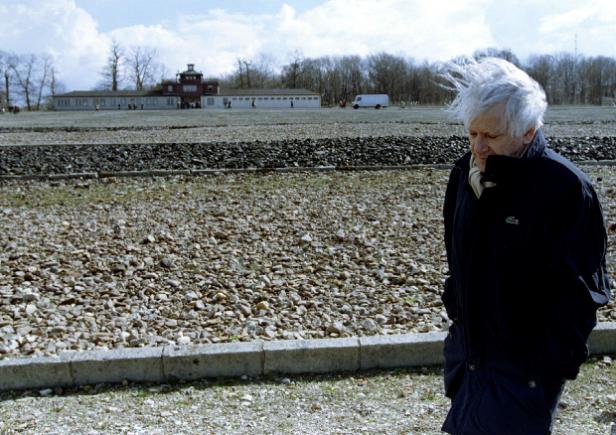
Jorge Semprun Returning to the Buchenwald Concentration Camp Years After the End of WWII

While I was reading this discussion, my mind was immediately jolted to a very vivid moment in Jorge Semprún’s ‘Literature or Life,’ his deeply personal account of his time in Buchenwald, a Nazi concentration camp in World War II. There is a retelling in the work about a conversation that several of the academics who were detained in the camp had once they were liberated; in this dialogue, they ponder how they might tell those in the outside world what had happened within the confines of the camp:

“—I imagine there will be an abundance of testimonies … Their value will be the value of the acuteness, the perspicacity of the witness … and then there will be documents… Later, historians will collect them, compile them and analyze them, and will write learned works… Everything will be said, everything will appear there … And it will all be true … But the real truth will be missing, the truth that no historical reconstruction, however accurate and all-embracing, can achieve…

The others look at him, nodding, apparently relieved to see one of us able to formulate the problems so clearly.

—Another kind of understanding, the essential truth of experience, is not transmissible … Or rather, it is only transmissible through literary writing.

He turns towards me, smiling.

—Through the artifice of the work of art, of course!” (140).

This segment underscores to me that there is an inherent quality in fiction (as opposed to documentary as specifically identified in this example) that has a very powerful potential to harness unique truths, in this case about a very particular experience in human history.

However, I also passionately believe in the Russian Formalists’ insistence on the importance of the act of defamiliarization, the action of removing objects from the automatism of perception. As explained on page 16, this is because “the purpose of art is to impart the sensation of things as they are perceived and nor as they are known”. It is also because “the technique of art is to make objects ‘unfamiliar,’ to make forms difficult, to increase the difficulty and length of perception because the process of perception is an aesthetic end in itself and must be prolonged” (Shklovsky 16). The book’s examples of Tolstoy’s mastery are chilling; especially the excerpt that details the concept of private property from the point of the view of the horse. When I read the lines “Many of those, for instance, who called me their own never rode me – although others did. And so with those who fed me. Then again, the coachman, the veterinarians, and the outsiders in general treated me kindly, yet those who called me their own did not” (17), I actually get chills – and maybe if those lines were written from a human point of view, it would not hit me quite that hard – and that would be because the effect of defamiliarization would not occur. This discussion makes me think of the Dada artistic movement or of performance theatre that unexpectedly involves the audience – both artistic actions that aim to create a species of rupture with what can sometimes be a detached, passive audience. By creating this sentiment of defamiliarization, the audience can no longer be passive and they must be an active participant. In my opinion, the most important thing here is that this action in turn opens up the possibility of active critique and reflection on the part of the audience members themselves.

Perhaps it doesn’t just take one type of approach or technique; perhaps one must use all kinds of kinds in order to get closer to these “unique truths”…

Categories
Shklovsky

The Beauty and the Form

In Art as Technique, Viktor Shklovsky asserts that when perception becomes habitual, then everything becomes meaningless: “Habitualization devours work, clothes, furniture, one’s wife, and the fear of war” (16). So, he argued, Art is a way of breaking that state of catatonia that also could transforms a life into nothing: “Art removes objects from the automatism of perception in several ways” (16).

When I was reading this essay, I immediately remembered one of my favorite novels, Death in Venice (1912), by Thomas Mann. In this story, a man (Gustav von Aschenbach) with a life full of habits and whose favorite word is “resist” suddenly discovers the Beauty (or what he thinks is Beauty) represented in the body of an efebo (Tadzio). His habitual –and orderly- perception of life suddenly breaks and ironically conducts him to death. As in the first example of Tolstoy that Shklovsky gives, in his work Mann “makes the familiar seem strange”: a trip to rest in Venice suddenly becomes a trip from the Apollonian to the Dionysian.

But, this “des-habitualization” doesn’t come in a form of a narrator (as the second example of the novel of Tolstoy that Shklovsky gives) or any other literary motif; it comes from the inside of the novel, from the philosophical idea of what Beauty is. Of course, Mann configures a narrator that makes possible to the audience to get inside the character feelings and thoughts, but it is subordinated to the essence of the text, which is, in my opinion, a classical conception of Beauty combined with a cruel irony.

My point with this comment about Death in Venice is that the “technique of defamiliarization” not necessarily comes from a formal resource; it could directly come from the thematic that is exposed. In that sense, the technique is subject to the idea and not at the inverse as Eichenbaum propose in The formal method. If we follow the idea that “[form is] substantive itself, and unqualified by any correlation” (9), then the exposition of Beauty, which is the most powerful “des-habitulization” that Death in Venice has, will be meaningless. In the First Surrealist Manifesto, Bretton said, “Beauty must be convulsive –or then it is nothing”. In the novel of Mann, exists that convulsion not only in the prose of Mann, but in the content.

A consideration that I could extract is that every theory (in any field) is a useful tool to approach a topic, but has his limitations. The fictional world of Literature and the real world are more complex than a theory. In the case of Formalism, I think that its most valuable input was to give to Literature his own space of study, separating it from other fields. It opens the doors to specific studies that came later, such as the ones presented on the book, but also one that I like, Palimpsests. Literature in Second Degree, by Gerard Gennette, which is, I think, a very useful manual of narratology.

[This is a screenshot from the movie Death on Venice (1971), by Luchino Visconti. We can see in the face of Aschenbach (Dirk Bogard) the consternation for his beloved Tadzio (Björn Andrésen). The form is very important here, but again, it is at the service of a deep feeling. This gesture is only possible because an intense feeling (content) is there]

Categories
Shklovsky

Shklovsky

In Viktor Shklovsky’s view, art resists and overturns the deadening effects of habituation. As our “perception becomes habitual,” he argues, “all of our habits retreat into the area of the unconsciously automatic” and as a result “we apprehend objects only as shapes with imprecise extensions [. . .]. We see the object as though it were enveloped in a sack” (15). Art promises to recover the sense of immediacy and wonder that habit slowly erodes: “The purpose of art is to impart the sensation of things as they are perceived and not as they are known” (16).

Habit, Shklovskky suggests, threatens everything: it “devours work, clothes, furniture, one’s wife, and the fear of war” (16). This deadening effect is clearly political: if we do not see work as it truly is, for instance, and do not resist the exploitation that it entails, it is because we accept it as simply a matter of routine. Equally, if we become immune to the fear of war then political leaders can indulge their aggressive impulses. Everything becomes indifferent; apathy reigns.

Art as a technique of defamiliarization, then, renews our capacity for perception and allows us to feel once again the true vitality of things in all their strangeness and apparent incomprehensibility. It jolts us out of our habitual ruts and “prick[s] the conscience” (16).

Yet however much the effect of art’s denaturing of perception (perhaps better, its capacity to return our perception to its apparently natural, untutored and pre-habitual state) is ultimately shocking, it’s worth noting that Shklovsky is not proposing some kind of “aesthetics of shock.” There is nothing particularly sudden about the realization that art provides; we have to work at it. Dehabituation is a slow process.

For the “technique of art is [. . .] to make forms difficult, to increase the difficulty and length of perception” (16). Shklovsky imagines patient readers (and viewers or audiences) who are prepared to mire themselves in apparent incomprehensibility in order gradually to improve (again, or to recover) their capacities of perception.

There is then some distance between what Shklovsky advocates and at least some of the techniques associated with the avant-garde: Buñuel’s razor in Un chien andalou, say, whose effect is immediate and visceral; or the scandal of a Duchamp ready-made such as the urinal presented as a “Fountain” to be set alongside the canon of European art. These provocations may rely on upending our expectations, but they do not quite have the pedagogical effect that Shklovsky seems to expect. Note for instance that his example, from Tolstoy, requires almost a page of quotation; and he tells us that to show how defamiliarization works in War and Peace “it would be necessary to extract a considerable part of the four-volume novel” (18).

So I wonder if it might not be better to think of defamiliarization, at least in Shklovsky’s version, as a rehabituation? We need new habits of perception, or of working through “difficult, roughened, impeded language” so that “the greatest possible effect is produced through the slowness of the perception” (19). Does this not require us to learn how to read (again), with new forms of attention that themselves have to become habitual, if not necessarily routine.

But of course the risk is that these new habits do become routine. To transpose slightly what Shklovsky is saying: if theory is difficult precisely so as to open up the text and our perception both of art and of things in themselves (or our sensation of them), then theory restores vitality to literature. But the danger is when these acquired habits themselves become routinized. In which case, perhaps, we need a new, meta-theoretical account of theory itself.


Spam prevention powered by Akismet