Hello, I wanted to share a link to the book Lit. Theory an introduction by Eagleton, that I found online: I hope it helps:
http://mthoyibi.files.wordpress.com/2011/05/literary-theory_an-introduction_terry-eagleton.pdf


Hello, I wanted to share a link to the book Lit. Theory an introduction by Eagleton, that I found online: I hope it helps:
http://mthoyibi.files.wordpress.com/2011/05/literary-theory_an-introduction_terry-eagleton.pdf

“this nonfortuitous conjonction of cybernetics and the “human sciences” of writing leads to a more profound reversal“
Jacques Derrida, Of Grammatology
At first, I thought I would write this article as a “handbook for the lost reader in the land of Derrida’s text”, but then I thought it would be presomptuous as I am not sure I found my way. But I may have found a few wooden sticks on the path, enough to sit down now, and gather my thoughts around an unfortunate, yet warm, campfire. As hard as the poetry of the critic is to decipher (because this is poetry, and ironically enough, I had to constantly relate the words with what they refered to and what they did not refer to, to understand it…one could call it “differencial reading”), I found the concept of differance, once understood, amazingly clear: we think through difference, or else, we see the world, put in shape in our minds in differenciating things. This start with the most basic perception: I know this is blue because this is not red, not because it is blue in itself. Color-blind people (very badly named indeed) will tell you this: most of the time, they still see different colours. Colours exists for them because they see a difference. What changes are the name they (or “we” , depending on the point of view) put on it. Once again, this “handicap” is not a problem in itself. The difference from the common perception is the problem.
“Sparkle, the fire is on”: our minds are just like computers: we write the world (“writing” being understood “not only the physical gestures of literal pictographic or ideographic inscription, but also the totality of what makes it possible) or the world is comprehended through our mind writing that acts as a computer: a + is not a -, a – is not a +, and the combination of those positive and negative signs creates the signification.
I tried to find examples to make it easier (that would be the grilled marshmallows to sweeten the Derrida’s hike experience). And I found this: translation…I am often struck (flabbergasted…I just love that word) with the fact that learning a new language, my students always look for the similarities, or else the equivalence of a word from French to English and vice-versa. And I tell them that I did the same, until I realized (was told probably) that if I wanted to understand English, I should not look for the same but for the difference : looking for a literal translation that would work, as if a word had an entity in itself that could be transferred from one language to another, would be a dream. It is an ideal indeed (remains of a the Platonician metaphysics?). But bound to fail. Whereas if one looks , first, at how an idiom in a language works differently from another in another language, second, at how the entire grammar is a system different from another grammar, third, at how this language comes from a different culture where one could find a lot of means of explanation, then we can understand and then we can translate…and learn. In that process, “differance” gives to a language its identity (French ≠ English ≠ Spanish) but only to let other differences appear inside of the language itself (verbs ≠ adjectives≠ nouns for example) and outside of it (latin-based languages ≠slavian-based languages)…and that is how we learn, and translate, the world, on multiple scales.
Ok…that is what I understood. Now I am going to eat my marshmallows…and maybe chocolate too, just to taste the difference.


Baudrillard’s article Simulacra and Simulations provides a rather grim analysis of the world: immaculately produced simulations have taken the place of reality, all reality is lost, all we have left is the hyperreal and the truth has been replaced by simulations that are impossible to determine as true or false.
This critique of the society of our times (Disneyland, Watergate, etc) rests on the nostalgia of a time when the real was represented instead of produced, nostalgia of ancient times. In his definition of the concept of simulation, Baudrillard uses a series of parallelism to show its opposition to the representations of reality that used to be: ” it no longer has to be rational, […] it is nothing more than operational. […] it is no longer enveloped by an imagery, it is no longer real at all. […] it is no longer a question of imitation, nor of reduplication, nor even of parody. It is rather a question of substituting signs of the real for the real itself” (Baudrillard, 366).
This concept of simulation relies largely on the comparison to a time where signs and significations haven’t taken over, and that brings me back to Derrida and his analysis of non phonetic writing. According to Derrida in “Of Grammatology”, our society is experiencing an inflation of the sign “language” and hence an inflation of signs (which is echoed in Baudrillard’s critique of the proliferation of the signs of the real), and it is due to (if I understood correctly) the death of the speech – the signifier in Saussure’s term, and the dominance of the non-phonetic writing. Surprisingly, Derrida was also referring to ancient times, times of Socrates and Plato and the Middle Ages, to illustrate the importance of the signifier and its relation with truth. The sound or phonè of language is closely related to “the feelings of the mind, expressing things naturally” (Derrida, 307), and to the nature. And according to its relationship to the nature, the writing can also be divided into “natural and universal writing” which is united to the voice, and nonphonetic writing which betrays life by “sterilizing or immobilizing spiritual creation in the repetition of the letter, […] it is the principle of death and of difference in the becoming of being” (Derrida, 318). I was surprised to see a similar death of truth in nonphonetic writing as the death of real by Baudrillard, and a common nostalgia for a time where a natural connection between the real and its representations were valued.

(Image by Moebius)

The reading of Derrida left me with a lot of confusions. As he argues, differance is ¨neither a word nor a concept¨, but the ¨juncture rather than the summation¨(279), it is ¨a strategy without finality¨; ¨it no longer follows the line of logico-philosophical speech or that of its integral and symmetrical opposite, logico-empirical speech¨, but ¨beyond this opposition¨ and ¨designates the unity of chance and necessity in an endless calculus¨(282). So..can I say the world or the whole system of the world is a chaos? I tried to understand this complex of the differences and the non-identical ¨same¨, and of the meanings, it seems that the theory of Derrida almost deconstruct all of the canonic base, therefore everything loses the meaning.
Here it reminds me of a passage in the book of Milan Kundera The art of the novel, in its first pages it says:
El hombre desea un mundo en el cual sea posible distinguir con claridad el bien del mal porque en él existe el deseo, innato e indomable, y de juzgar antes que de comprender. En este deseo se han fundado religiones e ideologías. No pueden conciliarse con la novela sino traduciendo su lenguaje de relatividad y ambigüedad a un discurso apodíctico y dogmático. Exigen que alguien que tenga la razón-o bien Ana Karenina es víctima de un déspota de cortos alcances o bien Karenina es víctima de una mujer inmoral; o bien, inocente,..,o bien es culpable…En este ¨o bien-o bien¨ reside la incapacidad de soportar la relatividad esencial de las cosas humanas, la incapacidad de hacer frente a la ausencia de Juez supremo. (Kundera, 4)
Although today many people admit that there is a diversification of values, significance or virtues, that there may not just exist one absolute truth but a lot of truths that interact with each other, dose this tolerance make life easier, are we still trying to find a appropriate way to get rid of the grey zone in the middle or a ¨Juez supremo¨ to sentence? The theory of Derrida makes me more vulnerable dealing with the daily life…
One of the main reasons that I find reading Derrida’s work useful is that I find it to be a useful tool/way of thinking in navigating the many messages that we are confronted with in today’s world on a daily basis. At no previous time have we had the capacity to be bombarded with so many messages as we do today; just as I am writing this blog post I can hear CNN’s Outfront program in the background; the ticker tape at the bottom of the screen succinctly summarizes complex news stories from all around the world in phrases of just a few words; and I am just a few computer mouse clicks from a myriad of Internet sources should I want to find out about pretty much anything in the world (albeit the quality of such potential sources is also of a very varying spectrum). This is why I think the practice of deconstruction is very valuable in today’s world as well; listening to a president’s speech or any other text for that matter is an exercise that is greatly enhanced if you are able to deconstruct it and identify the implications of signification that exist in speech (especially speech that is of a political nature).
I also find Derrida’s notion of ‘difference’ both interesting and useful; I like the clarification on page 258 of ‘difference’ as the “simultaneous movement of temporal deferment and spatial difference” and the explanation that “ideas and things are like signs in language; there are no identities, only differences”. I also agree with the view that truth will always be incomplete as if all things are produced as identities by their differences from other things, then a complete determination of identity would require an endless inventory of relations to other terms in a potentially infinite network of differences. A little discouraging, perhaps, to think of truth as always incomplete, but I also think that it’s important to keep in mind that just because it may be incomplete, this does not equate truth to never existing – it cannot be simply something that we discard because it can never be completely captured. Perhaps it would be best to think of something that we have to strive to approximate as best as possible, while knowing that it does function as always incomplete. This is also a notion that I believe to be very important to keep in mind as we approach the many discourses that we are exposed to on a daily basis.
One of the main reasons that I find reading Derrida’s work useful is that I find it to be a useful tool/way of thinking in navigating the many messages that we are confronted with in today’s world on a daily basis. At no previous time have we had the capacity to be bombarded with so many messages as we do today; just as I am writing this blog post I can hear CNN’s Outfront program in the background; the ticker tape at the bottom of the screen succinctly summarizes complex news stories from all around the world in phrases of just a few words; and I am just a few computer mouse clicks from a myriad of Internet sources should I want to find out about pretty much anything in the world (albeit the quality of such potential sources is also of a very varying spectrum). This is why I think the practice of deconstruction is very valuable in today’s world as well; listening to a president’s speech or any other text for that matter is an exercise that is greatly enhanced if you are able to deconstruct it and identify the implications of signification that exist in speech (especially speech that is of a political nature).
I also find Derrida’s notion of ‘difference’ both interesting and useful; I like the clarification on page 258 of ‘difference’ as the “simultaneous movement of temporal deferment and spatial difference” and the explanation that “ideas and things are like signs in language; there are no identities, only differences”. I also agree with the view that truth will always be incomplete as if all things are produced as identities by their differences from other things, then a complete determination of identity would require an endless inventory of relations to other terms in a potentially infinite network of differences. A little discouraging, perhaps, to think of truth as always incomplete, but I also think that it’s important to keep in mind that just because it may be incomplete, this does not equate truth to never existing – it cannot be simply something that we discard because it can never be completely captured. Perhaps it would be best to think of something that we have to strive to approximate as best as possible, while knowing that it does function as always incomplete. This is also a notion that I believe to be very important to keep in mind as we approach the many discourses that we are exposed to on a daily basis.
I have to confess that reading Derrida’s texts was very tough. But, after finished the reading process, the idea that keeps tingling in my mind is that, in synthesis, we can say that there is no Signified, only an infinite group of Signifiers. If am not wrong (won’t surprise if I am), Derrida creates the word “differance” to demonstrate that in language (and, I think, in life) we can never expect to reach a definite and concrete meaning. On the contrary, the “meaning” is given by the differences that a word, for example, have in relations to others. So, we only have “traces” that this process of differentiation left behind (here we can’t also talk about present, because it is always evocated from a past and evokes a future). This has a parallel to Saussure’s idea that a sign is defined by his difference with others. But, for Derrida, the idea of sign “is essentially theological” (309). He recognize that “perhaps it will never end” (309), but also consider that “its historical closure is, however, outlined” (309).
The discourse of Derrida is clearly against the metaphysic, because this tradition consider the existence of an ulterior and definite Signified. From this point, some categories of value are created (good/bad, superior/inferior, etc.), like in the case of speech and writing that Derrida points out. So, the sign, for him, is related with this metaphysical conception, because when we close it with a signified we give it a definite and concrete meaning. But, according to Derrida, the “meaning”, in fact, is a bunch of “traces” of the “differance”.
As I said, this is my synthesis of the ideas of Derrida. I am not completely sure about it, but it is what I understood (maybe is a “differance” from the “differance” of Derrida). But, I also was thinking of how we could apply this discourse to the daily life. I specifically was thinking in the political system. Applying Derrida’s ideas could be very revolutionary. We can say that traditionally, political and economic ideologies presented themselves as a closed Sign, so they have a concrete meaning that gives them a center. But, if this “metaphysical” idea of power is deconstructed, we can say that they don’t really have a signified that is beyond and true, so its authority is false. They are a “text”. In that sense, we can question every political ideology (and every ideology, in general) and not pretend to consider one as carrier of the “truth”.
To finish this post, I would also like to mention that while I was reading I also remembered a biblical phrase pronounced by God to Moses: “I Am that I Am” (I actually remembered it in Spanish: “Yo Soy el que Soy”). According to the ideas of Derrida, He would be the only one capable of defining himself by himself in a continuous present. We, the mortals, created by the “differance”, don’t have –as we would like to have- an ulterior meaning. So, we are basically nothing (nothing concrete, at least).
It was quite unnerving to read Baudrillard I found, especially his notion of the “hyperreal” (366) which would lend itself well to explorations of films such as The Matrix. Baudrillard claims that symbols and signs have come to replace reality and meaning within our current society, and that human experience is now a ‘simulation’ of reality. I find his claims resonate entirely with a film I saw by Chris Marker entitled Sans Soleil. The film addresses issues concerning memory and what our memories actually consist of and whether the death of ‘real’ memory has come about because of the invention of new technologies such as film and the photograph. In the film, the narrator recounts:
“Brooding at the end of the world on my island of Sal in the company of my prancing dogs I remember that month of January in Tokyo, or rather I remember the images I filmed of the month of January in Tokyo. They have substituted themselves for my memory. They are my memory. I wonder how people remember things who don’t film, don’t photograph, don’t tape. How has mankind managed to remember? I know: it wrote the Bible. The new Bible will be an eternal magnetic tape of a time that will have to reread itself constantly just to know it existed.”
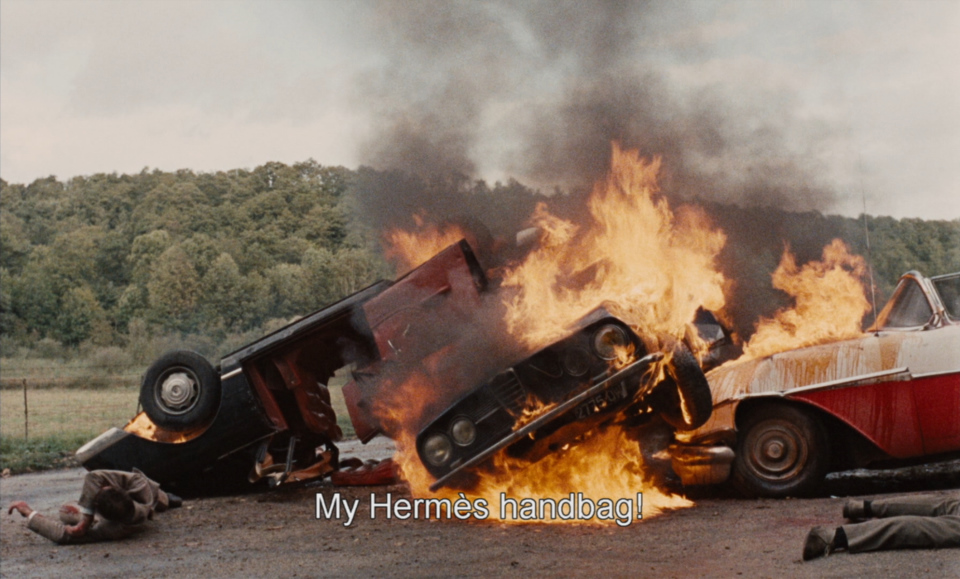
I think Baudrillard’s ideas relate entirely to the reader of the twenty-first century as we live in a society where so much emphasis is placed upon the importance of the aesthetic, and we tend to live so vicariously through film or image that our perception of the boundaries of our own reality can often become blurred and we find ourselves living a sort ‘simulation’ of ‘real’ life via a montage of borrowed realities from the media. We “consume signs of status” (365) such as cars and the latest technologies. Baudrillard’s idea of the automobile as the single gadget of solitude (360) also reminds me of another film; Weekend by Jean-Luc Godard, which is about a road trip undertaken by a couple who, on the way experience never ending traffic jams and car accidents. The road is often strewn with wreckages and bodies which they merely pass by, unnoticed and unfazed by the sight. At one point one of the protagonists asks another driver if this is a film or real life, and when he replies that it is a film, he doesn’t believe him. This illuminates the idea that the media of the twenty first century has constructed a perceived reality and distorted the consumer’s perception of it.
I would like to finish with another line from Sans Soleil, which also always chills me as I think it reflects how intrusive and powerful the media has become, perhaps even without society realizing. The narrator is talking of the comic book heroes painted on the walls in Japan: “And the giant faces with eyes that weigh down on the comic book readers, pictures bigger than people, voyeurizing the voyeurs.”
It was quite unnerving to read Baudrillard I found, especially his notion of the “hyperreal” (366) which would lend itself well to explorations of films such as The Matrix. Baudrillard claims that symbols and signs have come to replace reality and meaning within our current society, and that human experience is now a ‘simulation’ of reality. I find his claims resonate entirely with a film I saw by Chris Marker entitled Sans Soleil. The film addresses issues concerning memory and what our memories actually consist of and whether the death of ‘real’ memory has come about because of the invention of new technologies such as film and the photograph. In the film, the narrator recounts:
“Brooding at the end of the world on my island of Sal in the company of my prancing dogs I remember that month of January in Tokyo, or rather I remember the images I filmed of the month of January in Tokyo. They have substituted themselves for my memory. They are my memory. I wonder how people remember things who don’t film, don’t photograph, don’t tape. How has mankind managed to remember? I know: it wrote the Bible. The new Bible will be an eternal magnetic tape of a time that will have to reread itself constantly just to know it existed.”
I think Baudrillard’s ideas relate entirely to the reader of the twenty-first century as we live in a society where so much emphasis is placed upon the importance of the aesthetic, and we tend to live so vicariously through film or image that our perception of the boundaries of our own reality can often become blurred and we find ourselves living a sort ‘simulation’ of ‘real’ life via a montage of borrowed realities from the media. We “consume signs of status” (365) such as cars and the latest technologies. Baudrillard’s idea of the automobile as the single gadget of solitude (360) also reminds me of another film; Weekend by Jean-Luc Godard, which is about a road trip undertaken by a couple who, on the way experience never ending traffic jams and car accidents. The road is often strewn with wreckages and bodies which they merely pass by, unnoticed and unfazed by the sight. At one point one of the protagonists asks another driver if this is a film or real life, and when he replies that it is a film, he doesn’t believe him. This illuminates the idea that the media of the twenty first century has constructed a perceived reality and distorted the consumer’s perception of it.
I would like to finish with another line from Sans Soleil, which also always chills me as I think it reflects how intrusive and powerful the media has become, perhaps even without society realizing. The narrator is talking of the comic book heroes painted on the walls in Japan: “And the giant faces with eyes that weigh down on the comic book readers, pictures bigger than people, voyeurizing the voyeurs.”
