I am peer-reviewing abstracts for the Medicine 2.0 Congress in Toronto, September 4th and 5th. All of my favourite people will be there – why am I not going again?
 One of the best things I’ve done in recent years was take a sabbatical. It gave me a chance to step back, reflect and go outside my comfort zone. I found I enjoyed reading again, sitting and debating in classrooms about teaching and learning with people from other disciplines. Consequently, I’ve met people from across campus that I would otherwise not have met had I stayed in my hospital library. (Next year I’m going to conferences outside my area of specialization.)
As many of you know, I love interacting with kids and coaching sports. Understanding millenials and Myspacers helps me to get where information provision might go as students enter the health professions, and librarianship. I’m not justifying what I’m writing about these days, but there’s the theory. Enjoy the preprint. ~Dean
“Towards school library 2.0: an introduction to social software tools for teacher-librarians“.
by Jo-Anne Naslund & Dean Giustini
Abstract: This preprint is an introduction to the most popular web 2.0 learning tools for teachers and teacher-librarians. The authors supplement their discussion of social software by describing the major tools of web 2.0 and by illustrating how they are being applied in various school settings. Most importantly, the authors (both academic librarians) believe that social software is critical to learning in the digital age, and cite several major educators in this area to bolster their perspectives.
A number of these emerging tools impact “teaching, learning and creative expression within learning-focused organizations” (Horizon Report, 2008) and encourage collaboration, knowledge-building and collective intelligence (‘wisdom of the crowds’). In promoting web 2.0, we argue that teacher-librarians can play prominent roles in K-12 schools and raise awareness of relevant pedagogies for the iGeneration (Wikipedia, 2008). Many teachers have already dubbed this trend school library 2.0 (Harris, 2005).
 1. Speed loading (after desultory IE and Firefox speed). “if you want one of the fastest, safest, most convenience-loaded browsers available, go for Opera.”
2. UI – user interface (easy-to-use, navigate, and to manage your browsing & multitasking – wow, even Opera 9.5 Mobile)
3. Speed Dial (more speed, a handy frontpage for your most-visited sites)
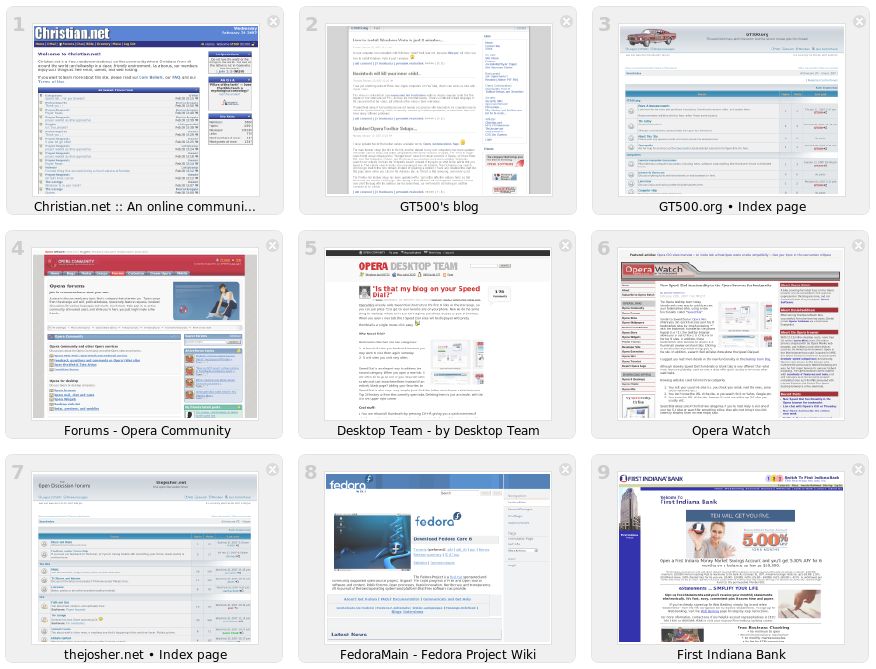
4. Security (anti-malware/ phishing features). According to Opera, 9.5 is “the first publicly-available browser to protect you from malicious software” assisted by Haute Secure, Netcraft, and PhishTank.
5. Looks (sleek, sophisticated, supports web standards (X)HTML, XML, XSLT, CSS etc.)
I’ve never used Opera as a browser – but the 9.5 version is seriously good.
************************
References
1. Clinical Cases blog – Ves Dimov on Firebox and Opera 9.5
I have consolidated what I have been able to track down about developments to Second Life for health librarians. A number of prominent names in this area are included: Guus van den Brekel, Carol Perryman, Patricia Anderson, and so on.
Let me know if I have overlooked anyone. ~ Dean
**************************
This brief snippet is from Alex Wright’s talk at Google in October 2007. I have to talk to this guy – Wright is, among authoring the NY Times piece “The Web Time Forgot“, also the author of Glut: Mastering Information Through the Ages, and holds a Master of Library and Information Science degree. How cool is that? dean
 This morning, my American friend Marcus Banks kindly sent me the link to today’s fascinating New York Times article entitled “The web that time forgot“. Written by Alex Wright (http://www.alexwright.org/), the piece sent my brain into overdrive this morning as I began to think about ‘the man who wanted to classify everything’ – Paul Otlet. I read through the article before attending meetings this morning, and couldn’t stop thinking about the piece and what I would eventually blog. (Bloggers can relate.)
One of the reasons for the brainstorm is that I have had a long fascination with the major thinkers in our field – and I take great pains to remind my students about them, as my teachers did with me. Great library ideas-men like medicine’s John Shaw Billings, the British Museum’s ‘Prince of Librarians’ Antonio Panizzi and classification/”Cutter number”.-man Charles Cutter. Often, members of the public point to Melville Dewey as a knowable, memorable librarian, but he is just the tip of the iceberg for those interested in reading about the many other icons.
One icon you may not hear about often (but one I remember Ronald Hagler mentioning at SLAIS) was documentation founder Paul Otlet. An international figure in information science between the wars, Otlet made an indelible mark on our field. However, he is remembered not for his ideas around organizing information as much as his lack of success in realizing his vision – which is aptly described in the NY Times piece.
************************
In the New York Times, Wright draws some very important parallels between the work of Otlet and the ideas that underpin Berners-Lee’s notion of the semantic web. This is an important but not altogether isolated revelation. The article made my head buzz with ideas and eureka moments after months of self-doubt around my thinking for a future, illusory web organized by librarians.
In the article, for example, Wright (http://www.alexwright.org/) writes:
 “I think Otlet would have felt lost with the Internet,” said his biographer, Françoise Levie. Even with a small army of professional librarians, the original Mundaneum [see photo left] could never have accommodated the sheer volume of information produced on the Web today.
“I don’t think it could have scaled up” Rayward said. “It couldn’t even scale up to meet the demands of the paper-based world [Otlet] was living in.”
What also seems clear is that Otlet’s version of hypertext has a number of important advantages over today’s ill-organized, everything-is-miscellaneous web. For one thing, Otlet’s vision was to develop better connections between ideas – think of these connections as smarter hyperlinks. Today, links on the web serve as a kind of ‘mute bond’ between documents. However, Otlet envisioned linkages carrying meaning through annotations of particular documents. That two-way interactivity is lacking in the weak logic of the current web, and librarians should work to change it.
************************
In retrospect, what is remarkable about Otlet is that he envisioned a world where knowledge could be linked and made available to anyone (what he called an International Network for Universal Documentation). He built what he called structured document collections that involved index cards filed in library-like cabinets according to ever-expanding ontologies. Indexers culled information from diverse sources and information retrieval answered written requests by copying relevant information from index cards. Light bulb – the semantic web!
Read the article. Some ideas are reminiscent of what Allan and I wrote here and here. It reminds me of the importance of standing on the shoulder of giants – and, to establish some understanding of the work of librarians that have come before us.
Uber Canadian health librarian Greg Rowell (who is a lot of fun, and a great colleague) and I have started the long process of redesigning LIBR534 – Health information sources and services. We started the UBC Health Library wiki about eighteen (18) months ago, and we are approaching a total of 700,000 page views, with almost 3000 views daily (and rising). Really, this is an astonishing number given our original goals.
Do we regret that we didn’t publish a book? Not at all. We feel pretty good about sharing the information we impart to student librarians, and we feel good about not hoarding information the way we used to do. We are also happy about providing Canadian perspectives on our work as LIS instructors, and practicing health librarians.
This weekend, I started a new entry on Major clinical studies & trial types which has had a huge amount of interest (700 views in two days). The idea behind this entry is to help LIBR534 students understand filters, and publication types by reviewing all of the major types of clinical studies. Is anything missing?
ps. Yes, preparatory to writing an article I am collaborating on with an American librarian colleague, I am doing some research into MMORPGs, and yes – the gaming entry is also being revised.
Categories
Medical apps on the Apple iPhone
Take note physicians and health librarians. This short six-minute section of Apple’s CEO Steve Jobs keynote from the Worldwide Developers Conference highlights just two (but important) applications for physicians.
1) Modality – Dr. S. Mark Williams, PhD, offers a quick demo of Netter’s atlases via the Apple iPhone.
2) MIMvista – Mark Cain discusses the excitement of medical imaging (radiology & rad oncology)
The links to these and other exciting medical applications are listed at the Apple iPhone for physicians wiki entry.
“Evidence-based web 2.0 (EBW2) is the integration of best evidence of social software use in promoting effective time/information management skills in the digital age. In addition to alloting time for experimentation, heuristics and ‘play’, librarians and information specialists will also want to systematically evaluate EBW2 and build a good evidence-base for the future effective application of web 2.0 tools.”
For a growing list of articles that potentially form the evidence-base for the effective use of web 2.0 tools, see this wiki entry.
Categories
SLA 2008 – ‘eavesdrop’ via Twitter
 I regret not gettin’ it together to go to the Special Libraries Association (SLA) Conference in one of the most beautiful U.S. cities – Seattle.
If you’ve never been to an SLA Conference before, it’s a massive affair with thousands of librarians from business, law, medicine and related areas coming together to share ideas and knowledge. The Biomedical and Life Sciences Section of SLA looks like a very active, jolly group.
In the absence of being there, why not check out the sla2008 – Twitter feed. How cool is that?? Several folks have been sending messages, telling me about sessions and who is presenting at the conference. The power of the social! (Read more about microblogging here.) Also, check out the SLA 2008 wiki.