Categories
Uncategorized

UBC Dermatology Research Day – Information Retrieval class

derm.jpgI was asked by Drs. Jan Dutz and Harvey Lui to present a session today on searching PubMed, and its close interface competitors such as OvidSP. Invariably, teaching Medline in its various incarnations puts you into Google and Google scholar, and true enough, that’s what happened today.

Why does Google scholar present old materials first? [Good question.] Why are the top cited articles on my topic listed further down the screen? Isn’t GS based on popularity, and citation counts? [All good questions].

With Google, there are few easy answers. What I can say is that Google is useful for certain specific kinds of retrieval work, and really bad for others. It’s fine as a browsing tool. It’s better than mother Google in that it points to peer-reviewed literature. It makes mistakes, its standards are poor, there are no sorting options to speak of – other than that, it’s highly consulted!

The point is that we can two-dimensionalize searching for health professionals by saying that you can either browse for materials or be precise and conduct targeted, specific searches. What’s your goal? What’s the plan? Conduct a trial? Apply for a grant? Better do a proper literature review.

Best line of the session? To the question: how many pages does Google crawl? I said, oh, about 500 billion or about the equivalent amount of debt from the Iraq war. That’s 1/2 trillion.

Too much information for physicians to sort through.

Categories
Uncategorized

Librarian Gary Price Is Out at Ask.com

ask.jpgSince 2005 when I began to blog, I’ve chatted to physicians, health librarians and educators from around the world. I’ve met some impressively talented people over e-mail and started friendships – and a great deal of debate online. I’ve met others from ‘beyond’ the blogosphere, and a few librarians working in the search engine field.

One regular librarian contact I have had is Gary Price, formerly of Search Engine Watch and, until today, Ask.com. Gary e-mailed regularly to tell me about Ask, improvements to its search capabilities and other news. I appreciated the inside scoop. Gary did outreach to the library community, and gave me at least two over-the-phone tutorials on using Ask. (I did like the image & blog search.)

But all of that ended this week. Ask is downsizing, and Gary is gone after two years. This is a loss but emblematic of the volatility of search companies. Gary carries on with ResourceShelf, and he’ll find another gig. Perhaps traditional library work again. Traditional library organizations should actively recruit librarians with search engine experience like Gary’s.

But this begs the question. Is the reverse true for librarians wanting to work in the search sector? What skills do they bring to the table? One of my goals as a blogger for 2008 is to continue to open up lines of communication with top search engine companies if only for the simple reason that so many doctors use these tools.

It seems self-evident to me that librarians and search engine companies should work together to improve web searchability. This is not just because our users like these tools but because we have to teach others how to use them (despite our occasional annoyance) in the context of our proprietary tools, like OvidSP and EBSCO.

I see Gary’s departure from Ask.com as a bit of a loss for librarians. But he gave Ask a valiant effort.

Categories
Uncategorized

More on Ubuntu – Access is about Caring

When I was taking my course on global/local learning, I did a post about the Ubuntu in libraries. Here is the paper I wrote about the creation of an Ubuntu operating system by the free and open software movement. I focus on a special implementation of the operating system in Tbilisi Georgia. Dean

Categories
Uncategorized

Top Ten (10) Things I Learned on Study Leave

fly.jpgI took a much-needed study leave in 2007. It’s hard to quantify how much I learned. However, I know many of you like some of the top ten lists, so here is one for the top ten (10) things I learned while on study leave.

**************************

Ten (10) Things I Learned on Study Leave

1. Librarians must find a way to embed themselves where users are working. A fine example is Eugene Barsky and clinical librarianship initiatives.

2. Librarians should team with open access advocates and OA faculty.

3. Due to the complexities of searching, and changing interfaces, librarians should offer cost-recovery information retrieval services.

4. I enjoy academic health librarianship – alot. Not everything is rosy but we fight on.

5. Given more freedom, I could articulate a vision for hospital library services and secure more million dollar donations.

6. Life is fragilesee video. It may be important to work less, love more.

7. Globalization is having a major impact on the academy, and librarianship.

8. Blogs, wikis and other ‘digital spaces’ should be considered legitimate learning spaces.

9. I blog, therefore I am. These folks agree with that notion.

10. More integration with the education faculty and the rest of campus needs to occur. Any future UBC teaching and learning initiatives should place educational theories and researchers high on the agenda.

Categories
Uncategorized

2007 Sabbatical Year In Review

Here is a synopsis of the 2007 sabbatical year. Enjoy – I did !!! Dean

Categories
Uncategorized

Search_Talk via Meebo

Chat with me, search with me, debate – I dare ya! (See Meebo far left) – Dean

Categories
Uncategorized

Blogging in Canadian academe

Interesting article and well-argued. Dean

Blogging in academe
http://www.ocufa.on.ca/AM_Feb08/FEB08-P16.pdf

Memorial University professors Dale Kirby [his blog] and Mary Cameron [her blog] explore the value of blogging in university teaching and research.

Categories
Uncategorized

Medical Chinese for Health Workers

What is medical Chinese? see our wiki entry

The purpose of basic medical Chinese is “…to help the medical interviewer learn to conduct a simple but thorough history and physical examination in Chinese. This includes a combination of words, simple phrases, and intermediate-level sentences, arranged under sections for taking a medical history and for physical examination, as well as a glossary of body parts/organs and common diseases. Some knowledge of basic Chinese is helpful.”

So how is your basic medical Chinese?

Categories
Uncategorized

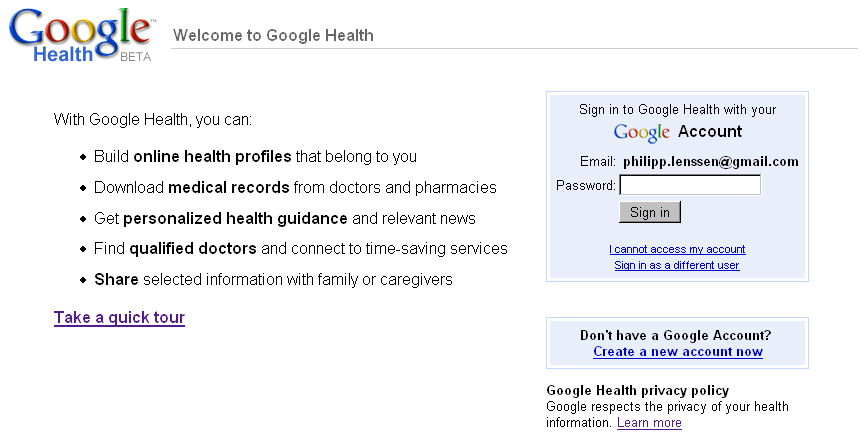
Google health won’t fly in Canada

In our recent web 3.0 paper, Allan and I discuss Google Health and Microsoft’s HealthVault within the context of access to patient health records. Making patient records available online is very much a Health 2.0 issue but we argue that both proposed systems are emblematic of other things, such as compromised privacy in web 3.0. Don’t worry Canadian health consumers, I doubt whether the Google initiative will work with our healthcare system here in Canada.

In any case, here is Google’s CEO Eric Schmidt in his Feb 28th keynote presentation at the Healthcare Information and Management Systems Society conference (HIMSS) in the United States. It’s an interesting business decision to move into the electronic patient record game and will prove a lucrative ad-space if it gets off the ground. It’s still unclear to me how it will work outside the U.S., if at all.

In public health systems, who owns health records? Do we own x-rays, blood tests and psychiatric records in a universal health care system? If we don’t – who does??

Categories
Uncategorized

Clay Shirky On The Wisdom of ‘Everybody’

shirk.jpgSeveral years ago, I read Clay Shirky‘s anarchic take on ontologies. One item called Why Ontologies are Over-rated had me nodding in agreement at the shortcomings of higher-order tools like classification schemes and ontologies. (New to Shirky? see his many writings here.)

My sense is that Clay Shirky is best described as an interactive telecommunications critic than proselytizer for/of social technologies. While he uses social technologies a lot and is interested in the social processes that accompany their adoption, he is critical of their application to learning contexts; however, he is not without his Buckleyan flights of erudite reductionism. In other words, Clay Shirky has his share of detractors.

Shirky has a new book out on the power of us entitled – Here Comes Everybody: The Power of Organizing Without Organizations – in which he points out that the digital age has provided us with the tools to collaborate without those nagging hierarchical structures that inhibit intellectual freedom. The wisdom of everybody. By examining philosophical, sociological, economic and statistical theories of the information age, he points to its major successes and failures. Some of the real doozies, according to Shirky, have been in web 2.0 and social software.

In web 2.0, grassroots activism is one of the big winners – Belarus’s flash mobs, for example, is a group that blogs their way to unprecedented anti-authoritarian demonstrations. User/contributor-managed Wikipedia raises the bar for production efficiency by throwing traditional corporate hierarchy out the window. Print journalism falters as publishing methods are transformed through the Web.

And I’m digging Shirky’s deconstruction of Web failures such as Wikitorial, which was the Los Angeles Times’s attempt to facilitate group op-ed writing. I agree with the book jacket’s assessment that Shirky has a keen eye on what makes or breaks group efforts in the digital world.

Shirky also blogs at many2many, a rather hip think-tank blog featuring megawatt media stars like Weinberger and danah boyd.

Spam prevention powered by Akismet