Categories
Marketing Blog

INTRO TO THE REAL WORLD

As my second year winds down and my stress levels wind up I often find myself being asked to look back upon the brief school months that have passed. In between anxiety attacks about the onslaught of exams, I realize how quickly I actually get to glimpse each of my courses. It feels as though I was just settling into the routine of my marketing class; getting to know my team and classmates, and then ‘bam’ – its over. As the finality of it settles in,  I’m asked to reflect on experiences and pages and pages of information jam-packed into three short months. It’s in these moments of calm before the panic where I’m quite proud of myself, my classmates and what we’re able to accomplish; everything that we’ve managed to learn and everything that Tamar has managed to teach and communicate.

I was planning on going into marketing since the start of this school year. I felt that I would find the most joy pursuing something with creative flair and connection to human nature and psychology. Intro to marketing with Tamar just confirmed that I was making the right decision. The final group video assignment was the most fun I’ve had in regard to a school project since I landed myself in University. Being able to collaborate creatively with my group, better understand the marketing mix and how to actually analyze a true, functioning-in-the-real-world business was, call me crazy, engaging and entertaining.

Knowing that the assignments given in this class are a reflection of what I may potentially be doing in the future gives me great relief. To know that I can actually enjoy my work and apply the concepts that I’ve learned in marketing, such as the 4P’s, to existing businesses that impact my daily life, almost makes every late night textbook foray and online submission scramble, incredibly worth it. Thank you Tamar, for one of the best University courses I’ve experienced so far.


Categories
Marketing Blog

THE CALCULATING MATHEMATICS OF TOBACCO MARKETING: ETHICS & MORALITY NOT PART OF THE EQUATION

50 MOST CREATIVE ANTI-SMOKING ADS

The Boards of Directors of all the major tobacco companies are in the business of making a profit for their shareholders; their continued employment and bonus awards depend upon it.

The cigarette industry spent $8 billion on advertising in 2010, most of which lured the youth market into future addictions. 1

Worldwide, 5 million people die prematurely of tobacco related diseases.1

In societies which set a high premium on freedom of choice, any attempt to restrict the consumption of any product which has been previously unrestricted would be perceived as heavy handed government interference and could have serious political implications.

Despite its predatory nature, tobacco marketing retains a unique grip on American society. It is highly unlikely that a politician who has been voted into office to represent the best interests of his tobacco growing electorate would support heavy taxes and marketing restrictions on their only source of income.

It has taken many years of doggedly exposing the dangers of tobacco use by concerned health groups to raise public awareness and the relatively recent levying of heavy excise taxes to make inroads into the status quo.

If the threat of death isn’t enough to curb the marketing leverage of the tobacco industry, is a sin tax the only answer?

It would seem to be the height of hypocrisy to exact taxes and damage settlements from the industry responsible for the problems while continuing to allow them to stay in business but, as with alcohol, prohibition doesn’t work.

Unfortunately our governments have become heavily addicted themselves. Without the massive infusions of tax money from tobacco and alcohol, we would have difficulty reducing debt and balancing budgets without these golden geese.

It strikes me that the key is to out market the marketers.

The recent incursion of no-nonsense counter advertising from vested health groups may be the strongest medicine. Smoking skeletons and humorous commercials depicting young, intelligent, non-smoking adults seem to be making headway. But as North Americans advance toward more informed decisions, it will be the developing nations who will need to make sense of the math behind tobacco marketing.

Every eight seconds a smoker dies. Those numbers don’t lie and honesty in counter marketing could be the only formula to significant change.


Commenting On A Classmate’s Blog

Lauren Telford 

1 CDC. “Fast Facts”. USA.gov. December 18, 2012.

Categories
Marketing Blog

THE STINK OVER DIRTY BALLS: AXE & ANARCHY

Unilever’s wildly successful, research driven and slightly scandalous marketing campaign has thoroughly captured the novice male consumer and promoted a sexy brand that has not only secured a halo effect for future brand buying with the males of this generation, but is now winning over their girlfriends.

Axe quickly became the No. 1 male brand in the total antiperspirant/deodorant category, earning Unilever $71 million in sales…($50 million more than its closest rival, Tag) and $186 million (excluding Walmart sales) in 2007, an increase of 14 percent from a year  earlier — which was leagues ahead of its nearest rival.1

But has Axe done too good a job at ‘tapping’ the market?

Research confirmed that young males are basically horny-nothing new here-but the Unilever market researchers also ”…isolated six psychological profiles of the male animal — and the potential Axe user…”.1 Equipped with this intelligence, Axe set about exploiting the ultimate guy fantasy of being irresistible to not just one adoring female, but a flock of sexy, mesmerized women. An unassuming waft of tantalizing Axe body spray can secure scrawny neophyte males mobs of oober attractive bikini clad Amazonian women, as long as the winds were favorable.

Axe’s early ads were so funny, so evocative and so successful at transforming the nerdy college dweeb that the brand took a sales hit because Axe essentially became the brand for ‘losers’. The nimble team at Unilever managed to broaden its pitch however, enabling them to win over the larger college male populace.

However, having so thoroughly grabbed the attention of its consuming male audience, it has also grabbed the attention of a few girlfriends screaming sexism.

From washing dirty balls to headless busty caricatures, Axe has pushed a few limits. Objectifying women has become a negative for Axe but the dexterous marketing team are again adapting. With a 74% share of the male deodorant and body product market, Axe is now going after the girlfriends.

AXE’S NEW ‘ANARCHY’ COMMERCIAL

Axe recently launched ‘Anarchy’ for men and women. The hilarious pitch has men and women wreaking mayhem as they roam the streets, randomly setting trees ablaze with their pheromone heat and triggering multi-car pile ups. It seems anything men can do, women can do better and this approach seems to be calming some of the sexist uprising.

Sex does continue to sell, and so does humor, and it would seem that the stink over Axe is the sweet perfume of marketing success.

Commenting On Another Blog

Maha Atal. “Axe’s Super Bowl Ad Fail: When Sexism Doesn’t Sell”. Forbes. February 4, 2012.

1Martin Lindstrom. “Can a Commercial Be Too Sexy For Its Own Good? Ask Axe”. The Atlantic. October 24, 2011.


Categories
Marketing Blog

TAKE TWO AND SUE ME IN THE MORNING


The Bayer Corporation, Johnson & Johnson, Bristol-Meyer, Merck, Astra Zeneca, Pfizer and Abbott Laboratories all have two things in common; they are all being sued for a cornucopia of ailments including recalls, failures to warn, birth defects, wrongful deaths, and  contaminations AND they’re among the most lucrative global pharma net earners in existence.

How can these lawsuit recidivists not only still be in business, but still be making the whopping big bucks?

Well Houston, we have a problem.

Pharmaceutical companies have cultivated and profited from the exploitation of a self perpetuating N. American addiction to prescription medication. This addiction wells from a collusive marketing campaign targeted at your own doctor and played out in your own family clinic.

Gwen Olsen, a former prescription sales rep blows the whistle on Big Pharma in her book, Confessions of an Rx Drug Pusher. Olson states plainly that major companies systematically solicit doctors with an aggressive marketing infrastructure so that patients essentially become captive consumers. Not only are doctors solicited, they are given incentives for every prescription pushed.

An article from The Economic Times by Gauri Kamath reveals that,

… pharma companies…shower doctors with lavish gifts and sponsor foreign trips…to exotic destinations as part of their brand-promotion efforts, thus influencing their prescribing behaviour.

Pharmaceutical companies, doctors and patients have settled their codependent brains for a long winter’s nap-with a heavy reliance on sedating Benzodiazepines and a generous chaser of denial.

It boggles me how these guys not only make money hand over fist off widespread legalized addictions, they survive repeated litigation over irresponsible FDA approved prescriptive malpractice that lay waste to real people in real ways, and they continue to sell themselves as successfully as they exploit their market.

No one seems to bat an eye. I guess that’s not listed as one of the possible side effects.

When Doug Bremner asks, “What is going on here?”1  …I concur.

Commenting On Another Blog

1Gauri Kamath. “Government drafts official code of marketing practices for pharma industry”. The Economic Times. June 4, 2011.

2Doug Bremner.“Does America Have a Prescription Drug Problem?”. The Huffington Post. November 25, 2011.

Categories
Marketing Blog

LAUNDERING LIES

Greenwashing businesses may take a bath. Products claiming environmental compatibility to assuage consumer consciences have mushroomed as quickly as carbon gases over China. Just when you thought American businesses were waking up to the screaming need for global stewardship, the stats start talking back.

Scott McDougall, president of TerraChoice, an environmental marketing firm based in Ottawa reported earlier this year that,

 …the number of “greener” products on store shelves has risen by 73 per cent since 2009. However, only 4.5 per cent of green products are what TerraChoice calls “sin-free”, while the rest commit “sins” that range from vague labelling and citing irrelevant facts to fibbing and outright fakery…1  

McDougall goes on to say that some manufacturers even have their art departments mock up authentic looking green certification labels and apply them to their products assuming that consumers won’t read the fine print or sweat the company’s website. But there may be hope as the horizon heats up.

With awareness affiliations like TerraChoice, greenwashing violators increasingly on the hook for civil lawsuits and the recent Green House Gases Inventory Report publishing European successes and American failures, businesses might be forced to clean up their practice. Worth considering right now if you’re worried about getting scammed by the greenwashers is Iphone’s GoodGuide application. The app enables you to scan a product barcode to confirm its green legitimacy on over 120,000 products. Now that’s the kind of accountability a smart consumer can rely on.

It comes down to consumer intelligence. If we care about what we consume, we won’t get washed. With over 350 eco labels on the market, reading the fine print and ‘buyer beware’ continue to be the savvy consumer mantra

…and hey, there’s an app for that!


Commenting On Another Blog

1 Mary Gooderham. “Beware the deadly sins of ‘greenwashing”. Special to Globe and Mail Update. September 6, 2012 11:11AM EST
Categories
Marketing Blog

FOOD FOR THOUGHT

Some days I would just kill for a Quarter Pounder with Cheese. McDonalds truly has mastered fast-food perfection; but I haven’t eaten in one of their restaurants for years. After watching just part of ‘Supersize Me’, I was completely put off fast-food. The truth of fast-food restaurants over the years has slowly been revealed, yet the likes of Mcdonalds, Burger King, Wendy’s…are all still wildly successful. Why?

Globally, there are more than 1 billion overweight adults, at least 300 million of them clinically obese. Obesity rates have risen three-fold or more since 1980 in some areas of North America, the United Kingdom, Eastern Europe, the Middle East, the Pacific Islands, Australasia and China.”1

In the book ‘Fast Food Nation’, Eric Schlosser states that $240 billion are being spent annually on health care costs in the United States.2

Correlation? I think yes.

McDonalds started in the 1940s but experienced incredible growth during the 1970s.3 With more and more people ‘on-the-go’, what better place to snatch a snack in 5 minutes or less than at Mickey D’s? But with so much information out about the importance of healthy eating and the risks of consuming unhealthy ‘Happy Meals’, why are people still eating McDonalds? It couldn’t be the advertising, could it?

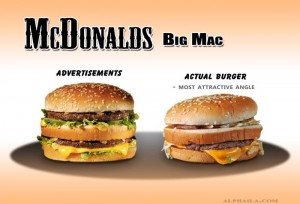
It seems I’m only tempted by fast-food chains when I see those juicy commercials on TV. When I actually see a real-life McDonalds burger, it doesn’t look even slightly similar. Recently, McDonalds has created a website ‘telling the truth’. Customers ask the questions, and they answer…truthfully. Here I was able to see the complete process of how the photograph their burgers for commercials. It was disconcerting learning about the time, effort, and money put into making a burger look so good. I didn’t even realize there was a job out there for ‘Food Stylists’.

With the obesity count rising, as well as the cost, it seems to me like McDonalds is bordering on some ethical issues. Dressing up their food, rumors about trick wording such as 100% Beef which is actually just the name of the company, and claiming their salads are healthy when their dressings are chalked full of preservatives and fat, it’s all rather deceitful. With people’s lives at risk and nations’ money being used up when there are so much larger issues to be resolved, why are we still allowing McDonalds to feed us fries…and lies?

Check out McDonalds’ truth


References

1,2http://www.worldometers.info/obesity/

3http://en.wikipedia.org/wiki/History_of_McDonald%27s

http://abcnews.go.com/blogs/business/2012/03/its-100-percent-beef-company-on-defensive-as-it-closes-plants/

Spam prevention powered by Akismet