Categories
Uncategorized

Canning fish

Canned fish is common today — it is cheap, easy to transport, pre-cooked and easily procured.

However, it is less commonly made in the home, according to Mrs Andrea. The most important point to note, she suggests, is that “fish should never be canned if there is the slightest doubt of its being fresh.”

A short chapter, the only two entries are for lobster and generic pickled fish. Lobsters have always been a delicacy, regardless of country, period or use — and today it is near impossible to find any sort of pickled, canned or preserved lobster meat. Mrs Andrea dissects how to best dissect the lobster — which you must buy live and cook in salted water.

Exact quantities of jars and water needed, and time taken are not listed in this section, as it is likely to depend on the weight of the fish used. It is doubtful that anyone would want to go through this process today in order to make some canned fish — but interesting to see how it was, even in 1915, considered an essential and common way to consume fish.
Categories
Uncategorized

Canning soup

Soup is easy to make — I know it, and can be backed up by Mrs Andrea. She offers recipes for different meat stocks, and uses these as a base for all recipes. Even the vegetable soups use beef stock, which brings to mind questions about vegetarianism and its lack of prevalence during this period, at least purposefully — many individuals became vegetarians by default due to the effects of war.

However, vegetarian cookbooks did begin to surface in the late 19th and early 20th centuries in America. Many include a meat substitute invented by John Harvey Kellogg — protose. Apparently, this consisted of a unique mixture of wheat gluten, peanut butter, onion and herbs.

As expected, soups are easy, and the chapter goes into little detail — it essentially calls on the cook to improvise with any meat or vegetables that they may have lying around in their kitchen.

Categories
Uncategorized

Canning with honey

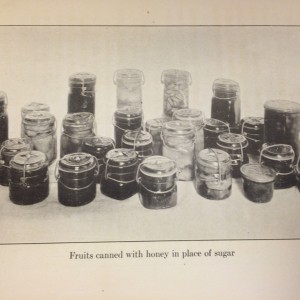
This is another of the few chapters that include photos — this time of fruits canned in honey in place of sugar. Photos are printed on thicker, shinier paper which is reminiscent of card stock.

honey

This chapter introduction brings the reader to the exact timeframe in which Mrs Andrea was producing this book — she refers to “the sugar shortage last year” on page 120, and goes on to say how she is “greatly indebted to the busy bee.” This tone of voice is exactly how somebody’s grandmother might speak when cooking with a grandchild, and is part of the book’s charm.

Mrs Andrea acknowledges that honey is more expensive than sugar, and to combat this she watered down the extracted honey to provide a lighter, more delicate flavour. She also talks of beekeeping — apparently a common pastime during the war, and suggests that sugar shortages would only be becoming more prevalent over time, which according to Mills and Rockoff, was indeed the case — rations were diminishing by up to 50 per cent and imports were becoming limited.

Mrs Andrea states that, like everything during the war, honey had gone up in price from 30 to 40 cents per pound. To a reader today, this still seems like a lot.

Categories
Uncategorized

Syrups and beverages

Another short chapter, this is one that I would love to try making all the recipes from — they include ginger beer, elderberry wine and pineapple syrup.

According to Mrs Andrea, the purpose of a syrup is to make sure of the fruit that is not in a perfect condition. This way, no fruit is wasted — one can even use the parings and the cores of a pineapple for a syrup.

The instruction for several recipes in this chapter are vague — perhaps assuming the maker of the elderberry wine will know how long it needs to ferment for. It also seems to need to take up a lot of space — a “barrel or a keg” — which would certainly provide difficulties for individuals living in a smaller residence in a city, for example.

It is interesting to note the vast difference here in timings — sometimes the instructions require an exact 30 seconds between each addition of fruit or sugar, but sometimes Mrs Andrea suggests leaving it “for three or four days,” for example. Sometimes the exact quantities of everything must be perfect, to the gram, but sometimes sugar can be added or left out, as per the chef’s taste.

It seems interesting how many of these recipes take the form more of an old family tradition, that one would have learnt from generations before them. Mrs Andrea’s scholarly training goes against this tradition, yet she is communicating in a personal manner, using anecdotes and stories to make her book not only a source of instruction, but an entertaining read.

Categories
Uncategorized

Pickling

Pickling is one food preservation technique that many people still carry out today. Even in student-aimed recipe books, instructions are provided for making kimchee and sauerkraut, both of which use pickling techniques.

This section has a comparatively small introduction relative to the sheer amount of recipes — all of which are similar, using the vegetable, a form of cider vinegar — now considered a modern “superfood” (sometimes diluted), mustardseed and brown sugar.

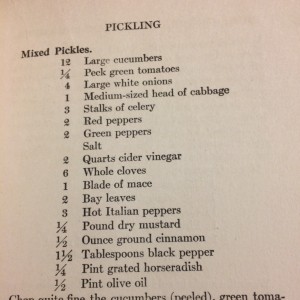
The “mixed pickles” recipe has a long list of ingredients, as it essentially combines every other recipe from the chapter.pickling ingredient list

The entire recipe takes more than three days, as it involves repeating a vinegar rinse, cooling, placing in jars and standing.

Categories
Uncategorized

Jellies

Jelly making is an art, according to Mrs Andrea.

Reading the recipes in this section, what this recipe book calls a “jelly,” I would have grown up calling a jam — the section brought to mind memories of trying our hardest to make strawberry jam in our kitchen, using pectin and burning the fruit so it stuck to the bottom of the pot. Mrs Andrea doesn’t offer a solution to this — but apparently prevention is the best cure.

This section introduction is again, very conversational — perhaps reminiscent of a Nigella Lawson show on TV. Mrs Andrea references the housekeepers of “years ago,” and “our mothers and grandmothers.” She also references cultural myths — apparently current jelly should never be made before the Fourth of July, as the currents become ripe after that and so are abundant in pectin.

Even before the recipes begin here, Mrs Andrea offers step-by-step general instructions for the delicate process of jelly-making. She compares her methods to other authors on page 83, and writes of her experiments in crab apples from the previous summer. This section reads rather more like a journal entry, more personal than the brisk tone we heard earlier.

Categories
Uncategorized

Fruit butter

This chapter is just two pages long, but interesting as a “fruit butter” is perhaps not something we are accustomed to seeing or making. Mrs Andrea begins by saying:

“This is a popular way to do up fruit, especially useful where school lunches are to be prepared.”

The acknowledgement of the fact that these are not “essential” methods of cooking here is interesting — she writes that they are generally made for providing some variety. There are three options for recipes here, and in all of them the sugar quantities are variable, depending on how sweet the fruit is, whether it is in season, or how the cook likes their fruit butter to taste. It is a lot freer than some of the other recipes previously.

The three recipes in the chapter are for apple butter, apricot butter and peanut butter. The peanut butter required four quarts of each unroasted Virginia peanuts, and four quarts of unroasted Spanish peanuts — but I am sure it would work with either.

I ended up making the apple butter at home with my roommates — as one of the simpler recipes in this lengthly, wordy cookbook, it definitely had to be done. The butter tasted like autumn in a spread, and we demolished several jars within just two weeks. It was more labour-intensive than we initially anticipated, but the stirring was a good way to pass the time.

Categories
Uncategorized

Conserves, jams, marmalades, preserves and sweetmeats

This chapter is 19 pages long, and is stained several times with black ink from a fountain pen, as if to mark the particular recipe — for example the “Golden Gate Marmalade” on page 65.

The high quantity of fruit here must be noted. For example, the aforementioned marmalade calls for 12 oranges, three pints of cold water for each pound of fruit, and half a pound of sugar to each pound of cooked fruit. While people used home preserving and canning as a method to save money, this seems rather expensive, especially if you consider individuals living in the Pacific North West, where the climate does not allow for many locally-grown citrus fruits.

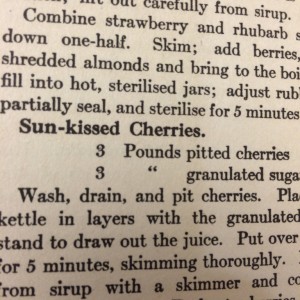
One recipe in this section is for “sun-kissed cherries.” The recipe actually calls for the heated cherries to lay out in the sun for 12 hours, which doesn’t seem like something that would be written in a contemporary cookbook today.sun kissed cherries

Although these recipes at first appear “hands-off” and simple, they all require close attention, timing, and multiple steps. The absence of step-by-step instructions means that the paragraph style of the page provides a more difficult estimate for the labour process.

The chapter ends with the line:

“Any combination of fruits may be used in same way.”

Essentially, the detail provided in the chapter could be considered redundant, but is useful for creative ideas.

Spam prevention powered by Akismet