Categories
Uncategorized

Drying fruits and vegetables

Another old method of food preservation, Mrs Andrea begins her chapter with an anecdote about her grandmother not knowing the dangers of bacteria when drying out apples in her garden shed. Dried fruit is still today a very common way to consume out-of-season produce, and many consider it a healthy candy alternative.

Mrs Andrea suggests two methods of drying — firstly to purchase a food drier, and secondly to use the sun. This would certainly be seasonally and geographically dependent. She also includes a photo of three styles of fruit and vegetable driers.
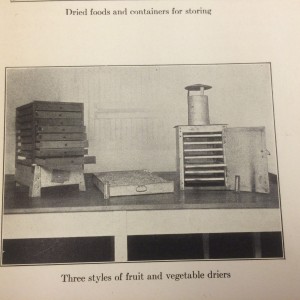
driers

A tip is offered in that one is recommended to not use the chicken incubator to dry fruits and vegetables. This begins to sound like a parody in tone, but Mrs Andrea remains completely serious.

Fruits recommended to preserve by drying include cherries, berries, apples, pears, peaches, plums and apricots — all standard fruits bought and consumed today.

Mrs Andrea closes her book by suggesting one exercises care over “troublesome insects,” which may be prone to laying eggs on the fruit. She suggests using a thin cheesecloth as protection.

Categories
Uncategorized

Salting Vegetables

This penultimate chapter begins with the advantages and disadvantages of salting as a preservation method for vegetable products — as one of the oldest ways  of preserving vegetables, it is flexible and requires very little hands-on attention.

One can use any container when salting, and Mrs Andrea suggests that the method is best saved for a “case where there should be a scarcity of glass and tinware,” a rare moment of comedy in this recipe book.

Her methodology is applied to all vegetables, and is followed by a sauerkraut recipe (a cabbage very much in vogue with the health-conscious society of today) which uses a total of 50 pounds of cabbage, a period of two to three weeks to cure, and one instruction to “remove the scum.”


Categories
Uncategorized

Canning meats

Mrs Andrea’s chapter on canning meats begins with a warning:

“In no kind of canning is it more important that each step in the process be carried out promptly than in canning meats.”

Returning to her conversational style, she suggests that “if you have a farmer friend find out when he is planning to market his cockerels and buy some.” Note here — “some” rather than a certain quantity or weight, and the assumption that one will indeed have a farmer friend.

Mrs Andrea’s scientific knowledge comes through here — she emphasizes the absolute importance of sterilizing meat and fish.

“It is so essential that it is better to over-sterilize than under-sterilize,” she writes.

The meats used in these recipes seem to me, strange specifics to be used for canning. Examples include roast pork and sausages — meats which are doubtless better eaten as prepared rather than out of a jar.

Spam prevention powered by Akismet