In early February 2011, a move seen as a chance for redemption for AOL by some and also a move that makes no sense to others, AOL acquired Huffington Post and puts the combined companies in a position to command over 250 million unique visitors online globally. AOL is currently fading in its dial-up Internet services and is trying to re-establish itself as a media empire that is already made up of MapQuest, AOL Music, Engadget, TechCrunch, and other well known media platforms. Huffington Post is one of the top 10 online news companies and boasts a large online visitor base of over 25 million monthly viewers and blog posts by celebrity contributors (who post for free) such as Bill Gates and Barack Obama.
According to Ben Parr, author of the article “AOL’s $315 Million Bet: “The Huffington Post” Will Make It Relevant Again [OP-ED]” states: “Until today, AOL has been a disorganized collection of media entities that weren’t strong enough on their own to truly transform AOL into a media powerhouse.”
“The acquisition of The Huffington Post will create a next-generation American media company with global reach that combines content, community, and social experiences for consumers,” said Tim Armstrong, Chairman and CEO of AOL. “Together, our companies will embrace the digital future and become a digital destination that delivers unmatched experiences for both consumers and advertisers.”
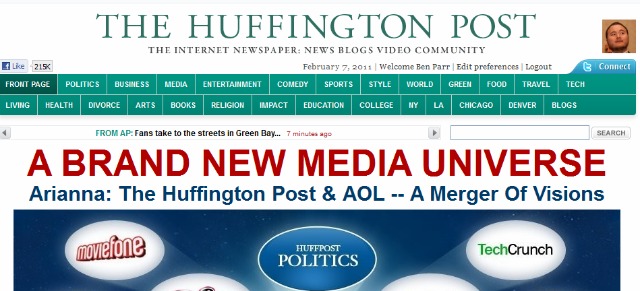
Arianna Huffington went on to state, “The Huffington Post will continue on the same path we have been on for the last six years – though now at light speed – by combining with AOL. We are fusing a legendary and powerful new media brand with [an] innovative news organization, known for its distinctive voice [and] highly engaged audience.”
It can be identified from what Armstrong and Huffington are voicing is that there is a goal to create a large community of visitors who go online to access interactive content. Where there are online visitors, there is also an opportunity to make money through online paid advertising. AOL has been using this knowledge to try and reinvent itself; however, passed acquisitions of MySpace, Friendster, and others have been deemed as failures, we will have to wait and see if AOL has learned from its past failures and make itself relevant, especially since online media is even more competitive than before.
With a huff and puff, AOL Inc. acquired Huffington Post
In early February 2011, a move seen as a chance for redemption for AOL by some and also a move that makes no sense to others, AOL acquired Huffington Post and puts the combined companies in a position to command over 250 million unique visitors online globally. AOL is currently fading in its dial-up Internet services and is trying to re-establish itself as a media empire that is already made up of MapQuest, AOL Music, Engadget, TechCrunch, and other well known media platforms. Huffington Post is one of the top 10 online news companies and boasts a large online visitor base of over 25 million monthly viewers and blog posts by celebrity contributors (who post for free) such as Bill Gates and Barack Obama.
According to Ben Parr, author of the article “AOL’s $315 Million Bet: “The Huffington Post” Will Make It Relevant Again [OP-ED]” states: “Until today, AOL has been a disorganized collection of media entities that weren’t strong enough on their own to truly transform AOL into a media powerhouse.”
“The acquisition of The Huffington Post will create a next-generation American media company with global reach that combines content, community, and social experiences for consumers,” said Tim Armstrong, Chairman and CEO of AOL. “Together, our companies will embrace the digital future and become a digital destination that delivers unmatched experiences for both consumers and advertisers.”
Arianna Huffington went on to state, “The Huffington Post will continue on the same path we have been on for the last six years – though now at light speed – by combining with AOL. We are fusing a legendary and powerful new media brand with [an] innovative news organization, known for its distinctive voice [and] highly engaged audience.”
It can be identified from what Armstrong and Huffington are voicing is that there is a goal to create a large community of visitors who go online to access interactive content. Where there are online visitors, there is also an opportunity to make money through online paid advertising. AOL has been using this knowledge to try and reinvent itself; however, passed acquisitions of MySpace, Friendster, and others have been deemed as failures, we will have to wait and see if AOL has learned from its past failures and make itself relevant when almost all other online media companies are trying to leverage themselves to have the largest visitor base themselves.