Categories
Uncategorized

Web – Destined to be King as News Source?

The internet is taking over as a news source for adults.

A research report released by Pew Research Center shows that the internet now only lags television as the source for news for adults in the United States. Newspaper viewership has been bumped down. It seems the time is ticking for companies that are solely relying on newspapers as their source of revenue.  While other media channels were able to make gains in revenue in 2010, newspaper revenues fell (read more…).
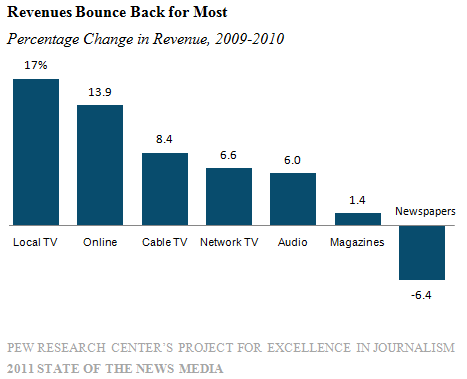
What is surprising however, is that television was able to increase its revenues despite having the largest decrease of news viewership.

While the information about television from the above two graphs may seem contradictory (shouldn’t revenues shrink with a shrinking audience), the increase in revenues for television can be explained by the fact that they were largely helped by the bail-out of the auto sector in 2008; much of the auto sector’s advertising was done through television. As audiences continuously turn to the internet, it is not unreasonable to assume that the auto sector will begin to focus their resources on that medium. Time can only tell exactly when the internet will become the king as a news source, but it is inevitable of all the content and convenience the web has to offer.

The significance of the Pew Research Report is that the shift to the internet combined with the increasing online presence of social media and mobile use will mean that the way that journalism is reported and marketed may have to change. Social media is a marketing system in itself, and it has become quite apparent that people in networks, market to their networks, information that they find interesting. Furthermore, this occurrence is significantly enhanced with the ability of people to access the internet from their mobile. Finding out about news anytime, anywhere, will amplify the requirement for news media companies to be the first to report, and the news must be appealing to gain the attention of internet users from the infinit amount of online content. In addition, news will have to be readily accessible, and just like any content on the web, Search Engine Optimization, and Social Media Optimization will have to be amongst the primary goals of the news media.

Categories
Uncategorized

Microsoft makes a blunder with Bing on Japanese Earthquake, then apologises

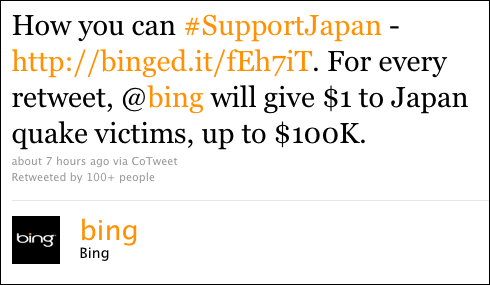
In response to the March 12th Japan 8.9 magnitude Earthquake, Microsoft announced that it would donate $1 for every retweet to one of Bing’s twitter posts. The original post said, “How can you #SupportJapan — http://binged.it/fEh7iT. For every retweet, bing will give $1 to Japan quake victims, up to $100K.” Yes, Microsoft limited it to only $100k, and users of social media quickly responded negatively and backlashed against this capaign by expressing their dislike of the use of a tragedy as a marketing campaign.

YouTube Preview Image

A few hours later, Microsoft responded with a public apology and a promise to donate $100k stating “We apologize the tweet was negatively perceived. Intent was to provide an easy way for people to help Japan. We have donated $100K.” Read more.

By quickly issuing a public apology and not pretending that no wrong was done, Microsoft showed that it listens to its followers, and was therefore able to mitigate the damage that it itself has caused.

Companies that have poor reputation management, and low levels of social monitoring often do not realise how the public perceives them and their products. In today’s age, where marketing is strongly about pulling customers rather than pushing products towards them, a company that is negatively regarded often fails. Microsoft’s apology clearly displays that the power is actually with its customers.

Update: Microsoft Pledges $2 Million In Japan Quake Aid: “Company will donate $250,000 in cash and $1.75 million in free software and services that can be used to reestablish communications.”

For more information on social monitoring, click here.

For more information on reputation management, click here.

Categories
Uncategorized

Social Media as a self-learned Disaster Response System


Social media seems to be a self-learned method for disaster response. In the wake of the Japanese 8.9 earthquake that happened on March 11th 2011, the power of social media cannot go unnoticed. Individuals and families within the areas of the

disaster are able to tweet about their safety and status, can ask for help and

Lee Jae-won / Reuters

resources, point to areas that were more seriously affected and more. However, the difference that social media makes over other traditional media is ease of access and

immediacy. Social media allows one to quickly communicate with the people they feel can help immediately, or take the necessary action to help; I underline feel because it may not be the most effective method available at the moment, but I also think it can be. Many people in Japan are already showing its effectiveness through tweets using Twitter.

There was an incident in 2009 where a couple of young girls were trapped in a stormwater drain and used Facebook to get help by updating their Facebook status.  A friend of theirs read the status and contacted help. (Read more…)

If the girls were able to use their mobile to update their Facebook, why not call for help instead?

That same question was raised by the Metropolital Fire Service, as well as Terry Flew, a professor of Media and Communications at the Queensland University of Technology. Flew explains that public education campaigns are facing an ongoing struggle to compete with social media.

There is no clear answer to the question, but I think that the struggle against social media should stop; it should be embraced as a method for to bring relief; as Flew states, “clearly it’s not good enough to say ‘well they should have rung emergency services’, the point is that they didn’t, and we need to think about why that’s the case and what strategies can be used in the future.”  A simple emergency relief tab on Facebook, Twitter, mySpace that is monitored by emergency sevices is a possibility, and even a community relief page are simple ideas that I think should be considered.

Further comments and ideas about this would be greatly valued.


Categories
Uncategorized

Paid Search – why bother?

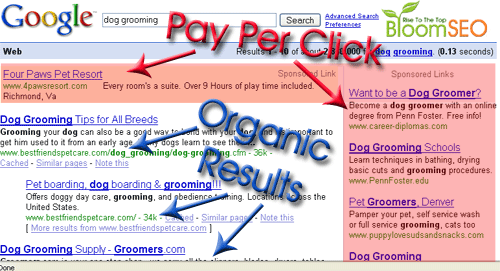
Organic search results are listings on a search engine results pages that appear because of their relevance and quality to the search terms entered as opposed to paid advertisements on those pages. In contrast, paid search results appear in opportune spots on a search engine results page, but at a cost.

On March 9th 2011, eMarketer released an article based on User Centric’s findings, and explains that Paid search ads tend to be overlooked; the findings show that organic search results were viewed 100% of the time and that users spent, on average, about 10x longer looking at these results when compared to paid ads on search engines.  Right hand side paid ads were only seen 28% of the time on Google, and 21% of the time on Bing (read more…).

The implications of this simply mean that Search Engine Optimization is extremely important; at the same time however, it cannot be concluded that Paid Search should be dismissed in exchange for SEO of Organic Search. A recent survey conducted by Anil Batra shows that the bounce rate of users that clicked on paid ads that had “unique” landing pages was much lower than those without. Furthermore, in many cases, paid ads that had ‘unique’ landing pages also had, on average, lower bounce rates than a website accessed through organic search (read more…).

Make your own opinion:

Organic Search

Advantages:

  • Free – does not cost anything
  • Generates more traffic as most people pay attention to the organic search results, especially as they get more knowledgeable about the relevance of SEO and how paid advertising works.
  • Ranking generally lasts as the historical clicks and attention to a website is recorded, and therefore helps maintain if not improve the ranking during times of re-evaluation periods by search engines

Disadvantages:

  • If a website’s search ranking is low, very little traffic will be generated
  • Website investment is required (need a relevant, great quality and content, and appealing website)
  • Improving search ranking takes time, and there may be a high level of competition for key terms relevant to the website content

Paid Search

Advantages:

  • Targeting by geography, time, and choice of keywords gives website administrators and marketers more control over which and when users see advertisements, as well as what they see as the advertisement description
  • Can choose to run the advertising as a campaign, and quickly get results to find what is working and what isn’t
  • Unique landing page control such that users land on the webpage of administrative choice

Disadvantages:

  • Costs money (either per click, or by number of impressions)
  • Impressions and clicks may not turn into conversions
  • There is a continuous increase in competition

In deciding which to use, or both, an organization/administrator should consider the goals that are to be attained, and how to achieve them through the understanding of the advantages and disadvantages of both.

Categories
Uncategorized

Being Successful in Social Media Monitoring

In the day and age were Social Media has become so prominent, online monitoring can allow a firm to prepare for crisis and reputation management, find niche campaign idea, research for future campaign ideas, and gain a competitive advantage through better understanding consumer behaviour, needs, and preferences. However, internal goals and systems must be aligned before a social media monitoring and campaign can be put in place so as to have a basis to compare what is happening in the media against the current goals and strategies.

I have provided a summary below of the 10 Steps for Successful Social Media Monitoring as explained by Maria Ogneva, a writer for Mashable:

  1. Define an Objective – have a clear end goal to guide you to target your resources correctly
  2. Decide Where to Monitor – determine the best channels to engage through and listen to
  3. Decide What to Monitor – track what people are saying about the brand, products, company name, competitors etc.
  4. Prioritize – Social media has many large channels and networks, focussing on key channels and networks will help you determine what is most important while using resources optimally
  5. Develop a Plan – figure out how to manage different situations, and the online reputation
  6. Involve Others – involving others can greatly help manage information flow
  7. Listen first – listening provides the basis of creating a profile of members, stakeholders, and community norms and will give an idea of how to communicate within the community setting
  8. Inbound vs. Outbound Conversations – outbound communication is the proactive participation in discussions, while inbounds refers to the communication that people are talking directly to you or about you with specific end goals.
  9. Build Relationships – building relationships, especially with influencers, can allow you to have a voice and become a resource for others
  10. Select Tools that Match your Strategy – selecting the right tools to use will be key to the effectiveness of the previous steps (read more…)

For more information on the above 10 steps, please click here.

As can be seen, Social Media Monitoring is an opportunistic approach to enhancing a brand/ name, and at the same time, allows for an better understanding of the target market and their influencers.

Spam prevention powered by Akismet