Categories
Uncategorized

Egypt v. Pro-Democracy NGOs – Democracy in the News

Egyptian pro-democracy workers wait in a holding cell before the hearing.

http://www.cbc.ca/news/world/story/2012/02/27/egypt.html


This article shows pretty starkly how democracy assistance can be viewed by its recipient nations. Despite the fact that Egypt has undergone a liberation from the tyranny of Mubarak, it is still resentful of those who “stirred unrest” in the regime. These people, most of whom are members of various democracy promoting NGOs who were operating in the area, are on trial for the use of illegal foreign funds to foment unrest.

This shows how democracy assistance and promotion efforts are often resented by those who receive it. It can often seem like a sort of ethical/political paternalism, where the foreign powers are trying the effect the moral revolution to pluralism because the locals obviously can’t do it themselves. But this got me thinking….

Just because Mubarak is gone, and there is a semblance of parliament doesn’t mean that this is a democracy. Military rulers still have power. Perhaps the negative reaction towards the democracy promoters isn’t because of their success at inciting the revolution which ousted Mubarak. Perhaps the military rulers wish to crack down on these NGOs because of the fact they are demonstrably well situated to pressure the current rulers to enact a more democratic form of governance. Civil society groups tend to agree.

“they are part of an orchestrated effort by the generals to silence critics and cripple pro-democracy organizations critical of their handling of what was supposed to be a transition to democracy.”

Categories
Uncategorized

Greek Austerity – an editorial note

As most news followers know, Greece is in a democratic pickle. The Greek government views austerity as being the way to tackle the nation’s economic woes, but the people overwhelmingly reject this strategy. How does the government proceed democratically? How does the government proceed intelligently?

I guess this boils down to a debate between the representative and agent views of democracy. Are our elected officials supposed to represent the people, and act as their constituents would act in parliament? Or are our officials supposed to be agents, deciding for us what is the best course of action?

I would say that in this case, the agent definition holds much more water. The fact that Greeks don’t want austerity measures is preposterous. Greeks should consider that politicians should not act on their behalf, but rather for their benefit. This is definitely true in a case where the popular sentiment is economically foolish. Government officials are elected because they have more knowledge and experience in running the country. Let them use it. This is no less democratic.

Categories
Uncategorized

Caesar and the Roman Republic

This is where my academic time and leisure time collide. I have recently started watching the HBO show ‘Rome’ which chronicles Gaius Julius Caesar and his rise to power via the overthrow of the Roman Republic. Unlike alot of the HBO offerings, this one focuses on more than just gore and nudity (although much is present) and instead turns to the political realm, often tackling issues of democracy.

Once Caesar had secured his place as leader of the Roman Republic (or whatever republican elements were left of it), he began a process of reform, all aimed to better suit the needs to the people. It is important to note that throughout his decidedly illegal military coup of Rome, he had the support of the people, and more importantly, their protected representative, the People’s Tribune. This was because the previous Republican government, which was democratic to a point, had sustained a reign of terror to preserve their power, and thus the typical Roman was poor and oppressed. Once firmly in power, land reforms, anti-corruption measures, and public works projects all accompanied his self appointment for life.

The show tells a narrative that few others do. This is one where the general who embarks on a military coup and takeover of civilian democratic government is praised by both the people, and more importantly the script. As far as the tone of the drama goes, Caesar is on the correct moral path, despite the elected politicians who cry over the death of Roman democracy. Unlike the pro-western democratic values and plots which permeate most of today’s pop-culture offerings, it is refreshing to see one which portrays a dictatorship as a good thing. Not necessarily because it is, but rather because it is good to express a multiplicity of views.

Categories
Uncategorized

Don’t Have High Hopes for Libyan Democracy – Democracy in the News


“Our western standards must be tempered by the cultural and social experiences […] We ought to lower our expectations”

– Lt. Gen. Bouchard, Commander of Canadian Operations in Libya

http://www.cbc.ca/news/politics/story/2012/02/13/libya-canada-nato-commander.html

It seems that we, as the West, have learned from out democratization efforts in Afghanistan and Iraq. Instead of toppling an autocratic regime and expecting a fully free and liberal democracy to arise magically out of the ashes, we are now taking other social considerations into effect. In realizing that a country has a long history of authoritarianism, expectations of democracy are now being tempered by reality. Perhaps this is because we have less political motivation to see Libya as a fully free democracy as we do with Afghanistan or Iraq because we didn’t directly have boots on the ground to topple that regime. We sacrificed far less for this coup, so we can view it objectively.

Instead of expecting a Liberal Democracy military experts are saying we will see a Libyan Democracy. This is clever wordplay but highlights the fact that despite our definition of democracy, this is not the ideal or even possible version for other nations. This is undoubtedly what collier and levitsky would call a diminished subtype. Nevertheless, it is nice to see that commentators are being objective instead of political.

Categories
Uncategorized

Measures of Democracy Report – Post Soviet Europe

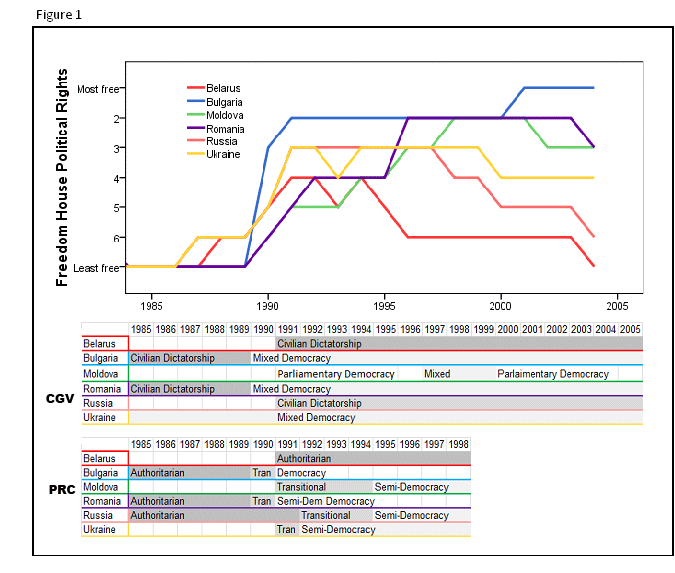
This is a link to the .docx file. The full text is a bit too long to become the face of this blog, but here is the first figure showing how some of the categorical variables are not able to fully capture political rights.

Measures of Democracy – Post Soviet Europe

Categories
Uncategorized

Online Seller Ratings – eBay and Google Merchant – Assignment 5

This post will compare the rating systems used to evaluate individual online sellers. These are often of critical importance to buyers in order to avoid scammers online. Usually, the higher the number of ratings of a seller, and the higher those ratings, the more likely they will be legitimate. It sucks to buy an Xbox off eBay and have it just be the box. You would likely respond with a negative post, thumbs down, scammer, 0 stars. We use the ratings systems to avoid this, but how accurate are they?

The most commonly seen rating on ebay is a compilation of binary variables. That is, a good rating or a bad rating. These are tallied up and given a percentage of good ratings over total ratings. A seller of 96% for instance would only have 4% bad ratings. This is further made accessible by a star rating system which indicates how many ratings have been given. Different colour stars indicate a different number of ratings in total. This is good for data transparency but is hard to decode, as the colours follow a pretty random hierarchy. Further you can see individual’s 5 star ratings and comments for a more detailed view of some experiences with the seller.

Google merchant uses a more holistic approach to calculating seller scores. It uses aggregate totals from snippets of customer reviews from 3rd party sites and also Google Checkout. They re-scale each review they find to a 1-5 scale. The problem is they don’t give any information on how they tally this score, just that “trust them, they do it accurately”. Here is a snippet from their official seller score page.

“We calculate Seller Ratings using a variety of signals beyond just the arithmetic mean in order to make sure Seller Ratings reflect not only the raw quantity of review scores, but also how representative and high-quality the reviews are. We’re constantly refining how we use those signals to give our users as helpful an overview as possible.”


eBay’s scores may reflect some polarization. Chances are, if you didn’t have any major problems with your experience, you would give a moderate review. This would likely be counted as a ‘thumbs up’ and therefore added to that total. As a result, most sellers on eBay who do so fairly regularly get scores in the high 90%’s. The degree of variation doesn’t neccessarily reflect the variation you might have in experiences with different sellers.

Google Merchant on the other hand, is hard to trust. They simply say that they throw it all into one big accurate secret calculation and ta-da! your super precise aggregation of the entire internet has created this score out of 5 for how reliable this seller is. It is good that they get these ratings from a bunch of different sites, but some transparency as to how the total is calculated is needed.

Categories
Uncategorized

Judges – The Un-elected Legislators


As a citizen of a democratic country, I own my sovereign self, and have the right to have this sovereignty expressed through democratic institutions. The actions of government, wars, economic policies, and ultimately laws, should all have a basis in the democratic process. We elect our representatives and they accomplish these things on our behalf, and we agree to abide by the decisions they produce. This is all basic democratic theory.

What then of judges? Especially Supreme Court Judges? They are unelected, chosen by their peers, and have a considerable, very real influence on our daily lives. Judges have to power to strike down laws they find unconstitutional, even if this action is directly counter to the public sentiment at the time. Similarly, their decisions on particular cases set that precedent in stone, ensuring that any subsequent judges are not able to rule a different way, even if the public would come to prefer the alternative in the future. In a very real way, judges make laws. Not the statutes themselves, but the interpretation of them, which is often of pivotal importance. Since these interpretations are binding to future cases, they modify the laws, even change their intention, and do this completely outside the democratic framework. The separation of powers here doesn’t seem to work, as the judiciary takes on legislative roles.

Sure, judges are only appointed by those who we the people elect. This is the same for our Prime Minister, we don’t directly elect him or her either. The difference is responsibility. Elected offices are responsible to those who elected them, including the PM. If they make unpopular decisions, they run the risk of not being re-elected. The same principle does not hold up for judges. The process of judicial appointment and recall are undemocratic at best.

Some would argue that this ensures that those being selected are then of higher caliber, more likely to make good decisions. If using this logic then, why engage in democracy at any level? Why elect our representatives if those already in power are better able to select more capable leaders? There are many arguments which challenge the undemocratic nature of the judiciary and especially judicial review of the charter of rights and freedoms. Management of that document is entirely in the hands of the courts. Is is democratic to entrust the exercise of our rights to a body which has no direct political responsibility to the people?

I am not coming down on the side of elected judges. There are many good arguments for appointed judicial offices, but I think it is very important to view the actions of this branch of government in democratic terms. As far as pure definitions of democracy go, the judiciary in Canada doesn’t fulfill them. We all abide by laws that were in part shaped outside the democratic process. That being said, the system works, and for the most part works well. Few would argue that we are not living in a democracy in Canada. Yet if considering democracy in a scholarly context as we do in the course, it is important to look at this debate.

Categories
Uncategorized

A democracy activist president suffers a coup, Maldives – democracy in the news week 6


Mohamed Nasheed, the highly acclaimed president of the Maldives ‘resigned’ from office recently amid protests surrounding his rule. He was well known for his environmental policies and his international fight against climate change. He was also well known to be a highly moral man, and apt politician. Before his political career, he was held in prision for over a year for an article he published accusing the then party in power of manipulating elections in 1989. He was then held again later on fake charges of conspiracy and sentenced to two years in solitary confinement where he was tortured. During his political career as an MP he stole documents proving electoral fraud from the president’s estate and was subsequently banished from the country. Nasheed has bounced back on his return to become the leader of the nation. He is a clear voice for democracy, human rights, and is regarded as one of the most highly acclaimed national rulers of the day.
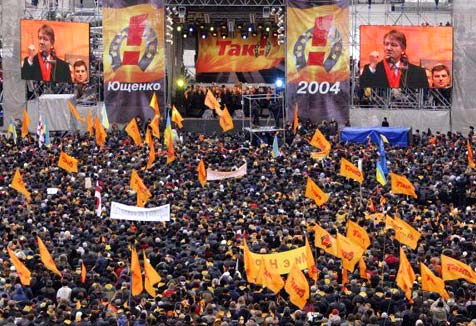
His recent resignation is being called into question as he states he was ‘forced out of power at gunpoint’. The security services of the Maldives are believed to be responsible. He defiantly awaits the execution of an arrest warrant issued by the new president. For someone who has fought his whole life for democracy, and has risen to the highest possible political office, it is a shame to see that he is being forced by what is essentially an undemocratic coup.

http://www.bbc.co.uk/news/world-asia-16959808

Categories
Uncategorized

For my empirical analysis of democratic regimes, I chose to focus on Post Soviet Europe.

Post-Soviet Europe
Belarus
Bulgaria
Moldova
Romania
Russia
Ukraine

I find these measures of democracy very interesting from a foreign policy perspective. I hope to find relationships between increasing levels of democracy and the existence of historical external pressure to democratize. I am also aware that several of these countries have had setbacks over time and i wish to see how these are reflected in the data. The various ‘colour revolutions’ will be interesting to witness from an empirical perspective and I wonder if the data captures the gravity of certain events.

Categories
Uncategorized

Week 5 – “What is Democracy Anyways?”

Well auntie Gertrude I am glad you asked that question. This is a question which a good portion of the course I am taking focuses on. The fact of the matter is that throughout history and across countries and disciplines there are thousands of definitions and conceptions of what democracy actually is. This is even further complicated by the fact that scholars like to append modifiers onto the word democracy to specify a specific subtype of the term, like ‘limited’ or ‘military’ or ‘parliamentary’. At the base roots, however, democracy is seen to be a political system where the people themselves posses state sovereignty. You can contrast this with authoritarian or monarchical regimes where the leader of the state is sovereign and the people are their subjects. In a very real way, in a proper democracy, the government is the subject of the people. This leads to a range of different degrees to which this may happen or not happen in a ‘democratic’ country.

The easiest way to ensure that people have sovereignty is through elections, and this is the most clearly visible characteristic of a modern democracy. Clearly the existence of elections alone can not guarantee democraticness. There needs to be a free and fair aspect to it, where people are not coerced to vote for the status quo, voting procedures and counting are done by an independent agency and fairly, and the existence of more than one political party. Any violations of these principles would nullify the very point of elections, and rob the people of their sovereignty thus ruining democracy. Similarly, not allowing for universal (or at least rationally universal) suffrage would negate democracy. It would essentially be robbing a portion of the people of their sovereignty and thus elevating the voters to a political status higher than non-voters. Instead of rule of the people, one would see rule of some people over others, the antithesis of democracy. In addition, the existence of frequent elections is necessarily. There are countries who are self-proclaimed democracies yet have not had an election for decades. The sovereignty in these states surely does not rest with the people.

It is often argued whether protection of minorities and human rights is a necessary component of democracy. Some would submit that the ability to choose ones own dictator is sufficient for democracy, that is the existence of elections. I believe, however, that for sovereignty to truly rest in the people, human and minority rights must be protected. Presumably, people would not exercise their sovereignty in such a way as to infringe upon their own rights, or allow a majority to do so. Therefore it is up to a democratically elected government to act in the interests of the people at large. A minimalist definition of democracy, where leadership competition is sufficient for the label, is something I disagree with. The root of democracy is a sovereign people, and this necessitates protection of all those who are able to exercise it through voting.k


Spam prevention powered by Akismet