Categories
Uncategorized

Re: In Turbulent Times, Zara Continues to Practice Supply Chain Resiliency

For a few years now, Zara has been one of the stores I frequent when I shop. I’ve been to Zara stores worldwide, from retail stores in Canada, the United States, Hong Kong to England. I knew that it had been and still is a very successful clothing company, but I had never knew the secret to its success. After the supply chain management lecture on Zara, I wanted to explore this topic a little further and see what others had to say about Zara’s business model. I browsed the web for external blogs on Zara and found this blogpost by Bob Ferrari amongst his many on Supply Chain Matters.

Bob Ferrari provides further insight into the operations of Zara. Although economic uncertainty dwells high in Europe, especially with Spain being one of the epicentres of financial concern, Zara has pulled off a 30 percent increase in profits. How? Zara’s growth can be attributed to two main reasons.

1) its broad geographic scope with retail stores opening worldwide

2) its unique supply chain modelled for fast response times catered to adapt to changing consumer tastes.
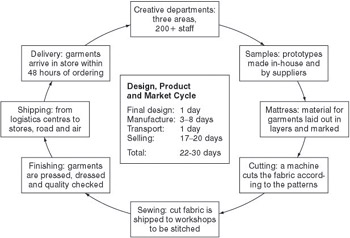
Zara also boasts a logistics capability of replenishing every retail store twice a week. As if this system was not efficient enough, Zara has decided to build a new state of the art logistics centre involving an investment of 190 million Euros to further set itself apart from competing firms.

Although this supply chain model is extremely hard to replicate, it is interesting to see if any new startup fashion companies will try to follow in Zara’s operational footsteps to success.


Categories
Uncategorized

Re: Social Entrepreneurship: An Impossible Task?

Post in response to Oliver Zhang’s Blogpost

I’ve chosen to reply to Oliver’s post because social enterprise is something that I am interested in. Although I’ve only been exposed to the very basics of social enterprise, it seems to fit with what I’ve always wanted to do – to become involved with a business and to make a sustainable and positive difference in the world. Social enterprise is the perfect combination of both. It defies the stereotype of businesses. Since the rise of capitalism, businesses/companies/corporations have been viewed in a negative light with regards to how it exploits workers to maximize profits. Now, the new and promising era of social enterprise rejects that stereotype and creates a new found meaning to business. There is one company that has caught my eye: TOMS. Because I have two pairs of TOMS, I have become familiarized with the business model of One for one. For every pair of TOMS shoes purchased, the company gives away a pair of TOMS to children in underdeveloped countries. The video below gives a bit more information on this social enterprise.

TOMS – Thank You! Video

Categories
Uncategorized

Power of the Dollar(store)

A Dollarama opened in my neighbourhood a few months ago. I fell in love after I first step foot into the store. Why? Because the Dollarama was somehow able to find an equilibrium between my tight student budget and my uncanny craving of goods. All the necessities that I need are there for me, for $1, $2, and maximum $3 – a slash in price of 50% or more in comparison to the other goods providers. So what’s so special about the dollar store that I have to blog about it?

Well, it is now Canada’s fastest growing sector in retail. Dollar stores are forcing mainstream merchants such as Walmart, Canadian Tire, and Superstore to rethink their strategic position before they get robbed of their customers. Dollarama Inc. has become a huge threat to these traditional companies; its rapid expansion across the country has attracted large sales increases, an estimate rise of 9 per cent increase annually. Dollarama draws customers with its simplistic layout, convenience and most importantly, low cost. Rivals are retaliating with dollar promotions in hopes of rallying back customers: Canadian tire launched its “Dollar Deal” promotion and Walmart has increased the number of $1, $2, $3 products.

What once was the destested, dirty, dollar store that middle class and well off shopper avoided has become a frequent stop for them. So what exactly is in store for Walmart, Canadian Tire and the lot? How will they cope with the power of the dollar store?

The future seems bright for the Dollar store.

For more information: Browse the Globe and Mail’s article on How Canada’s retailers discounted the rise of the dollar store


Categories
Uncategorized

Facebook Faceplant?

On May 18th 2012, Facebook was released to public trading on the stock market with an initial public offering at the price of $38. There was much hype around this IPO; many analysts were anticipating the stock to skyrocket. The opposite happened.

An article on Yahoo written on Sept 27th reports that Facebook’s stock has been down on 51 trading days, up on 39 and unchanged on two since its initial public offering.

What happened? How come facebook is faceplanting?

There have been debates… and many factors could come into play.

1. initial IPO hype was too high – analysts overvalued facebook’s stock

2. weak investor confidence in stock – may think facebook is a fad – doubtful of future success

3. mobile application does not provide efficient advertising

4.  advertising on facebook is less effective than what companies are hoping for

These are just a few of the many factors that could have contributed to the plummet of the stock price. Facebook Inc. closed the market on Oct 1st with a stock value of $21.99 per share, 43% below its IPO price.

What lies in the future for Facebook? We shall see. For now, things aren’t looking too well for Mark Zuckerberg and his company.

“Prices of Facebook stock since long-awaited IPO – Yahoo! Finance.” Yahoo! Finance – Business Finance, Stock Market, Quotes, News. N.p., n.d. Web. 2 Oct. 2012. <http://finance.yahoo.com/news/prices-facebook-stock-since-long-awaited-ipo-212925363–finance.html>.

Spam prevention powered by Akismet