Categories
Uncategorized

Technology is far outpacing managers’s ability to use it to their business advantage

Business data has become critical to the success of a company. The data can be used to improve performance such as reducing labour costs, increasing margins and boosting productivity. What are the downsides of focusing on Big Data?

As more businesses invest in big data analytics, which is the process of examine large amount of a variety of data, correlation and patterns about customer behaviour are revealed. Information overload threatens business growth due to increasing storage costs. Senior managers ask for more data, without always considering whether those data really help the business. This shows that without effective business technology management (BTM), Big Data has little significance. As mentioned in the IT and BMT lesson, 20 -77% of IT investments are wasted. Firms must be specific and know what data to seek out before investing in them. It is important to understand that Big Data gives quantitative information not qualitative information. Not only do companies incur costs when storing Big Data, they also miss out on opportunities to gather qualitative information from personal interactions. 


Sources:

How Big Data Gets Real 

Is More IT Always Better For Business?

Creating order from digital Chaos

Leadership challenges: Risk of information overload that threatens business growth

Categories
Uncategorized

Sony’s Investment in Scandal–Ridden Olympus

The executives of Japanese camera and medical equipment maker Olympus Corporation has been caught with violating laws regulating securities exchanges by falsifying company financial statements. The three executives responsible for this scandal have hid $1.5 billion USD in investment losses since the 1990s. The accounting scandal could result in a cut of global workforce and closing of its manufacturing plants.


Despite Olympus’ tarnished reputation, Sony Corporation has plans to invest $642M in Olympus. This gives Sony 11% stake in Olympus Corp. After experiencing losses for four consecutive years, Sony is looking to expand its product line to medical equipment. This is an example of horizontal expansion, as Sony would like to increase its share of the market for medical equipment. Sony can have economies of scale if they operate with Olympus as they have valuable resources and information. Both corporations experienced loss over the years. This joint venture could possibly bring Sony and Olympus back to the glory days.

Sources

Sony to spend $640M for 11% stake in Olympus 

Ex President of Japan’s Olympus Pleads Guilty

Olympus and Ex-Executives Plead Guilty in Accounting Fraud

Sony-Olympus alliance aims for high-tech surgery

Sony ties up with Olympus, takes 11 percent stake

 
Categories
Uncategorized

Facebook: Beyond Advertising

There is truth to Dan Gillmor’s comment about Facebook. “The more Facebook makes itself an essential part of our lives the easier it will be for the company to start charging us for using it.”

As Facebook hits a billion users, the public company is taking advantage of the growing influence it has among loyal users. The company plans to generate more revenue by charging U.S users who want to promote their posts and marketers for posting consumer offers.

Share prices have decreased since its public market debut and the company is looking to boost confidence among investors. There is a high probability that this could be a successful profit-generating tool. This new tool allows marketers to create offers that are more relevant to the right audience. However, the idea that individuals can pay to promote posts that hold little value to anyone else but themselves is ridiculed. Given Facebook’s market dominance, the premium products would be harmless to the company if services remain free.

Sources

Facebook to Charge for Posting Consumer Offers

Facebook’s Clever Plan to Charge You $7 to Promote Your Status Updates

Facebook to Start Charging U.S users for promoted posts

Facebook’s new business plan: from utility to monopoly 

Categories
Uncategorized

In Response to Joshua’s Post: Reviving RIM

In response to Joshua’s blog post, Research In Motion (RIM)’s poor performance in the market implies that customers have lost sight of its value proposition. The smart phone industry is extremely competitive. RIM has failed to keep up the pace with rivals such as Apple Inc. and Samsung Electronics Co. RIM hopes to revive sales through the latest Blackberry 10. If profit margins remain below 30%, it would be difficult for the company to be profitable.

RIM’s shortcoming in this competitive market is its failure to provide points of differences. BBM and push e-mail may no longer be a unique value proposition for customers. Developed markets is an over communicated environment. RIM should leverage the security strength of Blackberry in trying to reposition the competition. RIM may not be the first in innovation, but they must unoccupied positions in which it can be first. If they cannot be competitive in developed markets, perhaps they can gain market share in emerging markets of Asia Pacific, South Africa, Venezuela and Indonesia.

Sources:

RIM Has $12 Fair Value On International Market Adoption And Growing Subscriber Base 

RIM Buys Itself Breathtaking Room for BB10 Launch

How Plausible is a RIM turnaround? 

Categories
Uncategorized

McDonald’s Question and Answer Campaign


How does a business with strong brand identity market its point of difference? The fast-food chain, McDonald’s, launched “Our food. Your questions” campaign. The campaign is designed to “foster a message of transparency” by addressing questions through Twitter and Facebook.

McDonald’s campaign could secure customer’s confidence in the brand and fence sitters, who while don’t boycott the burgers but “might be more hesitant to visit the chain because of the negative messages they hear” (Krashinsky). Its point of difference would be the level of transparency it resonates with their guests. This strategy could alter customer’s view on the products and attract a larger customer base. However, McDonald’s approach to address uncertainties, through twitter campaign using #McDStories, could also create a platform for “haters” to illuminate more negativity to the brand. The fast food industry is highly competitive, and McDonalds is trying to unlock the perception about what the consumers think about the products and secure its market share.

Sources

“McDonald’s – Your Questions” Youtube Video

McDonald’s marketing tries a transparent approach

#McDStories: When A Hashtag becomes a Bashtag

Categories
Uncategorized

Breast Cancer Awareness or Multibillion Dollar Business?

Breast cancer awareness has spurred significantly in the past couple of years. Businesses find ways to attract customers by acting socially responsible, promoting breast cancer and selling breast cancer related products. From the National Breast Cancer Awareness month to the countless fundraising events, there is never a shortage of pink ribbons products.

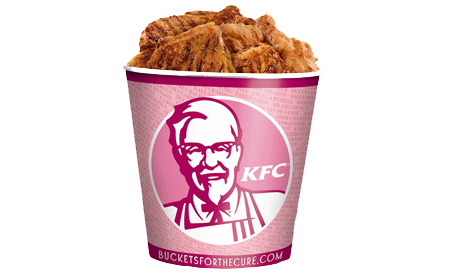
Has breast cancer become a big profit-generation tool? The branding of breast cancer awareness has become a multi-billion dollar a year industry. For example, Kentucky fried chicken’s “Bucket for the Cure” campaign donates 50 cents for each bucket of chicken purchased to the breast cancer advocacy group Susan G. Komen (Hutchison). Associating unhealthy fast food to the promotion of breast cancer is pushing it. This also speaks to business ethics. Businesses influence the movement as they try to become socially responsible. Many patients have been offended by the pink ribbon branding, which puts the effort in making the disease “pink, pretty, feminine and normal.” Many people wish to see the breast cancer movement return to purer roots. This questions whether a profitable business can be fully commit to a social movement without associating capitalism.

Sources
Pink Ribbon: Documentary 

Pinkification: how breast cancer awareness got commodified for profit


Spam prevention powered by Akismet