One of my favourite parts of marketing is when companies get interesting with promotion. Don’t get me wrong, we’ve all seen some terrible, hackneyed attempts at interesting or unusual promotion, but every now and then brilliant promotional campaigns come along and can get us very excited about companies or brands. One of the most inventive, in my opinion is Red Bull. Red Bull is nothing more than another caffeinated sugar-water, however they have differentiated themselves by positioning themselves as youthful, extreme and exciting. Going hand in hand with the image, Red Bull is involved in more extreme sports then many athletic-wear companies! After discovering many of the sports they were involved in, from the Red Bull Air Races to Red Bull Flugtag (where hobbyists construct weird and crazy flying machines and attempt to launch them off a ramp over water) I spent hours watching videos of their promotional events. By being involved with almost any imaginable extreme sport Red Bull has found incredible promotional succes and has developped a huge fan following for its events. For your enjoyment, here are some videos of the best they have to offer:
Doesn’t Everyone Want Premium?
As many of my penniless student friends have been touting ad-nauseum, McDonalds has been giving away free, premium coffee for the past few weeks. There has been much talk about this promotion and for many of my friends who walk campus like zombies in the morning, it has been very welcome. I think the idea is brilliant. Though many seem to miss this, while reading a classmate’s blog https://blogs.ubc.ca/sdbrewer/ I found that there is a belief that the premium coffee crowd and the McDonalds crowd are mutually exclusive. I disagree.
As one who enjoys both premium coffee and the consistency of magically, deliciously processed foods I think McDonalds premium roast appeals to most McDonalds customers. Dont get me wrong, I don’t believe that McDonalds is bringing about the end of Starbucks, and I doubt they will steal too many of their customers either. What I do believe is that many McDonalds enthusiasts, like myself, may now opt to grab their coffee along with their meal at McDonalds, as opposed to making the second stop
A while back, while trying to watch an episode of Mad Men on iTunes, I found myself staring at the image on the page….something didn’t seem right. It didn’t come to me right away but then I noticed; Don had dropped his iconic cigarette.
For a second I wondered how Don Draper, a fictional 1960’s ad-man, would respond if Apple executives asked him to remove a cigarette from an advertisement. I went out in search of public opinion and came across a blog that raised a very good point:
“Apple doesn’t appear to be doing this anywhere else: The marijuana leaf in the Weeds logo is intact and the gun in the Sopranoslogo doesn’t appear to have the safety on.”
http://responsiblemarketing.com/blog/tag/don-draper
Its very clear how powerful marketing’s abilities are to shape opinions and influence actions, so of course there is a large social responsibility aspect to all marketing. The question that comes of this is, how responsible is a marketer to shelter his/her audience from certain content? To me, Apple’s actions here feel like the result of too much censorship and a belief that it is easier to tiptoe around sensitive issue than to deal with consequences. How socially responsible does Apple have to be? Recently, Apple has manned up and switched the Mad Men page to put the cigarette back in Don’s hand. I applaud them, and I know Don would appreciate it.
Who’s choosing the planes?
As a student pilot, I often find free copies of various flying publications in my flight bag. Recently, I was struck by many of the advertisements I found in magazines that are targeted to GA (general aviation) pilots. It seems that the airliner-manufacturing giants, Boeing and Airbus are advertising their $100 million+ aircraft to readers of various GA magazines. Since the average GA pilot isn’t going to look at one of these advertisements, call up their banker and order one, and since airline exec’s decisions wont exactly be swayed by magazine advertisements, what are they doing?
Turns out that airlines are not always fully responsible for their purchase decisions. After coming across a chat about this exact issue at http://www.airliners.net/aviation-forums/general_aviation/read.main/2268059/ I found that the purchase decision to buy an airliner is driven as much by black and white considerations of range, payload, operating limitations etc. as it is by what passengers want to fly in. By advertising their aircraft directly to the passengers, airlines can benefit from the perceived advantages of using certain aircraft. If you look around the next time you are at an airport, youll likely notice that most large airlines proudly display their manufacturer name and model somewhere on their livery.
Spare Some Ink?
A few weeks ago I bought myself a new printer, and to be honest the price astounded me. For somewhere around $50, I got a brand new colour printer, with a scanner, a few miniature ink cartridges and several other features Ill never use. I went home happy, somehow the gods of retail were smiling down on me and I got a score. Then I went to buy ink.
Another $50 later I returned home feeling like an idiot!
Turns out I was duped by this long-since-dead, moustachioed man

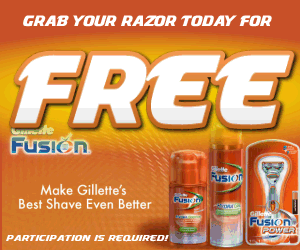
King Camp Gillette (that’s really his name), not only invented the disposable razor, but popularized a form of marketing that will likely endure as long as the shaving tools that bear his name. King saw a great opportunity with his disposable razor blades. Once someone bought the razor (far more expensive than the blades) they then had to purchase the relatively cheap blades for life. What he realized was that even though the razor was relatively expensive, the profit to be made from the blades once someone was a Gillette razor user, was far in excess of any profit that could be made from the razor. This is known as freebie marketing, or more commonly, as the razor and blades model. Based on that principal Gillette set up promotions offering massive discounts or even free razors. Though the razors were sold at a loss, the sales of blades more than made up for it.
A century later, those jerks at HP are pulling the same move on me with printers and ink! As I began thinking more and more about this principal of freebie marketing I realized just how widespread its use is. From free PVRs with cable contracts to discounted game systems with overpriced games, it seems the freebie model is alive and well. Though we may all feel slightly used when were out buying $30 ink cartridges and $20 razor blazes, the one thing that cant be denied is that freebie marketing works.
‘People hang on his every word; even the prepositions’
‘He can speak French…. in Russian ‘
‘His beard alone has experienced more than a lesser man’s entire body’
He doesnt always drink beer, but when he does, he prefers Dos Equis
It takes quite the remarkable individual to make the claim that he is ‘the most interesting man in the world.’ Dos Equis may have just managed to create him in their newest ad campaign. The ‘Dos Equis guy,’ is the impeccably charming individual seen arm-wrestling Josef Stalin and being lowered from a helicopter to play piano in the company’s most recent campaign. Perhaps the most interesting thing about ‘the most interesting man in the world’ is how he has managed to get people not just to talk, but to rave about what was until recently cheap, relatively unknown, Mexican beer!
Before this series of advertisements aired, I didn’t know of a single person who had ever heard of Dos Equis, andif I had come across one it was probably cheap, bland and unmemorable. Quickly after the campaign began to air, I started to see Dos Equis appear at parties and I slowly saw it being ordered at restaurants and bars. If thats not surprising enough, people began talking about Dos Equis as if it were a top-shelf beer. To be honest I was shocked by the notion that the attraction to the ‘most interesting man in the world’ is enough to turn off logic and taste buds. Is it possible that the masses have become so attracted to this bearded old man, they cannot see they are drinking Mexican Keystone Light?
As far as brilliant marketing goes this is the peak. At a time when the market for the drink was shrinking, this campaign had massively successful results for the company’s sales and image. Though you likely wont see me with a Dos Equis in hand any time soon, I have great reverence for their marketing work at creating a character so powerful it has changed the course of the company. Next time you see someone order a Dos Equis, I’d be surprised if you didn’t pause for a second and think about the man who’s ‘blood smells like cologne’