Monthly Archives: October 2021

Defining Growth – a Reflection Blog

The first unit of the Technical Writing course provided learners with the task of defining relatively complex terms within their respective professions to members of their team. Students then completed peer reviews of each other’s work, which has since been updated to reflect constructive comments received. This assignment had multiple layers to it that allowed students to work in stages, with active participation from their peers. The peer review process helped to enrichen each other’s definitions by clarifying what was and was not understood from an outside perspective.

I enjoyed this introductory writing exercise as the instructions were straightforward and allowed work to be completed in steps. My partner for the peer review process was Tamara, who provided many positive comments about my original work. She stated that she was able to understand what an oral and maxillofacial surgeon was after reading my blog post, and would recommend only minor revisions before posting my final draft. She noted that I switched verb tenses throughout the writing and advised of how this may be confusing to the reader. I was able to make relevant changes for a more coherent writing style throughout.

When reviewing Tamara’s definition of the term real property, I offered some critiques that pointed out grammatical errors and missing pieces to the format of her post. By making small clarifications to her definitions, any confusion I had during my first read through was cleared up. I appreciate that she fully processed my feedback and saw the benefit in updating her work to reflect my suggestions. I found her final draft absolutely easy to comprehend. Overall, I feel this was a successful writing experience. I have a new understanding of the challenges faced when defining new terms to a broad audience. I feel more confident in my peer reviewing abilities since practicing giving constructive feedback, as well as acknowledging and adapting to the feedback I received.
Link to revised definitions

Link to Tamara’s peer review 

Revised Definitions of an Oral and Maxillofacial Surgeon

As per Assignment 1.3, students are tasked to expand on a relatively complex term used within our particular professions. The purpose of these definitions is to provide the general public with a technical term in a manner which is easily comprehensible. The objective of this assignment is to exercise technical writing definitions and descriptive writing styles. A parenthetical definition, sentence definition, and expanded definition of a maxillofacial surgeon will be included below. The reading situation is a dental hygienist explaining what an oral and maxillofacial surgeon is to a client who needs a referral for a suspicious lesion noted on their tongue.

Parenthetical definition: The dental hygienist referred their patient to the oral and maxillofacial surgeon (oral specialist).

Sentence definition: An oral and maxillofacial surgeon is a specialist of conditions of the head, neck, jaw, and mouth.

Expanded definition:

What is an oral and maxillofacial surgeon?

An oral and maxillofacial surgeon is a specialist of the head, neck, and facial regions. They diagnose and treat a range of oral and maxillofacial conditions; oral = mouth, maxilla = upper jaw, facial = face. In Canada, surgeons must complete many years of education and pass a National Board Examination to be recognized as a certified specialist. After completion of a Doctor of Dental Surgery (DDS) or Doctor of Dental Medicine (DMD) program, a 4–6-year hospital residency is required, including rotations in various medical departments. Abnormal appearances of gums, lips, or the skin are frequently referred to them for further testing. Complicated tooth extractions or dental surgery, dental implant surgery, and bone and gum grafting are all standard treatments done at a maxillofacial surgery office. Less commonly, they perform dentoalveolar (tooth socket) surgery and trauma management.

Why would someone be referred to an oral and maxillofacial surgery?

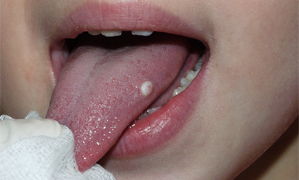
They often receive patient referrals due to a concern noted during a routine physical or dental examination. The concern, typically a lesion of the oral cavity, can be anything from a benign finding to more serious events such as oral cancer. A specialist should assess suspicious lesion noted during routine examinations that do not heal within 2 weeks. They will likely perform a biopsy of the area, which involves removing either a portion or all of the tissue mass and to test it under microscope. They may also use visualization devices or special dyes to stain cell differentiation and provide more information on the type of lesion noted.

Fig. 1: Oral lesion on dorsum of tongue. jcda. (n.d.). Retrieved October 1, 2021, from https://jcda.ca/article/b117.


Works Cited

The Canadian Association of Oral and Maxillofacial Surgeons (CAOMS) is a non-profit organization that serves oral and maxillofacial surgeons across Canada. Canadian Association of Oral and Maxillofacial Surgeons. (n.d.). Retrieved September 29, 2021, from https://www.caoms.com/.

Oral maxillofacial surgery? Pacific Coast Oral Maxillofacial Surgery. (2020, December 2). Retrieved September 29, 2021, from https://pcoms.ca/2020/05/what-is-oral-maxillofacial-surgery/.

What is an oral and maxillofacial surgeon? from 123dentist. 123Dentist. (2019, May 6). Retrieved September 29, 2021, from https://www.123dentist.com/what-is-an-oral-and-maxillofacial-surgeon/.