Categories
Module B

Integrating Pedagogical models and Digital technologies – Synthesis of WISE, MYWORLD, JASPER and CHEMLAND

Technology Enhanced Learning Environment –  WISE, MYWORLD, JASPER and CHEMLAND

Strengthening pedagogical structures

The National Centre for Excellence in the Teaching of Mathematics (NCETM) in their 2010 report and in the 2011 report by the Joint Mathematical Council of the United Kingdom report that expected increases in enhanced learning using digital technologies have not been realised. Both highlighted potential problems in the pedagogy, a lack of opportunities for meaningful interaction, and too few opportunities for the use and application of concepts across subject areas. Sutherland et al. (2011) elaborate this point to define a major need for student-led mathematical models with high problem solving content using computer programming and digital technologies that are widely used in society and the workplace.  The use of pedagogy and models that are centred on presentation and exercises were also highlighted as weaknesses.

Four substantive projects with foundational technology-enhanced learning environments (WISE, MYWorld, Jasper and Chemland) were explored, compared and contrasted for   learning goals and theory and found to include elements designed to create a deeper relationship/integration of pedagogy and technology with the hope of increasing the perceived benefits on technology integration.

Below is a synopsis of each project, their learning goals and learning theories, a comparison of each and the potential for inclusion/impact teaching, learning and integration of technology within the mathematics and science classroom.

Learning Goals and Theories

WISE

WISE is a web delivered project designed based on the principle of Scaffolded Knowledge Integration and to support the design of curriculum projects in which students investigate problems, critique solutions and debate with their peers (Slotta & Linn, 2009). The Web delivery mechanism means there is no software, all content and functionality can be accessed within the Web browser. The interface and working space are designed for and promote collaboration for students and teachers to work on combined lessons and projects. Teachers can create, share and modify lessons using WISE software online.

WISE looks at knowledge integration on three levels: i) understanding content, ii) knowledge and development of skills within the course (scientific inquiry skills) and iii) epistemic knowledge (understanding the nature of the course) based on learning theories of: Scaffolding (content delivery and tools to support learning including embedded hints, guides and reflection activities) and Distributed congnition (online discussions).

The key difference in WISE is the Knowledge integration on all levels in one learning environment using technology, web delivery (Snyder et al., 2002). In this way WISE differs from all other processes as it is all web based which creates limitations for use if there is not internet access. However, pedagogical approaches and theoretical frameworks could still be employed.

MyWorld

MyWorld is a GIS software integrated in Life Sciences explorations and lesson delivery. It is based on learning goals of facilitating the integration of content studies with the inquiry process and for inquiry to play a more significant role in scientific learning. The primary theories of learning within MyWorld are based on four premises:

‘1. Learning takes place through the construction and modification of knowledge structures.

2. Knowledge construction is a goal-directed process that is guided by a combination of conscious and unconscious understanding goals.

3. The circumstances in which knowledge is constructed and subsequently used determine its accessibility for future use.

4. Knowledge must be constructed in a form that supports use before it can be applied’ p. 357

MyWorld offers the tools and support that enable students to compute necessary information, construct knowledge and to create, analyse and test data. It is interactive, customisable and allows for visualisation of data with affordances of allowing students to enter or create new data. It therefore offers independence and capabilities that are not possible without the technology such as computational skills (real scientific tools). The software is not as user friendly as the others and can be more interactive in both the input of and manipulation of data. Unlike T-Gem and Chemland and WISE elements a prior learning module and/or thought tracking and discussion are not enabled within the environment.

Jasper

Jasper is a learning series based on anchored learning in which instruction is anchored on solving a complex problem. This makes it distinctive from the other models. Instruction must be anchored and presented in small chunks. It is a constructivist approach in which students have a meaningful experience. In this experience problem setting is essential and forms the basis of that meaningful experience. Understanding how people think is an essential element to the foundation for the Jasper model (Pellegrino & Brophy, 2008). The Jasper technology is a series of interactive movies with defined problems. The technology provides anchors for the instruction, content, and defining problem, as well as provides the structure for independent and collaborative work.

The Jasper series supports:

• Scaffolding
• Practice
• Feedback
• Revision
• Reflection
• Community learning (distributive cognition)
• Divergent thinking/ instruction (The what if scenario)
• The inquiry process/discover learning.

Materials supported are context specific, activity oriented, and developed in levels, with increasing independence. It supports independent learning, all information required are presented in the question, as well as collaborative learning.

Chemland and T-Gem

Chemland is a digital software used in simulations and explorations of scientific processes in Chemistry. It was investigated here within the T-Gem methodology. The underlying learning goals and theories are the use of technology to strengthen students’ mental modes of knowledge.

TheT-gem approach has three components: Generate, Evaluate and Modify with specific teacher and student activities. Prior to the three step process the teacher provides background content. This differs from the Jasper series in that provision of background content is not a necessary precursor. The teacher’s role is to provide prompts to elicit desired outcomes within the three areas, likened to the scaffolding prompts in WISE.


Teacher’s/Designer’s use of projects

WISE

To create a WISE project teachers can create, use and/or modify an online lesson. The task should be inquiry-based with scaffolding features such as cognitive hints, embedded reflection, embedded notes and embedded assessments. These should be sequentially organised within the lesson in a step by step approach in which the progressions occur naturally through clicks (automatically goes to the next step/activity/task). The experience should promote autonomous learning and so should include: scaffolding, student self-monitoring through collaborative reflection, activities and teacher feedback. WISE software has embedded features to support each of these areas.

Software tools for activities include: Drawing, Concept mapping, Diagramming, and graphing with additives/potential affordances for interactive simulations and models. The teacher’s role is as a facilitator/guide primarily encouraging discussion.

MyWorld

The design strategies suggest a three step process: Motivation – to acquire specific skills or knowledge within a real life context or setting; Knowledge Construction – Goal directed and involves the use of and facilitation of incremental constructs organised in a way to allow for linking to memory banks and experiences (prior learning) and for making connections and Knowledge refinement – the application of knowledge and how to access that knowledge.

MyWorld offers interactive components but I did not find it very user friendly enough to enable a level of ease of use with the software that enabled students to act as independently as desired in the motivation and goal directed stages described in the LFU model. In using LFU and or a MyWorld based technology and model for mathematics I would utilise activities within the three steps as highlighted and emphasise the digital technology. However, I would make the technology more interactive in both the input of and manipulation of data and I would also include a prior learning module before the motivation stage to identify or clarify misconceptions.

Jasper

The Jasper series is based on the premise that effective learning environments are: Knowledge centred (concept of understanding rather than just mastery of skills), Learner centred  (with a need to understand attitude and skills that students take to the classroom, preconceptions and misconceptions), Assessment centred ( gage where students are and develop accordingly) and Community centred (sharing and arriving at an answer etc).

The Jasper series is therefore designed to be an adventure series to provide motivation as in MyWorld but differs in that content is not taught directly but encourages students to find information. The Jasper series can therefore be used either as a motivation/ introduction to or culminating activity (application of concepts) depending on the pedagogical desires. In my programme, for example, in college mathematics with at risk learners I can use Jasper to provide context, a real world problem and creating more meaningful problems for students to solve rather than completing questions devoid of context and/or only practicing through drills and practice. The medium also caters to multiple intelligences and diverse learning styles (Gardner, 1983). Also, the SMART and STAR structures enable the tracking of thought patterns, progress and direction setting for both students and teachers (Pellegrino & Brophy, 2008). Jasper can also be used to assist students in structuring problems into manageable and separate and more approachable sections while distinguishing between relevant and not needed data (Vye et al., 2009). KWL charts can be used alongside Jasper to support metacognition and independent, self-paced learning by helping students to organise what they need to research.

 A Reflective/Synthesised framework

Independent use and Exploration

I am in agreement that in instances independent use and exploration of technology may not result in significant gains in learning. But I believe it is dependent on how and when that independent learning is introduced into the lesson and the support given to reflection of that independent learning process.
The kind of independent use and exploration I refer to is that placed within scaffolding strategies where the process is demonstrated and modeled, students are guided in the process, students then attempt the process themselves, and further explored in a way that they can test their theories/concepts.

However, potential missing elements, which if included will fill gaps in independent work, are: reflection, presentation, discussion, debate and analysis.

While working independently students can reflect on their process and present how and what conclusions they arrived, this can then be discussed whether verbally or asynchronously (discussion posts or chat room). In the latter an online medium should enable viewing of results and posting comments.The above are based on my current teaching experience, my interview and my exploration with  four substantive projects with foundational technology-enhanced learning environments (WISE, MYWorld, Jasper and Chemland).

Social affordances, Cognition and metacognition – Activities for success

“factors that might facilitate participation and interaction in CSCL environments are promoting alternative views for students to discuss, anchoring discussions to students’ personal experiences, option to make anonymous contributions, offering interesting and timely topics, making online discussion a part of legitimate classroom activity, and alternating face to face and electronic discussions.” Lipponen, L. et al. (2003).

Lippoen’s discourse reflects benefits seen in my practical teaching experiences. I instituted a primarily asynchronous (chats, blogs and discussion post) means of discussion set questions in two of my courses. Both offered independent learning and links to web resources that provided background content and examples. The two deliveries were slightly different in how materials and activities were organised to introduce or support discussions. The delivery model that worked better was the one that had fewer activities with one or two clear goals, with supporting materials that did not require having to use too many external links. In the latter experience also aiding success was that content was organised in one space and presented in small chunks.

Prompts suggested in Lippoen (2003) and resonated in Anderson (2004), are integral in my experience. Although some believe that the discussion environment should be a space for more student-centred and driven discussion I have found that it depends on the level as some students feel neglected and do not want to return to the discussion as much as if the teacher responds regularly to their comments (even if students are responding).

Another discussion point is that of modality of interaction (asynchronous vs synchronous means). Asynchronous means such as online discussions (blogs, chats, and posts) serve to extend discourse beyond the classroom, deepen student-to student interaction and enabling teachers to keep more abreast of individual students’ thoughts, conceptions and misconceptions. However, the latter becomes difficult to manage with large classes and if the lecturer has many classes. This gives me a greater appreciation for the metacognitive, reflection and discussion capabilities embedded within WISE. The integration of such tools was central in my delivery of  Mathematics and the T-Gem methodology.

All the series we have viewed so far present instruction and anchored problems in small chunks. Jasper requires the learner to seek solutions that may require the teacher to use supported environments that simulate/ aid scaffolding activities. Of them all WISE is the most comprehensive in creating the one learning environment experience. In the Chemland experience I would have to create my learning space to include my simulations and such affordances for communication and social interaction to enable this meaningful interaction that would engage all students but I would make that learning space one such as WISE which incorporates all elements in one learning environment. A lesson from WISE is the inclusion of reflection and metacognitive elements within the tasks themselves. A lesson from Jasper is to use multimedia and presentation tools that motivate and present anchored problem solving using real experiences but also to give students enough motivation to seek out additional information. The use of Simulations as presented in MyWorld is also noteworthy in instructional design and delivery.

Regarding physical infrastructure and support I think smartphones with internet connectivity, which are increasing in prevalence, may become viable options for facilitating discussions. Also increasing is the potential for Mobile Apps for education technology alongside developments in ‘Social software and participatory learning: Pedagogical choices with technology affordances in the Web 2.0 era’  (Lee & McLoughlin, 2007). There are other programs such as the one lap top per child program that may also help with infrastructure to support digital technology integration.

Teachers can therefore support at-risk-learners by:

i) modeling the process
ii) guiding students through the process
iii) enable independent exploration through application of concepts
iv) include media for discussion of results (synchronous and asynchronous, and enable feedback)
v) structure presentations and discussions on understanding sources of misconceptions and on clarification, using collaborative structures and distributed cognition strategies.


References

Anderson, T. (2004). Toward a theory of online learning. In T. Anderson & F. Elloumi (Eds), Theory and practice of online learning (pp.33-60 ). Athabasca, AB: Athabasca University. http://cde.athabascau.ca/online_book/ch2.html Retrieved 21 February 2011

Cognition and Technology Group at Vanderbilt (1992a). The Jasper experiment: An exploration of issues in learning and instructional design. Educational Technology, Research and Development, 40(1), 65-80. http://ezproxy.library.ubc.ca/login?url=http://dx.doi.org/10.1007/BF02296707

Gobert, J., Snyder, J., & Houghton, C. (2002, April). The influence of students’ understanding of models on model-based reasoning. Paper presented at the Annual Meeting of the American Educational Research Association (AERA), New Orleans, Louisiana.
Retrieved Saturday, October 29, 2005 from: http://mtv.concord.org/publications/epistimology_paper.pdf

Edelson, D.C. (2001). Learning-for-use: A framework for the design of technology-supported inquiry activities. Journal of Research in Science Teaching,38(3), 355-385. http://onlinelibrary.wiley.com/doi/10.1002/1098-2736%28200103%2938:3%3C355::AID-TEA1010%3E3.0.CO;2-M/abstract

Edelson, D. C., Salierno, C., Matese, G., Pitts, V., & Sherin, B. (2002, April). Learning-for-Use in Earth science: Kids as climate modelers. Paper presented at the Annual Meeting of the National Association for Research in Science Teaching, New Orleans, LA. http://www.worldwatcher.northwestern.edu/userdownloads/pdf/LFU_PF_NARST02.v3.doc

Joint Mathematical Council of the United Kingdom.(2011). A report from a working group of the Joint Mathematical Council of the United Kingdom. Chaired by Professor Rosamund Sutherland. Edited by Dr Alison Clark-Wilson, Professor Adrian Oldknow and Professor Rosamund Sutherland

Khan, S. (2007). Model-based inquiries in chemistry. Science Education, 91(6), 877-905.

Khan, S. (2010). New pedagogies for teaching with computer simulations. Journal of Science Education and Technology, 20(3), 215-232.

Lee and C. McLoughlin. (2007) ‘Social software and participatory learning: Pedagogical choices with technology affordances in the Web 2.0 era’ http://www.ascilite.org.au/conferences/singapore07/procs/mcloughlin.pdf   Retrieved 29 February 2012

Linn, M., Clark, D., & Slotta, J. (2003). Wise design for knowledge integration. Science Education, 87(4), 517-538. http://onlinelibrary.wiley.com/doi/10.1002/sce.10086/abstract

Lipponen, L. et al. (2003).Patterns of participation and discourse in elementary students’ computer-supported collaborative learning. Learning and Instruction. 13 (5), 487-509.

National Centre for Excellence in the Teaching of Mathematics (NCETM). Mathematics and Digital Technologies -New Beginnings. A report Date: September 2010. https://www.ncetm.org.uk/public/files/3399763/NCETMDigitTechReport2010.pdf , Retrieved February 23, 2012

http://cme.open.ac.uk/cme/JMC/Digital%20Technologies%20files/JMC_Digital_Technologies_Report_2011.pdf, Retrieved February 22, 2012

One laptop per child program http://one.laptop.org/ Retrieved 29 February 2012

Pellegrino, J.W. & Brophy, S. (2008). From cognitive theory to instructional practice: Technology and the evolution of anchored instruction. In Ifenthaler, Pirney-Dunner, & J.M. Spector (Eds.) Understanding models for learning and instruction, New York: Springer Science + Business Media, pp. 277-303. http://ezproxy.library.ubc.ca/login?url=http://dx.doi.org/10.1007/978-0-387-76898-4_14

Vye, Nancy J.; Goldman, Susan R.; Voss, James F.; Hmelo, Cindy; Williams, Susan (1997). Complex Mathematical Problem Solving by Individuals and Dyads. Cognition and Instruction, 15(4), 435-450. http://www.tandfonline.com/doi/abs/10.1207/s1532690xci1504_1
Categories
Module B

Integration for Real and Relevant Mathematics exploration – T-GEM, IWB, Web 2.0 and silumations

Technology Enhanced Learning Environment:T-GEM, IWB, Web 2.0 and simulations

Integration

Subject: Mathematics

Concept: Quadratic equations

This concept is a challenge from personal practice. Another pedagogical challenge experienced is adding relevance and real world application.

Digital Technologies: Interactive Whiteboard (IWB), Graphing Simulation, Web 2.0 technology

The interactive whiteboard was chosen for its interactive capabilities as well as strength in visual display, ease of use for student individual use and manipulation and for ease of integration of real world components and internet access and use.

Pedagogy: 3-step T-GEM cycle

The National Centre for Excellence in the Teaching of Mathematics (NCETM) in their 2010 report on Mathematics and Digital Technologies -New Beginnings highlight that IWBs did not make the impact on learning expected, particularly given its affordances. This was concurred in the 2011 report by the Joint Mathematical Council of the United Kingdom. Both highlighted potential problems in the pedagogy, a lack of opportunities for meaningful interaction, and too few opportunities for the use and application of concepts across subject areas. Sutherland et al. (2011) elaborate this point to define a major need for ‘student-led mathematical modelling, problem solving and computer programming which makes use of the powerful mathematical digital technologies that are widely used in society and the workplace’ (p. 3).  The use of pedagogy and models that are centred on presentation and exercises were also highlighted as weaknesses that relegate the use of IWBs to primarily presentational use.

To this end the T-GEM model will be used to inform pedagogical practice alongside digital technology that encourage interaction at the student level and that enables application of concepts across subject areas.


Teacher’s Role and Methods Students’ activities Digital technology Teacher’s work with technology
Prior Experience Teacher provides background information on quadratic equations, including challenge areas, skills needed and how to solve them while linking to other topics Students model solution process IWB (both teachers and students) TPCKTCK
Use of modified KWL charts as a process for solving problems – KWLWPK- What you knowW- What you want to knowL – What have you learntW – What do you want to learn and/or researchP- How and what will you practice Students can further simulate the shape of the graph Graphing simulation – http://www.tinafad.com/line2b.php(also can be used outside of class and extends beyond classroom) TPCKTCK
Generate Students are given a problem to look at the movement of planets in a solar system (specific picture or scenario given, at least three for testing of concepts) and to predict the graph/equation Students gather information on the different planets, the movement and reasons for certain phenomena Students use simulations  to generate relationshipse.g. Forge Fx simulations –http://www.forgefx.com/casestudies/prenticehall/ph/solar_system/solarsystem.htmNasa – http://space.jpl.nasa.gov/ TPCK
Evaluate Students are asked to evaluate actual results and suggest possible reasons for results Students explore and analyse results and other possibilities, researching background information IWB – graph the equation, integrating visuals of the solar system with graphing on the same interface.Graphing simulationhttp://www.tinafad.com/line2b.php TCK
Modify Students are asked to reflect on changes in knowledge constructs and the process of change, why and how did their knowledge change. Students author response, make presentations and comments on others’ presentation Discussion forums (Web 2.0 enabled, synchronous and asynchronous e.g. blogs, discussion posts, Wimba classroom, skype). Also extends classroom.IWB (capture visuals of process and presentation) TPK

References

Khan, S. (2007). Model-based inquiries in chemistry. Science Education, 91(6), 877-905.

Khan, S. (2010). New pedagogies for teaching with computer simulations. Journal of Science Education and Technology, 20(3), 215-232.

National Centre for Excellence in the Teaching of Mathematics (NCETM)

Mathematics and Digital Technologies -New Beginnings

A report Date: September 2010

https://www.ncetm.org.uk/public/files/3399763/NCETMDigitTechReport2010.pdf , Retrieved February 23, 2012

Joint Mathematical Council of the United Kingdom.(2011). A report from a working group of the Joint Mathematical Council of the United Kingdom. Chaired by Professor Rosamund Sutherland. Edited by Dr Alison Clark-Wilson, Professor Adrian Oldknow and Professor Rosamund Sutherland

http://cme.open.ac.uk/cme/JMC/Digital%20Technologies%20files/JMC_Digital_Technologies_Report_2011.pdf , Retrieved February 22, 2012


Categories
Module B

WorldWatcher LFU principles and design elements – Extensions for the mathematics classroom

Extensions for the mathematics classroom

WorldWatcher and LFU

Edelson et al. (2002) explored the implementation of Worldwatcher based on the LFU design model (see table 1 below) within a middle school use and application of a project, the ‘Planetary Forecaster’ model and software support, in the school’s curriculum unit for Earth systems science. The emphases were computer-supported investigations of geospatial data with hands-on laboratory activities. Students observed and measured the phenomena under study.

Table 1:  Overview of the Learning-for-Use Design Framework

Step Design Strategy Student Experience
Motivate Activities create a demand for knowledge when they require that learners apply that knowledge to complete them successfully. Perceive need for understanding
  Activities can elicit curiosity by revealing a problematic gap or limitation in a learner’s understanding. Experience curiosity
Construct Activities that provide learners with direct experienceof novel phenomena can enable them to observerelationships that they encode in new knowledge structures. Experience or observe phenomena
  Activities in which learners receive direct or indirectcommunication from others allow them to build new knowledge structures based on that communication. Hear, view, or read about phenomena
Refine Activities that enable learners to apply their knowledge in meaningful ways help to reinforce and reorganize understanding so that it is useful. Apply understanding
  Activities that provide opportunities for learners to retrospectively reflect upon their knowledge and experiences retrospectively, provide the opportunity to reorganize and reindex their knowledge. Reflect upon experiences or understanding

Source: Edelson et al. (2002)

Challenges

Students’ misconceptions, alternative or incomplete conceptions, for example the reason for seasons and or earth-sun relationships, shown by Russell, Bell, Longden, and McGuigan (1993), Dove (1998) ,  Atwood and Atwood (1996) , Philips (1991) and Jones, Lynch, and Reesink (1987) are a major challenge as they affect how students construct knowledge and the support needed to clear misconceptions as well as to apply and analyse concepts/data to create and or interpret results. These challenges were also experienced in the ‘Planetary Forecaster’ project.

Experience and additional design features – Suggestions for the Mathematics environment

I like the emphasis on inquiry and investigation and the open-ended element to tasks within the LFU model. These are potentially strong and transferable elements within my college mathematics environment. However, the challenges with misconceptions are not adequately addressed in either the pedagogy, the environment or the technology. Within my practical experience in teaching College mathematics and based on my interview and further extension with my framing issues assignment the steps that are most critical for at risk adult learners within fundamental mathematics education are that of knowledge construct, particularly having an interactive means for observing and experiencing the phenomena and in applying understanding (the knowledge construction and knowledge refinement stages respectively) (Edelson et al., 2002).

Although there are interactive components I believe there is a level of interactivity that needs to be achieved to best suit the Mathematics exploration and clarification and/or testing of concepts, particularly to enable students to act as independently as desired in the motivation and goal directed stages described in the LFU model. These were very essential elements noted in my framing issue analysis. Also, I believe that the process of inquiry so desired would be better suited for students if it were more user friendly and allowed for onscreen manipulation of content more interactively with the steps being more interactive than just inputting data and generating a visualisation. Students should be able to interact with and change the visualisation seamlessly as well as have access to further information on call that can be used to supplement the process. Perhaps technology that is more interactive such as sixth sense technology proposed  by Pranav Mistry.

In using LFU and or a WorldWatcher based technology and model for mathematics I would utilise activities within the three steps as highlighted and emphasise the digital technology. However, I would make the technology more interactive in both the input of and manipulation of data (sixth sense and interactive white board capabilities) and I would also include a prior learning module before the motivation stage to identify or clarify misconceptions. I would also make adjustments here to the MyWorld and the LFU model by incorporating technology at this stage (clarifications of misconceptions). Misconceptions can be a potential challenge to the model as seen in the case study on ‘Learning-for-Use in Earth Science: Kids as Climate Modelers’ (Edelson et al., 2002).

Traditionally Mathematics education does not have a highly reflective component but I have found that when students reflect on their process and are able to discuss ambiguities and processes of construct and refinement then learning is enhanced and long term wins in correct schema representation and organisation are realised. I would therefore strengthen the emphasis on reflection and thought tracking and include technology that allows for collaboration through the thought tracking process, enabling interactive viewing and discussion on individual constructs with online posting and discussion capabilities.

References

Edelson, D. C., Salierno, C., Matese, G., Pitts, V., & Sherin, B. (2002, April). Learning-for-Use in Earth science: Kids as climate modelers. Paper presented at the Annual Meeting of the National Association for Research in Science Teaching, New Orleans, LA. http://www.worldwatcher.northwestern.edu/userdownloads/pdf/LFU_PF_NARST02.v3.doc

servepeet (Poster). The Sixth Sense – part 1 [Video]. (2009 November 19). Retrieved from    https://www.youtube.com/watch?v=gsQ3-aCbydk&feature=related


Categories
Module B

Technology Enhanced Learning Environment:LFU and WorldWatcher

Integrating content studies and inquiry process learning

Educational challenges

Research and application of the Learning for Use (LFU) and WorldWatcher models were based primarily on the lack of integration of content studies with the inquiry process and for inquiry to play more of a role in scientific learning. The premise was that students were lacking strong ability to critically analyse and processes content and that the inquiry process will give students ‘a firsthand experience of the dynamic processes of questioning, evidence-gathering, and analysis that characterize authentic scientific practice.’ (Edelson, 2001,p. 355).

The major challenge as expressed above was that content and inquiry skills are taught separately  but  ‘the national science standards are based on an inquiry learning model, in which students develop deep, interconnected content knowledge and inquiry skills through activities that incorporate authentic scientific inquiry’ (Edelson, 2001,p. 356).

The researcher investigates the use of technology to support inquiry learning in order to help to create the perceived reform of integrating content and process learning in science.

The author’s theory of learning

The LFU model was designed to support instructional and activity design to achieve the integration of content and process described above. The learning theory is based on the premise that knowledge is constructed and in order to be recalled and reused futuristically it is easier to do so if learning is goal-directed, process driven, and that the conditions used in constructing and using knowledge determine how accessible that knowledge is for future use.

It is largely related to cognitive and situated cognition theories and is also constructivist (knowledge is constructed), goal directed (learning initiated by the learner) and based on context learning  (knowledge retrieved based on contextual clues); ‘ The implication of this principle for classroom learning is that the learning context must support the learner in creating appropriate indices to knowledge structures. Otherwise the learner will be unable to retrieve those structures when they are relevant in the future’  (Edelson, 2001,p. 357)

The LFU model is based on four principles:

‘1. Learning takes place through the construction and modification of knowledge structures.

2. Knowledge construction is a goal-directed process that is guided by a combination of conscious and unconscious understanding goals.

3. The circumstances in which knowledge is constructed and subsequently used determine its accessibility for future use.

4. Knowledge must be constructed in a form that supports use before it can be applied’ (Edelson, 2001,p. 357

Pedagogical design principles shaping the development of the WorldWatcher

WorldWatcher is based on a learner-centred design that empowers learners to explore, construct and utilise concepts based on principles of open ended questioning and design that engaged students in three areas:

  • Motivating them to acquire new skills and knowledge
  • Working with tools for computational activities needed in the acquisition of skills and  the creation of realistic knowledge structures
  • Refinement of knowledge – application and use of constructed knowledge

Integrating digital technology

Digital technology is a key part of the learning experience as it offers the tools and support that enables students to compute necessary information, construct knowledge and to create, analyse and test data. It is interactive, customisable and allows for visualisation of data with affordances of allowing students to enter or create new data. It therefore offers independence and capabilities that are not possible without the technology such as computational skills (real scientific tools).

Pedagogical principles in the design process – reflection and/or suggestions

The design strategies suggest a three step process:

Motivation – (specific type of motivation) ‘the motivation to acquire specific skills or knowledge within a setting in which the student is already reasonably engaged.’  (Edelson, 2001,p. 358).

Knowledge Construction – recognizes that incremental constructs are fundamental to the process and that knowledge constructs/structures should be organised in a way to allow for linking to memory banks and experiences (prior learning) and for making connections. It is goal directed

Knowledge refinement – ‘The third step is refinement, which responds to the need for accessibility and applicability in learning for use’. (Edelson, 2001,p. 358)

Pedagogical Principles in Design elements

There are many pedagogical principles embodied within each phase/step of the design. The overarching design is learner-centred, in that the outcome is driven by learners and is largely self-directed. Motivation involves pedagogical principles of scaffolding, constructivism and contextual cognition. Students are introduced to tasks that are related to their current setting and are introduced to knowledge or skills needed. There are tools to support learning/knowledge construction (scaffolding) and the task is real-life (constructivist) and is solved or approached contextually.

In the knowledge construction phase schema and information processing theories are integral to the organisation and processing of information. Constructivist elements are presented in the self-directed goal oriented process as well as knowledge construction being linked to prior experiences.

In the final stage of refinement connectivist, schema and distributed cognition heavily influence the process. In the former, knowledge is linked to and organised within other knowledge structures. This also relates to schema and information processing theories regarding the organisation of knowledge to be accessed for later retrieval. The reflection and sharing processes support knowledge construction through distributed cognition. Application of knowledge and testing of model structures are central within the process of refinement and are largely constructivist in this sense.

Reference

Edelson, D.C. (2001). Learning-for-use: A framework for the design of technology-supported inquiry activities. Journal of Research in Science Teaching,38(3), 355-385. http://onlinelibrary.wiley.com/doi/10.1002/1098-2736%28200103%2938:3%3C355::AID-TEA1010%3E3.0.CO;2-M/abstract


Categories
Module B

Technology Enhanced Learning Environment – WISE

Motivation for WISE

The motivation for the creation and development of WISE was the desire to use the power of easy to use, affordable and accessible technology to support a structured curriculum of science education using theories of inquiry-based learning and scaffolding knowledge integration in order to achieve literacy in science(Slotta & Linn, 2009). Literacy being understood as: i) understanding content, ii) knowledge and development of skills within the course and iii) understanding the nature of the course (Gobert, Snyder &Houghton, 2002) and as such WISE was created to integrate knowledge on these three levels in one learning environment: science content, scientific inquiry skills, and epistemic knowledge is WISE (Snyder et al., 2002).

As such using informed research on how students learn and how instruction is successful the power of the internet and communication tools such as reflection and discussion through distributed cognition fueled the design of WISE in a no software approach,  with embedded tools for cognition and metacognition organized in a step by step process  (Slotta & Linn, 2009).

Four pedagogical principles which motivated the development of WISE Linn (1998):

  • Make science accessible for all students
  • Make thinking visible – representation of students’ learning processes.
  • Provide social support so that students can learn from each other – collective knowledge of the classroom and get students to consider their own and others’ ideas
  •  Promote autonomy and lifelong learning, – develop science process skills, and encourage revisit and refinement

Developing a WISE project and comparison with the Jasper Adventures

A typical process for developing a WISE project

A WISE project is developed incorporating internet materials to deliver content and activities and for the completion of and discussion of tasks (Lynn, Clark & Slotta,  2003). The problem/task is designed to enable students to discuss current controversies in science and to design solutions to scientific problems. Web resources are provided to give content background. Hints and notes are a feature of the WISE software and are included in the design to help students to focus on what was learnt and use that knowledge in making predictions based on such integrations. Simulation and data visualisation tools are included to show results of students’ experiments and/or in making and testing predictions. Reflection notes are included in the design and is incdued in the step ny step design to support metacognintion, critical thinking and provide material for online discussions, which are mediated also through WISE software tools. The model also scaffolds student learning and guides process through questioning and providing hints (also included in the step-by-step process using WISE software tools). All content, tasks, problem definition, simulations, reflection, hints and discussions are input online in the WISE software in the sequence desired for students to complete. The teacher’s role during students’ use of WISE is to facilitate the process (walk around) encourage/ guide discussions and bring groups into small discussion groups.

Comparing TELE: WISE vs Jasper Adventures

The Jasper series is a collection of videos that present a number of real world problems to be solved. Factual and historical situations are presented and students are required to provide solutions. Like WISE, the Jasper series presents instruction with a problem solving approach. However, the Jasper Series focuses even more on the concept of anchored instruction in that the problem is presented in a compact presentation and students’ learning is anchored on that specific problem, only the problem is presented.  Jasper requires the learner to seek solutions that may require the teacher to use supported environments that simulate/ aid scaffolding activities. WISE is more comprehensive in creating the one learning environment experience.

A lesson from WISE is the inclusion of reflection and metacognitive elements within the tasks themselves. A lesson from Jasper is to use multimedia and presentation tools that motivate and present anchored problem solving using real experiences but also to give students enough motivation to seek out additional information.

Perceived limitations, hindrances or constraints related to WISE

WISE has a number of limitations that have to do with infrastructure, access, training and pedagogy. The internet is the base of the technology and without internet and/or computer access cannot be facilitated.

The knowledge of how to use and navigate the software and environment as well as how to facilitate and/or provide support to students may be not be intuitive for many teachers, which would mean increased time and pressure for training, creation and use. Even for ‘experienced’ teachers development time can be a challenge however teachers are able to change/share or modify lessons

From a pedagogical perspective, while I support the use use of hints, reflections et al. in the scaffold nature of the WISE environment I do think that the structured step-by-step process may limit divergent thinking and the process of discovery and inquiry desired. The Jasper series to this end, in its deliver and structure, would create more independent learner-directed approaches to problem solving and embodies discovery learning more so than WISE. That being said, there is great value in the WISE approach but I see it more beneficial to at-risk-learners and younger students in primary levels and lower graded within secondary levels of education.

Using a WISE project and adding customisations in WISE

A WISE project can be designed and delivered to target different outcomes. To show how to use a WISE project the example of Plate Tectonics lesson by Snyder et al. (2002) will be used as reference. The “What’s on your plate?” unit was used to investigate students’ understanding of models and to explore this understanding on model-based reasoning. Activities in WISE were designed to facilitate the outcome. There were two groups of students who would later discuss their results in collaborative and distributed cognition structures:

1. Students’ Model Building & Explanation of their Models.

One group of students constructed, in WISE visual models of plate tectonic-related phenomena while the other drew models of earthquake or volcanic eruption.

Using prompts embedded in WISE in iterative steps each group wrote,  in WISE a short explanation for their models. Students then posted their models and explanations to be viewed across groups.

2. Students’ Evaluation and Critique of the Learning Partners’ Models.

Students authored responses, based on set criteria of elements to be included, designated by prompts. Two texts were provided to support students’ knowledge of how to evaluate models and elements to be included in the critique. Evaluations were discussed in class and posted online facilitating a two way discussion.

3Students’Model Revision&Justification.

Students read evaluations and were asked to revise their models based on the critique given and content knowledge and write a revised explanation for their new models.

They were asked to justify changes to their models in WISE. Prompts also guided this activity.

4. Geology Websites.

On-line field trip exploring phenomena was conducted and students were guided to other websites. They were asked to write a reflection on “site visit”, about what they have learned. The reflection was guided by prompt notes.

5. Dynamic-runnable models.

Models enabling visualizations were included.

Customising WISE

I would like to include elements to enable modification/sharing of lessons to facilitate cultural and global collaborative learning and sharing.

Currently teachers are able to take lessons et al. and remodel for culturally specific and reflective content. In the sharing platform at WISE then teachers should be able to see and analyse and perhaps present lessons from different perspectives for their students.

WISE could create a space/category for culturally adjusted lesson (or a tagging system). Here teachers know where to go and compare and/or use lessons for cultural, globally diverse learning experience.

References

Gobert, J., Snyder, J., & Houghton, C. (2002, April). The influence of students’ understanding of models on model-based reasoning. Paper presented at the Annual Meeting of the American Educational Research Association (AERA), New Orleans, Louisiana.
Retrieved Saturday, October 29, 2005 from: http://mtv.concord.org/publications/epistimology_paper.pdf

Linn, M., Clark, D., & Slotta, J. (2003). Wise design for knowledge integration. Science Education, 87(4), 517-538.
http://onlinelibrary.wiley.com/doi/10.1002/sce.10086/abstract


Categories
Module B

Perspectives on Anchored Instruction – The Jasper Symposium

Theoretical framework

The theoretical framework underpinning the Jasper series is on anchored learning in which instruction is anchored on solving a complex problem. It is a constructivist approach in which students have a meaningful experience. In this experience problem setting is essential and forms the basis of that meaningful experience. Understanding how people think is an essential element to the foundation for the Jasper model (Pellegrino & Brophy, 2008),

Instruction/Materials supported

The type of instruction that materials support are:
• Scaffolding,
• Practice
• Feedback
• Revision
• Reflection
• Community learning (distributive cognition)
• Divergent thinking/ instruction (The what if scenario)
• The inquiry process/discover learning.

Materials supported are context specific and activity oriented developed in levels, with increasing independence. It supports independent learning, all information required are presented in the question, as well as collaborative learning.

The Technology

A series of interactive movies with defined problems.
The technology provided anchors for the instruction, content, and the problem , as well as provide the structure for independent and collaborative work.

Potential Cognitive and Social Affordances of the technology

The SMART and STAR structures enable the tracking of thought patterns, progress and direction setting for both students and teachers (Pellegrino & Brophy, 2008). Students are also enabled to structure problems into manageable and separate and more approachable sections while distinguishing between relevant and not needed data (Vye et al., 2009). Students are also able to understand what they need to research and are engaged in interactive and independent self-paced learning. Learning is further enhanced through the application of concepts rather than learning concepts out of context and then practicing through drills and practice.

Commentary

After reading up on the Jasper series, viewing videos and engaging in approximately one week of discussions with my colleagues on theoretical frameworks, models of instruction and types of instructional media, amongst other considerations, anchored instruction proved relevant and desirable in enabling real-world contexts for learning and increasing problem solving skills. With new media and technology available then interaction with and extrapolation of problem solving activities are strengthened and increase possibilities for meaningful learning experiences.

The Jasper series having a focus on how people think is essential for me. I spend a lot of time questioning to garner such information. However, this competes with the time spent on going through the content. I have turned to technology for assistance by posting videos, notes and practice questions. However, the Jasper series started me thinking that I perhaps need to include the problem solving aspect through video and other media alongside content delivery. My colleague Darren pointed out that as problems become more complex/in-depth then collaboration can be encouraged or becomes necessary.

In my discussion with Diane the structure and representations of theoretical frameworks within learning theories seen in the Jasper series were central to design and effectiveness. The series centres itself in cognitive and pedagogical practice in understanding how people think, across age groups et al. The necessity for Learning theories and continued scientific research in and application of theories of learning, information processing, retention levels and instructional design was apparent.

Anchored instruction in real-life, adventure based contexts, add interest to lessons and content. However, I do not think that real world scenarios are always possible. Students can be structured within an inquiry based and critical thinking model that can achieve application of concepts and so I agree with my colleague, Danielle, that in instances where real-world applications are not readily available then interactive (virtual and hands-on systems) technology and/or processes are necessary in bridging the gap. It therefore provides questions and design challenges and implementation for such when virtual and hands-on ‘manipulatives’ are not available.

I am constantly searching for ways of creating relevance for some topics, for eample quadratic equations. This consideration leaves me questioning problem solving and authentic learning models as to distinguishing them in validating problem solving as a skill not needing the content to be relevant to life but the process integral in creating the skills.

References

Cognition and Technology Group at Vanderbilt (1992a). The Jasper experiment: An exploration of issues in learning and instructional design. Educational Technology, Research and Development, 40(1), 65-80. http://ezproxy.library.ubc.ca/login?url=http://dx.doi.org/10.1007/BF02296707

Vye, Nancy J.; Goldman, Susan R.; Voss, James F.; Hmelo, Cindy; Williams, Susan (1997). Complex Mathematical Problem Solving by Individuals and Dyads. Cognition and Instruction, 15(4), 435-450. http://www.tandfonline.com/doi/abs/10.1207/s1532690xci1504_1

Pellegrino, J.W. & Brophy, S. (2008). From cognitive theory to instructional practice: Technology and the evolution of anchored instruction. In Ifenthaler, Pirney-Dunner, & J.M. Spector (Eds.) Understanding models for learning and instruction, New York: Springer Science + Business Media, pp. 277-303. http://ezproxy.library.ubc.ca/login?url=http://dx.doi.org/10.1007/978-0-387-76898-4_14


Categories
Module B

Investigating Technology Enhanced Learning Environments – The Jasper Series

Description

The Jasper Series is a series of fourteen movies that are used in technology enhanced learning environments.  Each movie/video provides a number of problem solving scenarios that require students to come up with mathematical solutions to real life problems/questions.

The media offers audio and visual sets that are arranged and narrated as an adventure. The voices used in the narrations all give the lessons/problem solving scenario a movie like or a book-like (Sherlock Holmes type of adventure) quality.

Instructor perspective/Impact

The Series provided an interesting medium for presenting problems. The movie gave some connectivity with the persons involved and in some instances provided broader contexts and links such as historical facts. For example in Movie 6, Charles Linbergh as the first person to desire to fly solo across the Atlantic and his non-stop trip from New York to Paris in 1927.

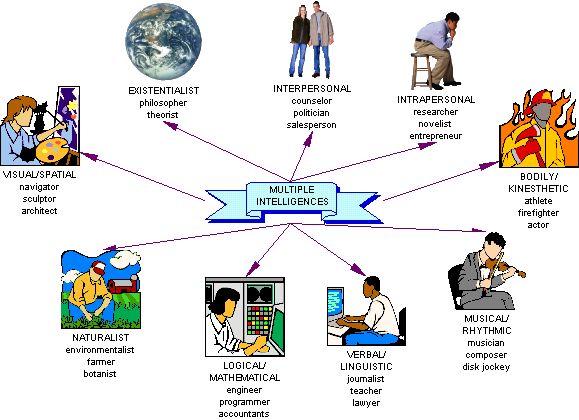
The movies are constructivist in nature and provide context, relevance and added interest through the use of voice and animation versus text. Many more senses are involved and multiple intelligences catered for (Gardner, 1983).

Multiple Intelligences (Source – http://wik.ed.uiuc.edu)

Critical questions are asked in contexts that are more real than abstract and that students are more readily able to relate to and connect with. It also will engage them more to want to do the research/ work needed to solve the problem.

Questions

Instructor perspective

  1. How can lessons be made more contextual and not abstracted from students’ reality? For example, I think there are many areas in Mathematics (at some levels) that are not readily applicable to everyday use, for example factorisation of quadratic formulas.
  2. Can lessons be structured in such as way that they all start from a contextualised problem and all learning platform from there? How is this possible or how can it be different for abstract concepts?
  3. How can I add real-life aspects to perceived abstract or non-relational elements?

Design perspective

  1. What type of technology, pedagogy and assessment do we need to have to support such education as described in 2 above?

Resources

1. The Jasper Series – https://www.vista.ubc.ca/webct/RelativeResourceManager/Template/ModuleB/MB_L1ACTJasperMovies.htm

2. Charels Lindbergh – http://www.charleslindbergh.com/history/paris.asp

3. Theory of Multiple Intelligences – http://www.tecweb.org/styles/gardner.html

4. Photo of Multiple Intelligences – http://wik.ed.uiuc.edu


Categories
Module B

Pedagogy for Technology Enhanced Learning for Math and Science

Investigating Pedagogical design of a technology-enhanced learning experience for math and/or science


When we look at a technology enhanced learning experience we look at the process of learning alongside the affordances created by technology within the environment itself.  The environment and the space are both influenced by the type of technology and how it is used to support learning.  Technology can often influence and sometimes change the learning process.

If we consider technology enhanced learning experiences then one has to consider the environment, the tools and the process of learning. Taking this into consideration with Kozma’s recommendation  that, “Designers should provide students with environments that restructure the discourse of …classrooms around collaborative knowledge building and the social construction of meaning” (Kozma, 2003, p.9), then designers need to create collaborative models/technology that employ sharing and the ability for multiple users on any one task. Designers should also include areas for/avenues for discourse and discussion that allow  for the sharing of ideas, concepts and debates while presenting original thought and analysing that of others.

Therefore, an ideal pedagogical design of a technology enhanced learning experience would be one in which I would:

i.            Enable both asynchronous and synchronous means of communication through technology, with students giving original authorship/creation and analysis of other colleagues’ work. Utilisation of posts (audio, video and text) in web 2.0 technology would be incorporated

ii.            Use technology that is interactive and that will enable interactivity and self and group directed patterns. Students will engage actively in hands on tasks and activities while interacting with technology in collaborative tasks and using of the technology collaboratively, for example, technologies such as Interactive Whiteboards, laptops/ipads with interactive educational apps

iii.         Use technologies that extrapolate inquiry, investigation and problem solving skills. I would place great emphasis on questions and tasks in that they must be of the level/limits such that the technology enables completion as well as introduces new levels and concepts.

iv.          Use hardware and software that at best reflect and allow for a real-life experience or practical application of concepts.

References

Kozma, R.  (2003). Technology, innovation, and educational change: A global perspective, (A report of the Second Information Technology in Education Study, Module 2).  Eugene, OR: International Association for the Evaluation of Educational Achievement, ISTE Publications.


Categories
Module B

Definition/Metaphor of Technology

I. Definition/Metaphor of Technology

I like Muffolleto’s (1994) discussion of technology ‘as a way of acting’. I believe that it is more so now as man has become even more integrated with technology. Donna Harraway’s (1991) discusses the concept of cyborgs, which talks of this seamless integration of man with computers/machines/technology. Technology as a way of acting means not only the use of technology but also the thinking patterns associated with and/or influenced by its use. I believe that both these constructs are more prevalent now.

If we look at Lorenzo Simpson’s definition of technology as ‘the constellation of knowledge, processes, skills and products whose aim is to control and transform’ (1995:16) and Arnold Pacey’s concept of technology as entailing ‘ordered systems that involve people and organizations, living things and machines’   (1983:6) in light of Harraway’s concept of cyborgs and Muffoletto’s  thought of technology as ‘a way of acting’ then concepts of technology can be considered as a way of thinking and performing with tools and systems and the design and performance of processes and systems according to the influences and affordances of these tools.

References

Harraway, Donna (1991b) ‘A Cyborg Manifesto: Science, Technoogy, and Socialist-Feminism in the Late Twentieth Century’ in Harraway, Donna Simians, Cyborgs, and Women: the Reinvention of Nature London: Free Association Books

Kozma, R.  (2003). Technology, innovation, and educational change: A global perspective, (A report of the Second Information Technology in Education Study, Module 2).  Eugene, OR: International Association for the Evaluation of Educational Achievement, ISTE Publications.

Muffoletto, R.  (1994).  Technology and restructuring education:  Constructing a context.  Educational Technology, 34(2), 24-28.

Pacey, Arnold (1983) The Culture of Technology London: Basil Blackwell

Simpson, Lorenzo C. (1995) Technology and the Conversations of Modernity New York: Routledge


Spam prevention powered by Akismet