Categories
Module B

Investigating Technology Enhanced Learning Environments – The Jasper Series

Description

The Jasper Series is a series of fourteen movies that are used in technology enhanced learning environments.  Each movie/video provides a number of problem solving scenarios that require students to come up with mathematical solutions to real life problems/questions.

The media offers audio and visual sets that are arranged and narrated as an adventure. The voices used in the narrations all give the lessons/problem solving scenario a movie like or a book-like (Sherlock Holmes type of adventure) quality.

Instructor perspective/Impact

The Series provided an interesting medium for presenting problems. The movie gave some connectivity with the persons involved and in some instances provided broader contexts and links such as historical facts. For example in Movie 6, Charles Linbergh as the first person to desire to fly solo across the Atlantic and his non-stop trip from New York to Paris in 1927.

The movies are constructivist in nature and provide context, relevance and added interest through the use of voice and animation versus text. Many more senses are involved and multiple intelligences catered for (Gardner, 1983).
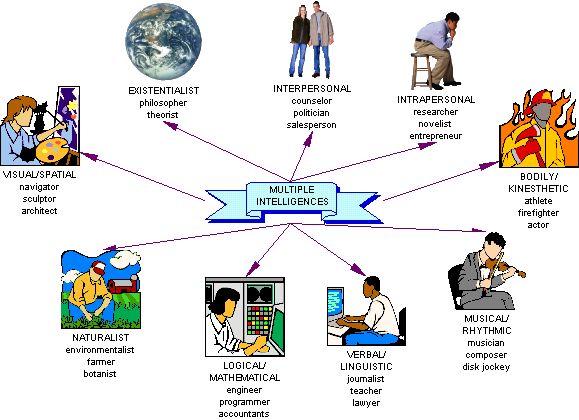
Multiple Intelligences (Source – http://wik.ed.uiuc.edu)

Critical questions are asked in contexts that are more real than abstract and that students are more readily able to relate to and connect with. It also will engage them more to want to do the research/ work needed to solve the problem.

Questions

Instructor perspective

  1. How can lessons be made more contextual and not abstracted from students’ reality? For example, I think there are many areas in Mathematics (at some levels) that are not readily applicable to everyday use, for example factorisation of quadratic formulas.
  2. Can lessons be structured in such as way that they all start from a contextualised problem and all learning platform from there? How is this possible or how can it be different for abstract concepts?
  3. How can I add real-life aspects to perceived abstract or non-relational elements?

Design perspective

  1. What type of technology, pedagogy and assessment do we need to have to support such education as described in 2 above?

Resources

1. The Jasper Series – https://www.vista.ubc.ca/webct/RelativeResourceManager/Template/ModuleB/MB_L1ACTJasperMovies.htm

2. Charels Lindbergh – http://www.charleslindbergh.com/history/paris.asp

3. Theory of Multiple Intelligences – http://www.tecweb.org/styles/gardner.html

4. Photo of Multiple Intelligences – http://wik.ed.uiuc.edu


Categories
Module B

Pedagogy for Technology Enhanced Learning for Math and Science

Investigating Pedagogical design of a technology-enhanced learning experience for math and/or science


When we look at a technology enhanced learning experience we look at the process of learning alongside the affordances created by technology within the environment itself.  The environment and the space are both influenced by the type of technology and how it is used to support learning.  Technology can often influence and sometimes change the learning process.

If we consider technology enhanced learning experiences then one has to consider the environment, the tools and the process of learning. Taking this into consideration with Kozma’s recommendation  that, “Designers should provide students with environments that restructure the discourse of …classrooms around collaborative knowledge building and the social construction of meaning” (Kozma, 2003, p.9), then designers need to create collaborative models/technology that employ sharing and the ability for multiple users on any one task. Designers should also include areas for/avenues for discourse and discussion that allow  for the sharing of ideas, concepts and debates while presenting original thought and analysing that of others.

Therefore, an ideal pedagogical design of a technology enhanced learning experience would be one in which I would:

i.            Enable both asynchronous and synchronous means of communication through technology, with students giving original authorship/creation and analysis of other colleagues’ work. Utilisation of posts (audio, video and text) in web 2.0 technology would be incorporated

ii.            Use technology that is interactive and that will enable interactivity and self and group directed patterns. Students will engage actively in hands on tasks and activities while interacting with technology in collaborative tasks and using of the technology collaboratively, for example, technologies such as Interactive Whiteboards, laptops/ipads with interactive educational apps

iii.         Use technologies that extrapolate inquiry, investigation and problem solving skills. I would place great emphasis on questions and tasks in that they must be of the level/limits such that the technology enables completion as well as introduces new levels and concepts.

iv.          Use hardware and software that at best reflect and allow for a real-life experience or practical application of concepts.

References

Kozma, R.  (2003). Technology, innovation, and educational change: A global perspective, (A report of the Second Information Technology in Education Study, Module 2).  Eugene, OR: International Association for the Evaluation of Educational Achievement, ISTE Publications.


Categories
Module B

Definition/Metaphor of Technology

I. Definition/Metaphor of Technology

I like Muffolleto’s (1994) discussion of technology ‘as a way of acting’. I believe that it is more so now as man has become even more integrated with technology. Donna Harraway’s (1991) discusses the concept of cyborgs, which talks of this seamless integration of man with computers/machines/technology. Technology as a way of acting means not only the use of technology but also the thinking patterns associated with and/or influenced by its use. I believe that both these constructs are more prevalent now.

If we look at Lorenzo Simpson’s definition of technology as ‘the constellation of knowledge, processes, skills and products whose aim is to control and transform’ (1995:16) and Arnold Pacey’s concept of technology as entailing ‘ordered systems that involve people and organizations, living things and machines’   (1983:6) in light of Harraway’s concept of cyborgs and Muffoletto’s  thought of technology as ‘a way of acting’ then concepts of technology can be considered as a way of thinking and performing with tools and systems and the design and performance of processes and systems according to the influences and affordances of these tools.

References

Harraway, Donna (1991b) ‘A Cyborg Manifesto: Science, Technoogy, and Socialist-Feminism in the Late Twentieth Century’ in Harraway, Donna Simians, Cyborgs, and Women: the Reinvention of Nature London: Free Association Books

Kozma, R.  (2003). Technology, innovation, and educational change: A global perspective, (A report of the Second Information Technology in Education Study, Module 2).  Eugene, OR: International Association for the Evaluation of Educational Achievement, ISTE Publications.

Muffoletto, R.  (1994).  Technology and restructuring education:  Constructing a context.  Educational Technology, 34(2), 24-28.

Pacey, Arnold (1983) The Culture of Technology London: Basil Blackwell

Simpson, Lorenzo C. (1995) Technology and the Conversations of Modernity New York: Routledge


Categories
Module A

Interview Reflections

IV. Reflection on Interviews

Main areas of interest

I had several questions in my interview process. The main ones were however if technology can embody the essence of the nature of the course and/or how technology itself enhances pedagogy i.e. improves students’ experience (more meaningful) and understanding of the learning process.

Assumptions, beliefs and/or ideals

Prior to Interview

I believed that technology should mirror or embody processes within the subject area and that it should allow for students interactivity, opportunity for feedback, enable problem solving  and be applicable to/linked to personal, societal and global situations/experiences while being open-ended (allowing for divergent options and/or further investigation.

After Interview

After investigation, and reviewing my interview and transcripts from my colleagues, I would say that the technology itself does not have to be the subject (as in the math or chemistry process) but rather encourage/enable students to explore for themselves. Take them to other limits and likewise assist them in their own self-paced investigation.

Pedagogy is a key consideration and I see that more time needs to be spent on generating questions and tasks and researching and incorporating technologies that can facilitate tasks and questioning processes while allowing students to interact with the problem in real and concrete ways.

I believe even more that the technology must be interactive and enable individual time and work with the technology. This process in and of itself will enable self directed learning, divergent options and further investigation. I learnt that while not all math concepts may show real life processes or applications, visual representations or extrapolation of what solutions offer are very important. These can be aided with technology.

Recurring themes

One of the main points raised was the time saved in the use of technology and the more time that can be spent on going through material for understanding rather than dissemination.

Lone ranger activities in driving technology integration were mentioned. Other similarities were seen in the necessity of strong pedagogy over the use of technology. Cost and teacher training and support were high considerations. As was the need to model classrooms to reflect the reality of the social and technological aspects of society.

Differences or points of debate

Such instances occurred around questions of the impact of technology on increasing students’ understanding. Some found that they interacted with the technology more so than their students and that students benefited from teachers being able to use the technology to add interest to the lesson and to deliver content in an easier and more effective way. Others felt that technology in some cases did not push students to understand and work with concepts but rather becoming more reliant on the technology to solve problems. However, from my interview and others’,  technology was shown to increase students’ understanding while also enriching the process by enabling them to engage in self-paced and self-directed learning. In the case of the latter such benefits were seen/ generated when students were able to interact with the technology themselves and when teachers created questions/tasks that pushed students to use concepts and were supported by the technology that widened boundaries and limits.

Follow up questions/further investigation

One question therefore at the end of the process is about the teaching process and if it does not stretch or push the student then is it effective? This would apply to technology use in education as well and whether or not it supports stretching/pushing students and/or expanding their experiences and investigations. Similarly, if a technology does extend limits is it effective? How do we enhance without technology, that is, if we do not have access?
I would like to know more about/explore technology that enable student interaction in a real-life and relevant context, while enabling concrete reference. Technologies that allow students to direct their investigation and that allow them  to track thoughts/processes. Interactive Whiteboards (IWBs) are definitely on the top of my list of technologies to explore further.


Categories
Module A

Interview – Technology in the Math Classroom

III. Classroom Practice, Technology in the Math Classroom


Interview Excerpts and Analysis


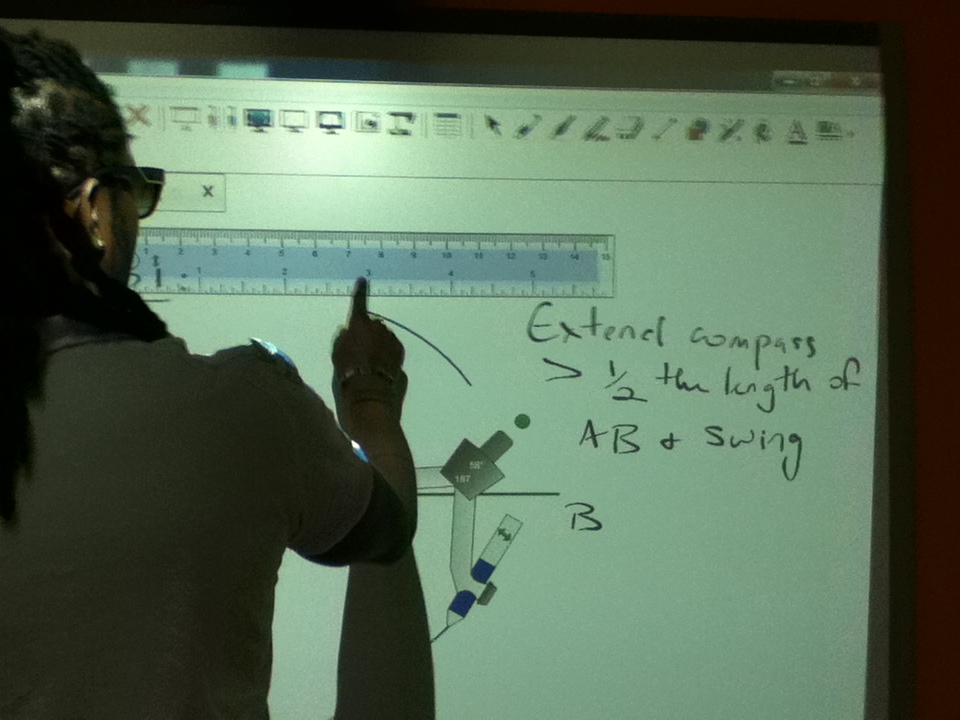
Subject: MathematicsLevels: Grades 3 (8 yrs old) – College levelTechnology: Smart Board/Whiteboard interactive                      
Interview excerpts Analysis
Motivations for Using technology in the Classroom

  1. ‘I wanted a touch and interactive technology. I saw it in my head and I searched around and went to conferences until I found it’.
  2. ‘I really wanted to get technology into the classroom’.
  3. ‘Students are able to get more involved in the lesson. It’s interactive and so students can get to use the technology.’


The main drive came from the teacher to implement the technology from what they thought was a better experience for students. The main drive was the desire for increased interactivity. Therefore any technology of value had to be touch enabled and interactive.
Technology – Advantages of and Disadvantages of use

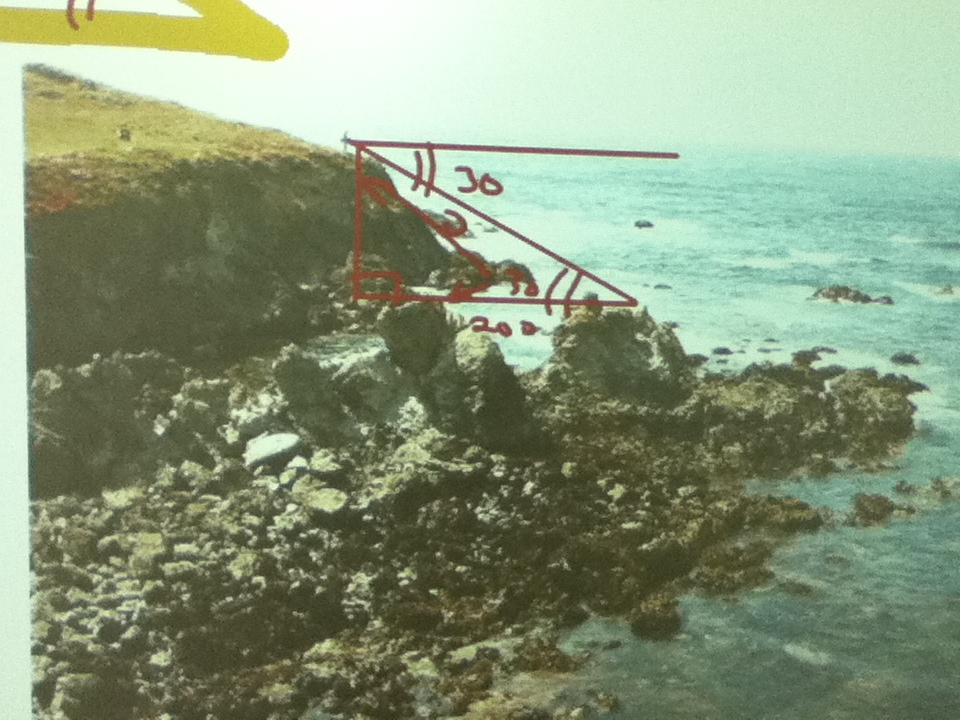
  1. ‘It’s interactive. Students can come to board and use technology. They can extrapolate concepts that they would be previously asked to just imagine. It helps them to reduce levels of ambiguity and clear up concepts’.
  2. ‘Using the traditional way you spend time writing notes on a regular whiteboard. With the technology you can preplan notes. You don’t need to waste time writing notes. It saves on a lot of time. Also, you don’t need to erase the board. Students can’t miss notes.
  3. ‘The days of writing off notes are over. You can now spend time on understanding’
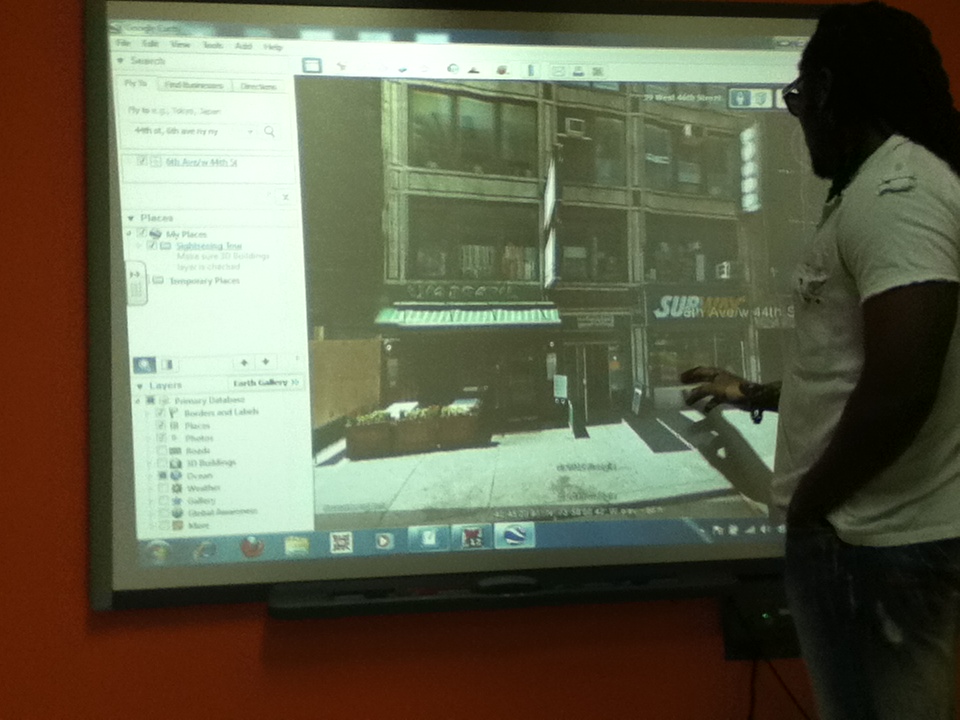
  4. ‘I can just click on something. I can have the power of the internet right here. I am released from my curriculum being restricted by what I just walk into the classroom with.’

Disadvantage

  1. ‘Subject to power supply or computer crashing’
  2. ‘If students cannot make use of access such as Internet access for notes etc’
Time, organization and classroom management were great advantages alongside expected benefits of increased interactivity and engagement. Students do not need to spend writing off notes and can concentrate instead on understanding and on taking personalized notes.Students are offered practical and concrete reference as well as self-paced learning with opportunities for making learning relevant, as well as clear up ambiguities and interact with concepts in a more meaningful way.The only disadvantages seen by the teacher are reliance on resources needed to facilitate the technology use. 
Student Experience Using the technology‘Organization of notes is better for them and it’s cool and fun’.‘It is very user friendly and these students of this age are technology oriented. They pick up based on watching you use it and you teach them whatever else as you go along’‘Their interest is definitely piqued but technology is really just a tool. It boils down to the teacher and how the teacher can influences students to want to practice and learn.’‘ Interest is piqued because the class reflects technology in their everyday life’[no cultural or gender bias] but ‘boys want to play a bit more but that is it. The girls are good’ Interest is added based on interactivity. Students are more inclined to try and explore concepts for themselves as they are desirous of working with the technology. It also offers them increased practical ways in working through concepts and unclear areas.It simplifies the experience in understanding concepts and making connections (in content and in real-life).
Teaching experience using the technology‘The thing is how you view mathematics and how you view how to teach. Some teachers use smartboard without implementing or using features of the technology.  I use the technology and features to influence how I teach. In the past what you would see is the finished product and trying to remember how to get there. Here they see process.  You can take notes from the interactive session and email as a pdf. The student can follow blow by blow and understand.’‘you can have a teacher that does not know how to use the features’ The teacher has to be knowledgeable of and use technology to its full potential and limits to stretch themselves and the students
Pedagogy/Teaching methods‘It doesn’t make sense to assess them in a way that they will not get assessed. We have standardised exams and so what we can change is how we deliver it [the content] so that they can understand better and when we break down past papers they will go into the exam a lot more visually aware.’‘Technology is just a tool’‘Teachers need to have an open mind and know there is no set way to teach. How can I stretch the limits of technology to make the lesson better, how can I stretch students to have that experience?”Finding ways of using the technology to its limits’‘How the teacher can influence students to want to practice and learn.”Can just have a bad teacher with technology.’‘There is only so much and no more a teacher can introduce and then some onus is on the student. Technology can be a blank screen and it is how the teacher uses it to get what they want or in trying to get across the task’‘I just want to use the technology all the time. It is just a matter of how you view the mathematics and how you view how to teach. That’s the major difference. You could have teachers who have the technology and just use it as a regular whiteboard.’ Technology stretches limits and capabilities of the teacher as well as offers access to resources that can enrich the experience. However, onus still lies on strong pedagogy and teaching methods that utilise the potential of the technology and that create tasks that get students to want to learn and practice, whether with the technology or otherwise.
Challenges with implementing the technology

  1. ‘Power supply, computer and cost of technology’
  2. ‘Cost is a big challenge particularly in developing countries.’
  3. ‘You have teachers who don’t know how to check emails yet asking them to learn all of this technology. The openness of a teacher and willingness to learn is important and if they don’t have the technology to interact with daily it gets hard. Teachers then take up a lot of time and the wow factor for students gone.


Teacher training in being able to fully utilise the technology is essential in gaining benefits. Teachers’ openness and a willingness to learn are paramount. Also, the drive to research and find the technology you need.
Ideal Classroom‘Each student with Ipads or any tablet technology plus the interactive technology’ Technology integration is crucial because if the classroom does not reflect the reality and interactions of students then school and learning become abstract, dull and boring for today’s technology driven and oriented society.
Reasons for innovation‘The classroom needs to mimic outside. We need to tweak the curriculum to keep up with changing times. We must challenge ourselves as teachers to make new ways or models to increase interaction of students and how we deliver info to let technology answer a lot of questions students may have and increase their drive to interact and learn’


Categories
Module A

Unpacking Assumptions Part 1 – ‘Good’ technology:use and expectations

Investigation – Expectations of ‘good’ technologies and their use in the Mathematics and Science Classroom

Questions

What is a good use of technology in the math and science classroom? What would such a learning experience and environment look like? What would be some characteristics of what it is and what it isn’t?

What makes this a good use of technology? Is this a vision or is it possible in real classrooms? What makes this vision a challenge to implement and what might be needed to actualize it?

Response

Mathematics and Science traditionally involve inquiry, investigation, problem solving, testing and/or applying concepts/models within specific contexts or situations and analyzing results. As such technologies that facilitate such would be good inclusions. Both fields are interactive and the environment, technologies and learning experiences should allow for creating specific circumstances and situations in which students can use and apply concepts/areas of investigation and apply them to day to day experiences as well as global situations.

Appropriate Technologies and Learning Environments should:

i. Be Interactive – students would be able to enter formulas and be able to see and analyse results with opportunities for feedback

ii. Allow for self-direction and choice

iii. Provide support for self-directed inquiry (equipment/tools, background information, examples, simulations, testing procedures, feedback on results)

iv. Enable problem solving – allow for synthesizing and application. Students should be given real world problems and be able to use mathematical or scientific concepts to solve problems

v. Create conditions of use or for use of technologies, for example simulations

vi. Be applicable to/linked to personal, societal and global situations/experiences

vii. Be open ended – allowing for divergent options and/or further investigation

Appropriate Technologies and Learning Environments are not:

i. Static

ii. Only drills and practice – learn a formula and practice examples

iii. Singular/devoid of context (must be applied in context and show a variety of applications) – in the ‘not ideal model’ concept/formulas are presented by rote learning

iv. Stand alone (i.e. it must be linked to feed back and application) – in the ‘not ideal instance’ students are not able to have independent self-paced practice.

Vision or Reality

This is a good use of technology as it enables real life applications of concepts and the ability for students to engage in interactive, inquiry based processes reflective of the nature of the subject of study (Mathematics/Science). This will help to add interest and applicability to students and act as motivators as concepts will be less abstract. It also means that environments can be created in which students are able to work more independently at their own pace, in a fun and interactive way, while offering the teacher increased opportunity to facilitate the process and offer more individual and specific feedback.

All these are central tenets of theories of learning such as Constructivism; Situated cognition; Bruner’s Discovery Learning; Ausubel’s Meaningful Learning; and can provide opportunities to diversify learning as earmarked in Garner’s Theory of Multiple Intelligences.

It is possible to achieve such in the classroom through the use of technologies such as simulations (some offered free on internet), web inquiries, and software. However, challenges are presented as in many instances monetary investments are needed for implementation and use at higher levels of engagement, particularly if more context specific adjustments are required. For example simulations and software developed in first world countries not being directly applicable to, and most times not representative of, third world countries. Also, investments in internet accessibility, computers and other tools are needed. This is not always possible.

What is needed to make such technologies and their use available in creating desired learning environments are cheaper and readily accessible technology and support for building human capacity within countries to fuel context specific, user-friendly design and/or creating a global network or repository that offers open source context specific design and applications for simulations et al. Also essential to the realisation are: the building of internet capability and capacity within schools along with tools and infrastructure (such as computers and IT administrators); teacher and student training in using and managing the technology (often teachers express inability to use and apprehension in using technology in the classroom) and a general cultural awareness in the design and delivery of technological tools and technology mediated environments


Categories
Module A

Auto e-ography

I. Auto e-orgaphy: My Technology and Me – Journey to technology use in the Mathematics and Science Classroom

Technology, although ever-present in my life, never gained as much meaning to me until I became an educator. I surfed the internet, engaged in online chat and talk whenever I was online but there was never a drive for me to login unless I had to and I preferred to watch rather than play video games. There were two pivotal moments in my journey and relationship with technology: My Blackberry and Educational technology.

My relationship with technology grew with my acquisition of my smartphone and best friend, my blackberry  :-). Instantly I was on top of all my mail, increasing and maintaining better contact time with work, friends and family. With anytime, anywhere access information and the concept of knowledge and its acquisition took on a different meaning.

My love for and integration with technology was further cemented in October of 2009 when I had an epiphany of the power and practical use of digital technology in supplementing the teaching and learning process through enabling independent study. On this great day I was in attendance at an education technology conference. The presentation under discussion engaged us in the creation of computer-aided tutorials, which provided immediate feedback. I had just started teaching at my present College and had been searching for ways to assist my students in areas I had identified as in need of remediation and also to increase critical thinking and analysis. I had been using technology somewhat but needed more from the process. I just wasn’t sure how, what or how to do it. Thus I was sold at the conference, which offered practical and clear cut solutions that I could design on my own. Two months later I began pursuing entry into the MET programme. Since then I have taught a number of courses in which I employ digital technology and have found them successful in: increasing concrete reference; enabling situation and contextual analysis; providing stimulation for creativity and standard setting; enlarging the community and providing examples/ experiences from a global perspective; increasing dialogue, contact time and timely feedback;  providing opportunities to increase critical analysis; enabling independent study, drills and practice and personal inquiry.

In 2010 when I was asked to teach College Mathematics I realised I was yet again in need of more support and am looking for ways for creating/using simulations and for means of demonstrating abstract concepts in practical contexts, which is where I am at now in my timeline of My Technology and Me.

Timeline of experiences and roles

From: Observer and infrequent Participator

Digital games (Atari, Nintendo)

Net Surfing, Email, Instant messaging, Skype, Social Networks

To: Engaged and Self directed

Blackberry

Net surfing, Email, Instant Messaging, Social Networks (Increased capacity and

convenience  through smartphone) , Skype, Wii, Videography

Now: Design oriented

Education technology

PowerPoint tutorials, Online quizzes and tutorials, Websites, Blogs, Videos, photos,

digital stories, Moodle (Online course delivery)

Looking For/To:

Creating/using simulations and for means of demonstrating abstract concepts in

practical contexts


Categories
Uncategorized

Welcome

Welcome to the blog. This is an e-portfolio which covers inquiry and analysis of issues, perspectives, strategies and effects of technology use in the Mathematics and Science Classroom.

Spam prevention powered by Akismet