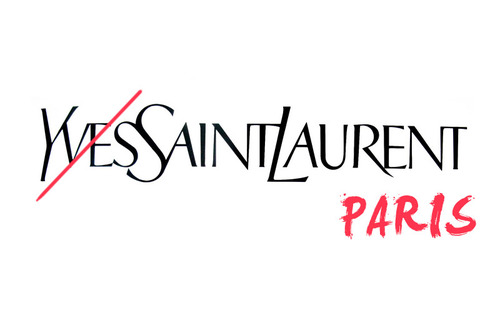
 It was recently announced by newly appointed creative director of fashion house Yves Saint Laurent Hedi Slimane that he plans to change the company’s name from Yves Saint Laurent to Saint Laurent Paris. This major change to an iconic brand name has critics questioning Slimane’s motive. Although many are quick to speculate fashion/political reasons for this change to the name, it may be as simple as Mr. Slimane is zeroing in on and targeting his consumer audience. Although Saint Laurent Paris remains a high end couture brand name of apparel recently their products have been promoted by more lower level celebrities for example; reality television star Lauren Conrad. Their clothing is also routinely featured in publications such as US Weekly which targets a younger, lower income demographic of women than a magazine such as Vogue, which features competitor brands such as Chanel or Celine. The addition the location of the brand name’s flagship store would offer a sense of brand identity to
  consumers less familiar with haute couture clothing lines. This change in addition to the ultra causal Spring/Summer collection debuted by Slimane at Paris Fashion Week suggests that he is making this drastic change for more marketing reasons than brand aesthetics. Read more here.
Month: October 2012
Categories
Pepsi Tries to Shift Brand Identity
In the world of soft drinks it can be stated that the fiercest rivalry is between Pepsi Co. and Coca Cola. The point of parity between these two soda giants is that they both produce brown, carbonated, sweetened beverages, though most cola die hards will swear differ completely taste wise (although the rest of us may not be so convinced). It is no secret however, that Pepsi Co. has been lagging far behind Coca Cola in respect to points of difference for the company.
Over the last century Coca Cola has set itself apart by marketing their soda as a quintessential All-American staple, pushing the sales and popularity of Coke far ahead of those of Pepsi. However Pepsi Co. looks to get back in the race with their most recent ad campaign.
The marketing team for Pepsi Co. has produced the #NOW campaign, which looks to create a younger, fresher identity for their product. This is achieved through the use of social media (hashtags on Twitter), celebrity endorsement (i.e. Nicki Minaj) and the featuring of trendy, young people consuming Pepsi products. This attempt to redevelop a “second place brand” which has never really had a specific brand identity may be enough to finally put Pepsi Co. on par with Coca Cola when it comes to popularity. Only time will tell. Meanwhile check out the #NOW commercial here.
 According to this Globe and Mail article by David Parkinson, many major tech companies such as Microsoft, Apple and S&P have either introduced or substantially increased their dividends (money payed by the company to their shareholders via cheque) over the last few years.
A sector once known for their high spending on marketing, research, product development, etc. to try to gain profit, most major companies seem to be profitable enough now to be able to dole out large dividends to their shareholders as they have never before. Looking at statistics, the technology sector’s dividend pay out rate has risen 1.5% in the last decade. This makes it almost on par with the average financial sector payout rate, a sector known for its high dividends.
But what does this change really mean?
As Parkinson suggests in his article, perhaps this marks the movement of technology shares from being higher risk “roller coaster” investments to being safer, dependable investments with good return rates. As today’s society seems to grow more and more dependant on all forms of technology, his reasoning is not unfounded. What do you think? Are tech companies shifting from higher risk to low risk investments?