Memorandum #5

February 23, 2014

To: Dr. David Michelson

From: Danny Kim, L2C4 Team Leader

This memorandum serves as an update for progress of the EECE 380 Design Studio III team, L2C4, during the week of February 17 – February 23, 2014.

We had our weekly team meeting on Monday, February 17, where we talked about our progress in the software and hardware portions of the project from the previous week.

Updates on Hardware Portion:

The 4 pole crystal ladder filter we previously designed did not have enough gain from its resolution  peak from the noise of the circuit as we hoped. We decided to improve our design by building a 2 pole crystal ladder filter with a better gain. With our original filter having ~1 KHz bandwidth, our new filter has a bandwidth of ~2 KHz in order for us to see how high the peak of a signal is. Previously, the signal was getting attenuated but as a result of our improved crystal ladder filter, at our centre frequency, we are getting a gain of ~10 dBm when the Mixer, Voltage Controlled Oscillator, and RF Amplifier are all connected.

We were having trouble with the output of the crystal ladder filter being too low of a voltage to be accurately measured by the peak detector. We decided to add an amplifier after the filter and before the detector. We designed two different solutions. The first is a CE-CB cascode amplifier that creates isolation from the input to the output and the second is a 4th order butterworth low pass filter using 2 high speed amplifiers. The butterworth was able to pass a signal through with much less distortion and we were able to create a voltage gain of up to 100V/V. We are unsure of which one to use as of now. The butterworth is a much better amplifier, but it comes with the cost of a much more complex circuit.

We spent this week solely on hardware, so there is no update from software portion this week.

In the following week, we plan on meeting on February 24th to discuss current state of the project and plan our goals.
 

Memorandum #6

February 23, 2014

To: Dr. David Michelson

From: Ryan Wong, team leader

This memorandum serves as an update for progress of the EECE 380 Design Studio III team, L2C4, during the week of February 24 – March 3, 2014.

This weed, we focused mostly on integrating the hardware component with the software component.

Updates on Hardware Portion:

There was much progress on the hardware, finally completing a design for an amplifier that worked at high frequencies. The team constructed a series of three LM7171 inverting amplifiers with an overall gain of 45 dBm. Our implementation of the subsystem block diagrams from the output of the mixer  involved the 10.7MHz BPF, Crystal Filter, cascaded op-amps, peak detector, active LPF, and voltage divider. From there, our filtered DC signal entered into the myDAQ cleanly.


Updates on Software Portion:

This week, we focused mostly on adding extra features to the software portion, as well as integrating it with the hardware component. We played around with the ramp generator to determine the optimal range of frequencies that would produce the more accurate signal, which we decided was between 0.1 to 0.5 Hz. Any frequencies above 0.5 Hz generated a very wide signal that was significantly shifted to the right. We also implemented a means for the user to enter the desired center frequency and the span from the front panel, by using a numeric control and a dial. From these values we were able to determine upper and lower frequencies that we plugged into the X Span and Y Span property nodes of the XY Graph to enable the user to zoom in and out of the graph. We also implemented an algorithm that resets the XY graph after every cycle of the ramp generator. This way, the VI would no longer have buffer issues.

Thus far, the software portion has the following capabilities:

  • Determine  the maximum signal power and store it in a shift register, while continuously comparing the maximum value with the current measured power values. Display the maximum signal on the front panel and reset after every ramp cycle.
  • Determine the corresponding frequency of the signal detected, store it in a shift register and display on the front panel. Reset after every ramp cycle.
  • Count the number of significant signals in one ramp cycle and use this number to determine the modulation index up to 1.5.

We are currently in the process of calibrating the dBm measurements on LabView.

Memorandum #4

February 16, 2014


To: Dr. David Michelson


From: Jacklyn Dang, L2C4 Team Leader


This memorandum serves as an update for progress of the EECE 380 Design Studio III team, L2C4, during the week of February 10 – February 16, 2014.


We had our weekly team meeting on Tuesday, February 11, where we talked about our progress in the software and hardware portions of the project from the previous week. At the conclusion of the meeting, we decided on the goals to be attained by the end of the week.


Updates on Hardware Portion:

 Last week, we had placed an order for some high frequency op-amps to provide gain in the peak detector, and output signal of the mixer. We hoped that using an LM7171 200MHz op-amp would allow us to reach the needed gain at 10MHz, however we were unable to successfully build a non-inverting amplifier. It appeared that even a simple buffer would not work with this IC, outputting a DC voltage that correlated with the supply voltage of the op-amp. This failure led us to designing common-emitter BJT amplifiers instead. These designs have carried out into the subsequent week, as we are still working on obtaining a high gain with poles at the appropriate frequencies.


Updates on Software Portion:

As mentioned in the previous memo, we had completed the software portion of the project, but had not been able to test it without the completion of the hardware portion. During the first lab section this week, we worked on adding both required and extra features to the software portion of the project. We focused on implementing a user friendly and interactive interface for the analyzer that had the ability to zoom in and out on specific areas. We also aimed to add a marking feature to our spectrum analyzer. We were successfully able to implement and test the zoom feature, as well as implement a marker. We have been unable to test the marker due to a problem with LabView that will be described below.


During the second lab session we encountered a problem with the LabView program. The program itself seemed to be lagging quite significantly and therefore it majorly affected the updating of values from the MyDAQ to the graph in LabView and we would not get a continuous, fast updating view of our signal. We know that this is not caused by our sample number or sample rate in the MyDAQ assistant as we had previously used the same values and not had any problems, but we also experimented by increasing samples and sample rate which still produced the lagging output. We have consulted with the TA and with the lab technician that was available during the lab, but neither had any insight into the problem. We believe that the computer we were on was just running slowly that day, and that the next time we run LabView  the program will run smoother. If not our task for next week will be finding a solution to this current problem.

We plan on meeting during the reading week to continue working on the hardware portion of the project. Our next scheduled meeting will be on Monday February 24th.

Memorandum #3

February 10, 2014

To: Dr. David Michelson

From: Lauren Aliman, L2C4 Team Leader

This memorandum serves as an update for progress of the EECE 380 Design Studio III team, L2C4, during the week of February 3 – February 9, 2014.

We had our weekly team meeting on Monday, February 3, where we talked about our progress in the software and hardware portions of the project from the previous week. We also talked about how each individual component of the Spectrum Analyzer works and how they all tie together. At the conclusion of the meeting, we decided on the following goals to be attained by the end of the week:

Hardware

  • Develop “unit” tests for each separate block
  • Simulate the entire system for integration testing of the RBW and peak detector, replacing the MyDAQ visual display block with the lab spectrum analyzer

Software

  • Attain a good understanding of the theory behind the software design.
  • Generate an XY-graph that acquires data from the ramp generator (y-axis) and from an analog myDAQ input (x-axis).

Updates on Hardware Portion:

Last week’s issue regarding unexpected gain at high frequencies outside of the RBW filter was solved by adding the 10.7MHz BPF in series with the RBW. It was noticed that placing this BPF at the input the crystal ladder had different effects than placing it at the output. We attempted to use the RF amplifier that was provided in our kit to add gain to our ~10MHz filtered signal, however the amplifier provided gain for frequencies that we considered noise, so the professional 10.7MHz BPF was connected after the RF amplifier to eliminate these high frequencies.

The current peak detector will be upgraded to have an op-amp to compensate for the diode voltage drop. However, the 10MHz op-amp that we purchased had major attenuation starting just below 1MHz, to the point where there was an unreadable signal at 10MHz. A proposed solution was to use a 100MHz op-amp that causes no attenuation at 10MHz. This part has been ordered and we will attempt to have a functional precision peak detector by the start of next week.

Updates on Software Portion:

During the first lab session, we spent some time talking about how the outputs from each component of the project look like, in both the time and frequency domains. By doing so, we were able to get a clear picture of what was going on, which made designing the software portion a lot more straightforward.

To display the amplitude of a signal in the y-axis of the graph, we connected a DC signal from a signal generator to one of the analog inputs in myDAQ which we then mathematically manipulated to display the corresponding power in dBm. For the x-axis, we adjusted the ramp generator to have voltages ranging from 3V to 6V. We then came up with a linear function, that simulates the behavior of a local oscillator, to convert the ramp generated voltages to corresponding frequencies between 45 MHz and 57 MHz. By the end of the second lab session, we ended up with a graph consisting of a single pulse that sweeps across the displayed frequency range (45-57 MHz). This output makes sense because we were only feeding the myDAQ input with a constant DC signal. On the other hand, the output from the peak detector would have to be a DC signal whose voltage changes along with the signal from the local oscillator; in other words, each frequency in the given range corresponds to a different output voltage from the peak detector. In theory, the display should work; however, we are yet to come up with a method to test the software portion without connecting it to the peak detector.

We will have our next weekly meeting on Tuesday, at the start of the lab session, to plan out this week’s goals.

Memorandum #2

February 2, 2014

To: Dr. David Michelson

From: Douglas Mosher, L2C4 Team Leader

This memorandum serves as an update for progress of the EECE 380 Design Studio III team, L2C4, during the week of January 28 – February 2, 2014.

On Monday, January 27, our team held a meeting, where we delegated responsibilities for the spectrum analyzer project. The team was broken down as follows: Jackie and Lauren will be responsible for the software portion (MyDAQ, LabView, LO, ramp generator, etc.) and Doug, Danny and Ryan will be responsible for designing the hardware (peak detector, crystal ladder, filters, etc.).

The software team focused on becoming familiar with LabView. During the second lab period ,a successful ramp generator was implemented and adapted to work with the MyDAQ module. We implemented the ramp generator by building a block diagram in LabView. We attached a signal simulator to the MyDAQ output and then enclosed the system with a while loop. Our team encountered a problem where the ramp generator would periodically stop and then begin running again. This was resolved by changing the settings in LabView to continuously output samples from the signal simulator. We were also successfully able to output the ramp generator through the MyDAQ and were able to verify the output using an oscilloscope. We also spent time to fully understand the theory behind the the software design.

The hardware team focused on the peak detector and the crystal ladder this week. 10MHz and 11MHz op-amps were ordered on Friday, January 31, to be used for a precision peak detector. Our team, as well as several others in our lab section, encountered an issue where the AC signal from the RF generator had a significant offset in its amplitude when connected to a basic peak detector. This issue was solved by adding a first-order high pass filter (RC circuit) before the input of the basic peak detector. The current design requires improvement, as the detected peak has a slight voltage drop compared to the actual AC signal’s peak. This should be fixed with a precision peak detector design.

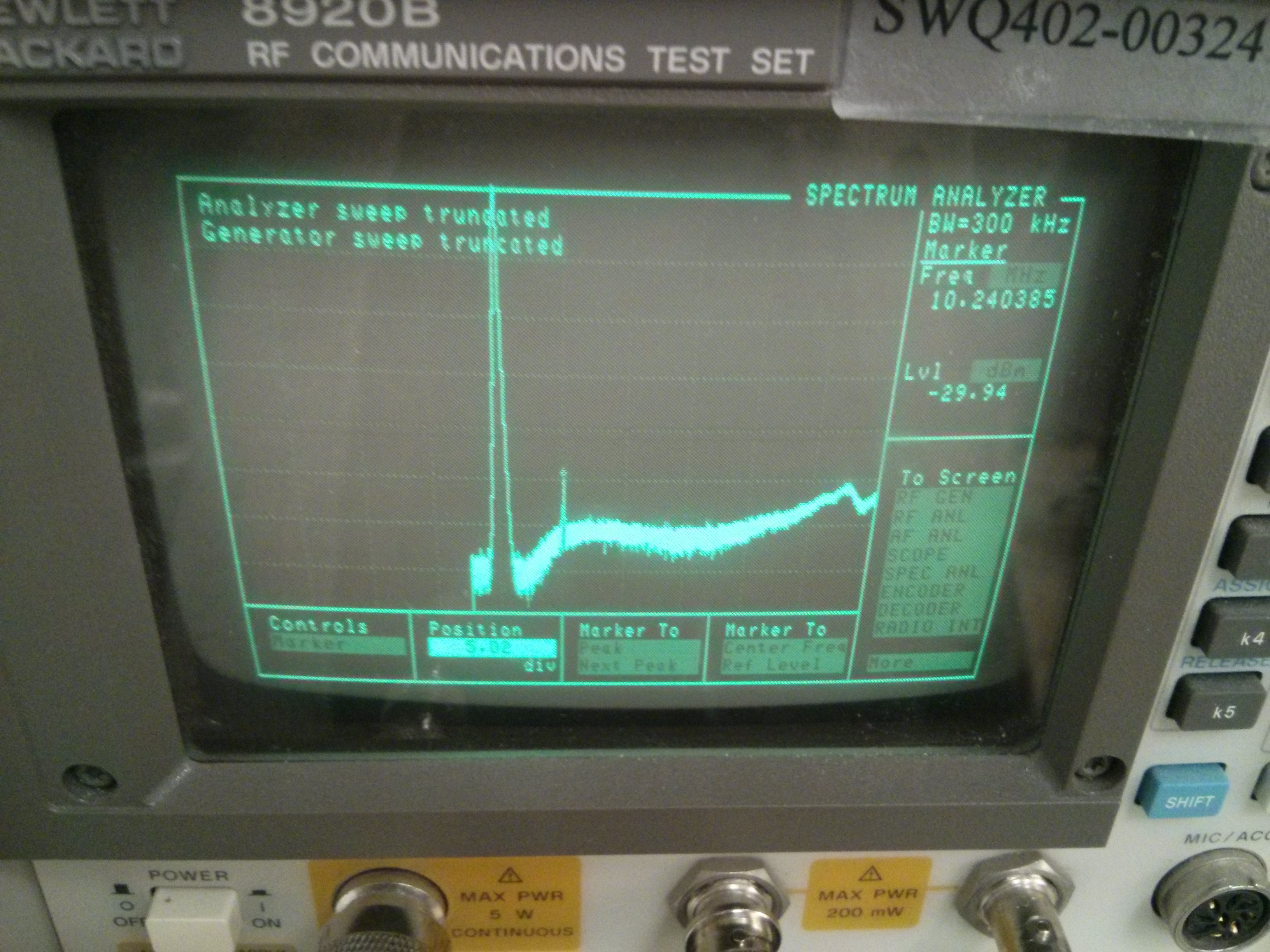
As for the crystal ladder circuit, we managed to generate a BPF with a BW of ~1kHz. However, due to the faultiness in the crystals, the center frequency is slightly off from 10MHz (~9.9987MHz). Another issue was that the BPF would negate all frequencies relatively close to 10MHz, however, higher frequencies in the 50-54MHz range were not stopped. After observing the spectrum across a 100MHz range, we noticed that the dBm gradually increased to values higher than the amplitude of the BPF itself (Figure 1). Filtering the input of the crystal ladder improved this issue (Figure 2).

Figure 1: BPF without correction

Figure 2: BPF with correction

We plan to meet after lecture on Monday, February 3 to discuss component testing and subsystem interfacing, as well as plan out new weekly goals.