Categories
The Road Ahead

Return to Corn

On September 27, Bloomberg reported on what I feel (intuitively, and probably naively) was an inevitable plummet in the corn markets, due to the lower stocks and fragile demand patterns. “Corn for December delivery fell 0.8 percent to $7.19 a bushel at 8:07 a.m. on the Chicago Board of Trade, after touching $7.185, the lowest for a most-active contract since July 12.” [1] By the end of the week (according to September 30 TradeSim prices), December corn had risen again to 756.25. Similarly, December wheat had risen to 902.5 from its September 27 decline of ” 0.1 percent to $8.6825 a bushel in Chicago” [1]

The following day, corn rebounded; “Corn futures for December delivery rose by the 40-cent limit on the Chicago Board of Trade to close at $7.5625 a bushel at 2 p.m.” reports Bloomberg in its article, “Corn Futures Jump Most Since June on Unexpected U.S. Supply Drop.” [2]

Bloomberg also reports that “The USDA this month predicted a harvest of 10.727 billion bushels, a drop of 13 percent from last year and down from 10.779 billion forecast in August.” [2] This means that the upswing from Thursday’s low point, combined with greater demand than last year because of lower supply, will make December (and maybe March) futures contracts worth more.

Rabobank’s September report agrees, reporting Corn as Bullish and below normal stock levels. [3]

As of my trade on September 30, December corn contracts were selling for 756.25, and March contracts for 759.50. Since I am not confident enough to risk too many corn contracts, bought (long) two December contracts and look forward to seeing the market activity in both December and March contracts next week.

[1] http://www.bloomberg.com/news/2012-09-27/soybeans-set-to-gain-as-drop-to-seven-week-low-may-boost-demand.html

[2] http://www.bloomberg.com/news/2012-09-28/u-s-corn-stockpile-unexpectedly-drops-sparks-price-rebound-1-.html

[3] http://www.rabobank.com/content/images/Agri_Commodity_Markets_Research_Grain_Stocks_Sep2012.pdf
Categories
Cool Source of Information

Rabobank AgriCommodity Markets Research

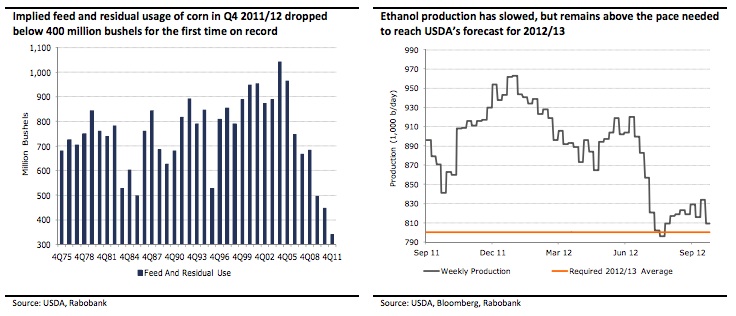
Since I am in Europe this week, I thought I would look into some European news sources. Rabobank is familiar to me as a sponsor of the Tour de France, but they produce monthly agricultural commodity reports with good summaries and comparisons of production, stock, and market levels of various agricultural commodities.

It reports basic market trends and predictions, but it also simply links market movements with related products, like ethanol for corn (below), and different grain usages like feed and residual production.

This report, combined with more recent information about contract prices, was useful in determining whether the recent fluctuations in the corn markets were an indication of upcoming volatility, or a fluke.

Find the Rabobank September report here: http://tinyurl.com/8v5kser

Categories
What Went Right/Wrong

Missed the boat on an active week in corn markets

This was a week away from market news, which made me appreciate my last strategy of getting out of the volatile corn markets and moving into the more stable wheat markets. I ended the first week up more than $2000 from being active in the corn market, but after a second weekend “playing” in the wheat market, my balance had only dropped $37.25.

Had I been keeping up with the markets, I could have followed the drop and subsequent rise toward another equilibrium in the corn market, because according to Bloomberg and Rabobank, the dynamics reflect the USDA predictions of stock and production levels and corresponding supply and demand effects. According to a Bloomberg article from September 27 titled Corn Retreats as USDA Reports Declining Export Sales, “U.S. exporters sold 368 metric tons in the week ended Sept. 20, compared with 69,578 tons a week earlier, the Department of Agriculture said today. Corn prices are down about 15 percent since the worst U.S. drought in half a century spurred a rally to a record $8.49 a bushel on Aug. 10. Wheat export sales at about 426,000 tons were 13 percent below a week earlier.” [1]

Meanwhile, I was short in the wheat market, which, as reported above, dropped from the previous week. Luckily, this market is less volatile, so my damage was minimal.

Categories
The Road Ahead

Wheat Weather

After Andrew Borden’s talk on Wednesday, I am intrigued by using weather to predict market movement. Therefore, I intend to spend the next week or so betting on global weather patterns. My split wheat position has treated me well, since losses on my long position were offset by greater gains in my short position.  Since the next week will keep me further from a computer, I will remain in the market in this (hopefully) less risky position.

According to Spectrum Commodities [1], China is the world’s largest wheat producer, followed by India, the US, France, and Russia. Canada enters the production landscape as the sixth largest, producing over three times the amount consumed domestically. As China is the largest producer, it makes sense to look at Chinese weather patterns. However, India appears to be a more prominent player in winter wheat, so for trading in December futures contracts, the Indian forecasts are more relevant.  [1]  According to CNN, weather in India is expected to remain consistent, meaning harvests should be good. Therefore, prices should remain constant, and I will go short an additional contract in spring wheat.


[1] http://www.spectrumcommodities.com/education/commodity/statistics/wheat.html

Categories
What Went Right/Wrong

Up in Corn, Split in Wheat

This week I experimented in hedging by going both long and short in the same commodity. I successfully spent a few days making money in a short corn contract, but I wanted to try something more complicated, so I took the advice of Andrew Bordern and “Sold High and Bought Low.” I got out of my corn contract and went long in a December wheat contract, with a plan to sell it on Friday. Reuters reported a “recent surge in wheat prices” in their September 18 article “OUTLOOK-India wheat seen stable after fall in global prices,” [1] so I expected prices to drop soon. Therefore, just in case Reuters was wrong, I decided to see what would happen to a long position for just a few days. By the end of trading on Thursday, I had – as predicted – lost just over $112.

My short corn contract, on the other hand, did quite well, as predicted. I was skeptical of judging my trades on the production in one country – India – but covered those hesitations with my split position.

This analysis did bring up a question, however – how quickly does it take for the market to respond to actions in one producing country? How long does it take the Law of One Price and Adam Smith’s promise of equilibrium to balance out prices for such a commodity?

“A sharp fall in U.S. wheat prices weighed on grain prices across the globe and its impact was felt in India as it could cut export demand for Indian wheat,” according to Reuters.  “Wheat futures in India, the world’s second-largest producer, are likely to remain stable for the rest of the week, after falling on Monday on global cues.”

The last two days of my held contracts fall in line with these observations and predictions, however, suggesting perhaps one major producer can effectively predict the market movements.


[1] http://in.reuters.com/article/2012/09/18/markets-india-wheat-idINL3E8KH59X20120918

Categories
Cool Source of Information

Cool Source of Information: Commodity Trends

This week, after entering the market on corn futures, I decided to try a different commodity, since this is a good time to start understanding many sides of the market with simple trades. As a newcomer to market trading of any kind, and as someone much more comfortable with qualitative analysis than quantitative, I have been reading reliable sources like Bloomberg and Reuters.

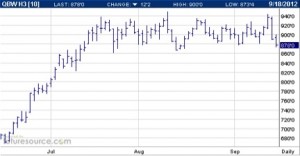
On the Wall Street Journal, I found market data for each commodity. Below is the chart showing historical trends in the wheat markets.


On this Wall Street Journal Market Data Center website, you are able to see detailed data and trend graphs for (presumably) all the futures on the market for each commodity.  With such a great scale of historical information, I was able to notice that wheat futures have been fluctuating in the last two months around a consistent level, so I went long and short in nearby futures to observe the difference between the different contracts of the same commodity.


Categories
What Went Right/Wrong

USDA trends and the resilience of corn influence a short position

I decided to start my trading with corn, since I am most familiar with the sight of expansive fields of it, as a former US Midwesterner. My few farmer friends are in the Midwest, and the drought this year has meant I am most comfortable with speculation in the media about its effect on corn and corn’s various food byproducts. A novice in the circles of options and futures trading, and the stock market, I let the experts at Bloomberg explain recent trends and expectations for me.

“Corn Bulls Retreat as Near-Record Costs Curb Demand” appeared to be a simple headline to guide my first trade [1]. It serves well to first understand that a bullish market is optimistic, and therefore invests more in the future at stake, and a bear market is pessimistic and therefore dominated by sales (short) of futures at hand. The 13 September Bloomberg article states that “the US government said the worst drought since 1956 will damage the crop less than analysts had expected and on speculation that near-record prices will curb demand.” This shrinking demand means prices will decrease, suggesting a short position is desirable. While Damien Courvalin, an analyst at Goldman Sachs, wrote that “Prices may have to rise further before consumption is constrained,” the argument that “The USDA lowered its estimate for U.S. exports by 3.8 percent from a month earlier to 31.75 million tons, down 19 percent from a year earlier” appeared on a more influential scale and with sufficient evidence to convince me to go short on my first corn future speculation.

I made the trade on Thursday, so one day of trading later, my decision looks good, as my marked to market balance has increased by approximately $37. I anticipate seeing what week opening patterns exist in this market before making my next trade.


[1] http://www.bloomberg.com/news/2012-09-13/corn-bulls-retreat-as-near-record-costs-curb-demand-commodities.html

Categories
Uncategorized

Gateway to domestic price hikes

The Northern Gateway Pipeline from Alberta to Kitimat will send Albertan oil to the Pacific Rim, in which the largest market in the current discussion is China. In a simple exercise in supply and demand, this will raise the price of crude oil for Canadian refineries, and lower the sale price realized in Chinese sale of Canadian crude oil, according to Gil McGowan, President of the Alberta Federation of Labor, in his interview with CBC’s Carol Off (“As It Happens, The Tuesday Edition,” 4 September 2012).

Canadian oil producers are currently attracted to selling crude oil in China because of the “Asia premium,” higher prices on crude oil sold in China in particular, presumably even with transportation costs under consideration. This would reduce supply for Canadian refineries and processors, therefore raising the domestic sale price of domestic crude oil. These higher raw materials costs will mean higher production costs and likely lower employment rates in the Canadian oil processing and refining sectors.

Although it seems counterintuitive that exporting Canadian oil can lower profits in both domestic and international markets, the global market is a fascinating circus, as always. McGowan also explains that the Saudi Arabian oil producers who currently supply most of China’s oil can readily lower their prices to compete with the Canadian oil at “Asia premium” prices, therefore eliminating that Canadian premium and reducing profits.

The proposed route of the Northern Gateway pipeline tears through some of the most beautiful and ecologically unique landscape in the world; here, the Sacred Headwaters in Northern BC, by Paul Colangelo for Patagonia (http://www.thecleanestline.com/2012/08/the-sacred-headwaters.html)

Spam prevention powered by Akismet