Categories
Cool Source of Information

Great weekly summaries, plus more candy corn

This week I stumbled quickly on a great recap of the week’s markets, at ForexPros; an excellent, concise weekly outlook informed by summaries of last week’s activities:

http://www.forexpros.com/news/commodities-news

On a more newsworthy note, for those of you trading corn, Stephen Colbert has reported on a brilliant continuation of last week’s news that cattle farmers are turning to (HFCS-filled) candy as a more affordable feed for their cows than (HFCS primary ingredient) corn itself.

http://www.colbertnation.com/full-episodes/thu-october-18-2012-the-killers

Plus, for anyone unfamiliar with Americana, Colbert’s story about the Corn Palace is also definitely worth watching. (It follows his story on “candy corn.”)

Categories
The Road Ahead

A Macro View

I have spent the last few days in Baltimore, Maryland, and as such have been re-immersed in US politics, less than two weeks before the presidential elections. And while the USDA Crop Progress Report comes out on Monday, none of the shocks in the markets have lasted for longer than a couple of days. Since I am trading with a longer-than-day-trader strategy, this means my “weekly” (or so) outlook should consider the election more seriously.

Unfortunately, I take a rather cynical view of politics, and don’t anticipate any major changes in governmental policy with any new administration, or any new combination of staff or Congress under a continued Obama administration. I do, however, think policy regarding agricultural subsidies and requirements governing products like biofuel has a major influence on national supply and demand (recognizing in this observation that biofuel and wheat are not close substitutes). Because I anticipate little policy change, I find myself returning to other drivers of price fluctuations, like weather. However, judging from this week’s quick reaction and re-balance from the Ukraine’s trade announcement, even international trade decisions from enormous global producers may not have much effect on Chicago prices.

Taking this macro view may be more in line with my trading style. Therefore, I will hold my general short position in wheat, but I am interested to see what will happen with my spread position, so I will remain patient with that for the rest of this week.

Categories
What Went Right/Wrong

A jump in wheat

My spread position this week didn’t see much action, since any difference between contracts was hugely overshadowed by Wednesday’s surge in prices due to Ukraine’s announcement they would stop exports in November. [1] In keeping with longer-term trends, wheat prices ended slightly lower than at the beginning of the week, meaning my combination of long and short positions ended without seeing any major shocks. (Hooray!) While this means I didn’t have any great revelations about my short position, it does mean my last couple of weeks of losing money fast slowed down.

Below is the graph of my contracts from the beginning of term, showing my slowly growing confidence in a long term short wheat contract.


[1] http://www.forexpros.com/news/commodities-news/grain-futures—weekly-outlook:-october-29—november-2-239990

Categories
Cool Source of Information

Seasonal trends

I’m trying to figure out how to enter a spread this week, which means I’ve found seasonal trend charts useful from Futures Buzz: http://www.futuresbuzz.com/seasonal_charts.html 

Categories
What Went Right/Wrong

Week 5: Surprise!

Right when I thought I had these general trends under control – Surprise! All of our trading commodities suddenly hit bottom and rose last week, catching me completely unawares. I shouldn’t have been surprised, frankly, but it did cause me to panic a bit and get out of my short contracts quickly. This means I’m now only trading in wheat, which is less interesting but, since I’ve discovered I’m not a good day trader, is probably a better idea. I ended the week down $4,328.33 from the end of last week ($39,50,29 to $35,178.96), but more importantly, down $7,865.87 from my Monday ending balance of $43,044.83.

I am uncertain whether I should have kept my medium to long-term strategy that led me to enter those short corn contracts in the first place. Looking at longer term trends in the corn markets means I am looking at entering a spread this week, but that’s a subject for the next post.

Why did the prices rise, and why should I not have been surprised? As I said last week, I was looking at the Australian wheat harvest this week, and I anticipated a drop in prices because of an increase in supply. However, I failed to remember that it is the size of the harvest relative to expectations that is key, not today’s greater supply of wheat as compared with “yesterday’s.” So I went short on Tuesday when I should have gone long, and got out of it on Friday.

By early last week, predictions had come true, and prices had gone up. In a hasty move, because I didn’t have time to read up on the news, I noticed gathering disaster forming, and I got out of almost all of my contracts without entering the market any other ways.  I think I cut my losses, but it does mean I lost consistency with my longer-term strategy.

According to Bloomberg, “Wheat climbed 35 percent this year as dry weather in parts of the European Union and Russiacut global stockpiles to the lowest in four years, helping boost food costs 7.7 percent the past three months. The U.S. Department of Agriculture cut its estimate for Australian output 12 percent to 23 million tons on Oct. 11. That may be lowered a further 2 million tons in coming reports because of dry conditions, said Rabobank International.” [1]
[1] http://www.bloomberg.com/news/2012-10-22/wheat-harvest-in-australia-seen-slumping-to-lowest-in-five-years.html

Categories
Cool Source of Information

Candy Corn?

In what I believe is evidence of how backward many US agricultural policies have become, candy has become cheaper than corn (and, more importantly, fresh vegetables for humans to eat).

However, imagining cows eating gummy worms does bring a smirk to my face.

http://www.dailyfinance.com/2012/10/10/cash-strapped-farmers-feed-candy-to-cows/

Does this mean we should be considering sugar as a substitute for corn in evaluating market supply and demand? But aren’t gummy worms made from HFCS anyways? – meaning this practice is even more convoluted than it seems, hence the nutritionist’s observation that candy provides cows with “the same kind of energy as corn.”

Categories
The Road Ahead

The Road Ahead – Week 5

The news from the USDA will likely start a slow reaction in the markets; wheat is slow moving but pretty consistent, in my limited experience, so I will try to observe it a bit better and maybe go long in corn, depending on demand fluctuations, next week.

I haven’t had my eye on wheat, but this week I will get back into it, observing news about the Australian harvest in particular.


Categories
What Went Right/Wrong

Lessons Learned – Week 4

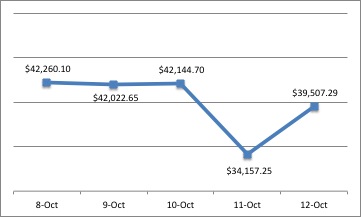
I ended the week in not a bad position, despite the massive jump in prices after the USDA report was released on Thursday, but the progress I thought I’d made earlier this week on understanding what I’d convinced myself was a confusion about short and long trading was overturned. As it turns out, I hadn’t been confused at all before – I just convinced myself that my confused classmate was right.

Nevertheless, I proceeded to lose nearly $10,000 in one day, only to rebound the following day by more than half of that loss.  I’m holding only short contracts, which seemed like a terrible idea at the end of the day on Thursday, but perhaps isn’t so bad in the medium to long-term.

(Above: Equity Balance for Week 4)

The prices jumped on October 11 because the USDA report saw smaller world supply. [1] However, this was offset quickly (seen in the recovery of prices on Friday) by a drop in demand for US exports, too. [2] According to Bloomberg, wheat is still overpriced, so I will stay in my short contracts and hope that drop was a short-term effect of the USDA report. After all, the CBOT reflects supply and demand on a global scale, and prices will likely recover after the USDA’s United States focused news and forecasts. Already, corn, wheat and soybeans prices are back down, with wheat and soybeans lower than they were before.


[1] http://www.bloomberg.com/news/2012-10-11/corn-surges-most-in-two-weeks-as-usda-sees-smaller-global-supply.html

[2] http://www.bloomberg.com/news/2012-10-12/wheat-tumbles-as-drop-in-u-s-exports-may-signal-slowing-demand.html)

Categories
Cool Source of Information

Cool Source of Information – some fun this week

Something fun this week – after screwing up royally with what I thought was a profound revised understanding of basic market dynamics, I returned to my finance class notes from last winter, and I found the link to this movie clip from Trading Places, with an excellent explanation.

http://www.popmodal.com/video/1277/Trading-Places-Final-Exchange-Scene-amp-Explanation


Categories
The Road Ahead

The Week Ahead: Oct 8-12

The drought’s affect on corn prices is still dominating most of the information sources I have found. I am still struggling to understand which factors trigger the Stockout Property of the LOP, since decreasing stocks due to the drought should (intuitively) increase prices with increasing demand. However, corn prices are falling. Forecasts for increased demand from Korea and storms in the Midwest lead me to predict further increased demand and spot price increases. The USDA is “is expected to say this year’s US corn harvest was the smallest in six years and that corn supplies could hit 17-year lows by the end of next summer due to crop losses from the worst drought in over 50 years.” [1]

I decided to take a general view to determine which of the infinite factors at play to observe. If stocks of corn come close to running out, storage costs will decrease. If we follow the logic that the cost of storage is the only driver of price increases, corn prices should decrease. However, lower supply should increase prices. This puts us in a (relative) equilibrium position. Therefore, prices for corn should stay relatively stable, and other global pressures will be the instigators of price changes.

Perhaps decreasing liquidity is an issue;  “Volume in Chicago continues to shrink, falling 9% Monday to just 146,212 contracts, according to the preliminary report from the CBOT. Open interest was off 3,163 on modest fund selling.” [2] I am not sure what all of that means, but less liquidity should lead to an increase in prices.

Therefore, we’re looking at three drivers of corn price increases:

  1. lower supply
  2. higher demand (from Korea)
  3. decreased liquidity

Why, therefore, have prices been dropping? Will they continue to fall this week? Bloomberg provides one possible answer: “Corn Prices Set to Drop as South American Farmers Boost Planting.” [3] And while the harvest isn’t set to be ready until later next year, anticipated future supply means there is less need for more storage of low stocks of corn in the near future since they will be replenished in 2013.

Therefore, I have revised my prediction, and in anticipation of lower prices, have reversed my long position for two short December contracts, and two short May contracts, so I can observe the spread over the next week.

My wheat contracts continue their slow progress, so I will hold onto my short contract for at least the next few days.


[1] http://www.brecorder.com/markets/commodities/america/84567-cbot-corn-falls-on-seasonal-harvest-weight-.html (Thanks for the reference, Ishrat!)

[2] http://farmfutures.com/story.aspx/morning-market-review-bryce-knorr-0-30780

[3] http://www.bloomberg.com/news/2012-08-29/corn-prices-set-to-drop-as-south-american-farmers-boost-planting.html

Spam prevention powered by Akismet