Categories
Cool Source of Information The Road Ahead

Surprise in corn + MarketWatch easy-to-read charts

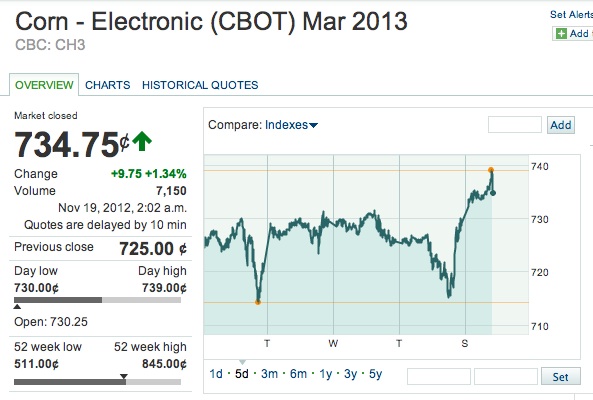
Last week’s expected corn pattern didn’t go so well, but it did end the week on an unusual high, judging from the week’s prices.

Source: http://www.marketwatch.com/investing/future/corn

So, even with all the news about corn shortages, I will try to capture some profits in the first couple of days this week.

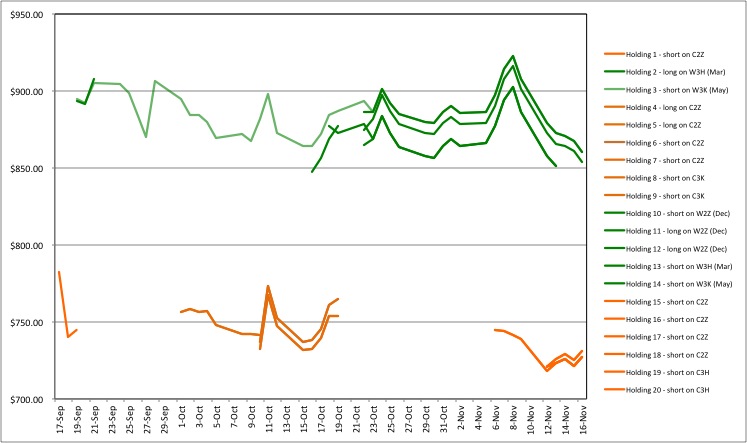
However, looking at my semester’s trends, it does seem like my short wheat position is still a much better long-term option than the choppy history I’ve had in the corn markets.

Therefore, I’m going to stick with learning some more corn lessons in the last couple of weeks, and hopefully take home some profits from getting out of two of my wheat contracts before the week begins.

Categories
The Road Ahead

The week ahead: Week 9

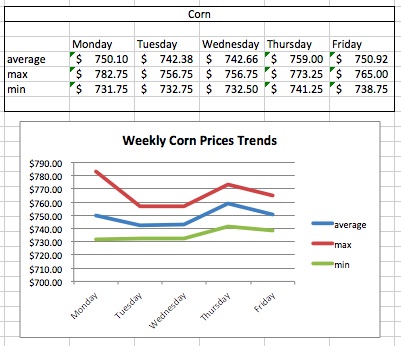
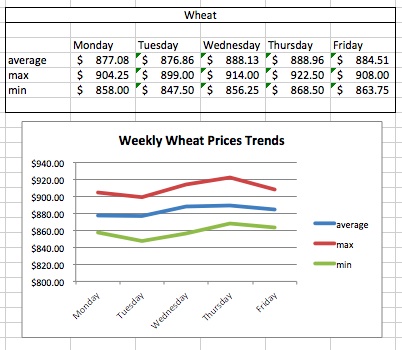
I’ve been watching a consistent holding of wheat futures for the past few weeks, and very nearly freaked out when the prices skyrocketed after the US election this past week. This made me question my usual Wednesday/Thursday routine, so I looked for weekly trends in my corn and wheat holdings. Observing the trends in my own holdings (in true business school market research style), it appears my intuition was true.

The Thursday peak is surprisingly consistent. But what is most alarming is the dramatic fall at the beginning of the week in corn prices, a trend that begs to be tested.

Categories
The Road Ahead

A Macro View

I have spent the last few days in Baltimore, Maryland, and as such have been re-immersed in US politics, less than two weeks before the presidential elections. And while the USDA Crop Progress Report comes out on Monday, none of the shocks in the markets have lasted for longer than a couple of days. Since I am trading with a longer-than-day-trader strategy, this means my “weekly” (or so) outlook should consider the election more seriously.

Unfortunately, I take a rather cynical view of politics, and don’t anticipate any major changes in governmental policy with any new administration, or any new combination of staff or Congress under a continued Obama administration. I do, however, think policy regarding agricultural subsidies and requirements governing products like biofuel has a major influence on national supply and demand (recognizing in this observation that biofuel and wheat are not close substitutes). Because I anticipate little policy change, I find myself returning to other drivers of price fluctuations, like weather. However, judging from this week’s quick reaction and re-balance from the Ukraine’s trade announcement, even international trade decisions from enormous global producers may not have much effect on Chicago prices.

Taking this macro view may be more in line with my trading style. Therefore, I will hold my general short position in wheat, but I am interested to see what will happen with my spread position, so I will remain patient with that for the rest of this week.

Categories
The Road Ahead

The Road Ahead – Week 5

The news from the USDA will likely start a slow reaction in the markets; wheat is slow moving but pretty consistent, in my limited experience, so I will try to observe it a bit better and maybe go long in corn, depending on demand fluctuations, next week.

I haven’t had my eye on wheat, but this week I will get back into it, observing news about the Australian harvest in particular.


Categories
The Road Ahead

The Week Ahead: Oct 8-12

The drought’s affect on corn prices is still dominating most of the information sources I have found. I am still struggling to understand which factors trigger the Stockout Property of the LOP, since decreasing stocks due to the drought should (intuitively) increase prices with increasing demand. However, corn prices are falling. Forecasts for increased demand from Korea and storms in the Midwest lead me to predict further increased demand and spot price increases. The USDA is “is expected to say this year’s US corn harvest was the smallest in six years and that corn supplies could hit 17-year lows by the end of next summer due to crop losses from the worst drought in over 50 years.” [1]

I decided to take a general view to determine which of the infinite factors at play to observe. If stocks of corn come close to running out, storage costs will decrease. If we follow the logic that the cost of storage is the only driver of price increases, corn prices should decrease. However, lower supply should increase prices. This puts us in a (relative) equilibrium position. Therefore, prices for corn should stay relatively stable, and other global pressures will be the instigators of price changes.

Perhaps decreasing liquidity is an issue;  “Volume in Chicago continues to shrink, falling 9% Monday to just 146,212 contracts, according to the preliminary report from the CBOT. Open interest was off 3,163 on modest fund selling.” [2] I am not sure what all of that means, but less liquidity should lead to an increase in prices.

Therefore, we’re looking at three drivers of corn price increases:

  1. lower supply
  2. higher demand (from Korea)
  3. decreased liquidity

Why, therefore, have prices been dropping? Will they continue to fall this week? Bloomberg provides one possible answer: “Corn Prices Set to Drop as South American Farmers Boost Planting.” [3] And while the harvest isn’t set to be ready until later next year, anticipated future supply means there is less need for more storage of low stocks of corn in the near future since they will be replenished in 2013.

Therefore, I have revised my prediction, and in anticipation of lower prices, have reversed my long position for two short December contracts, and two short May contracts, so I can observe the spread over the next week.

My wheat contracts continue their slow progress, so I will hold onto my short contract for at least the next few days.


[1] http://www.brecorder.com/markets/commodities/america/84567-cbot-corn-falls-on-seasonal-harvest-weight-.html (Thanks for the reference, Ishrat!)

[2] http://farmfutures.com/story.aspx/morning-market-review-bryce-knorr-0-30780

[3] http://www.bloomberg.com/news/2012-08-29/corn-prices-set-to-drop-as-south-american-farmers-boost-planting.html
Categories
The Road Ahead

Return to Corn

On September 27, Bloomberg reported on what I feel (intuitively, and probably naively) was an inevitable plummet in the corn markets, due to the lower stocks and fragile demand patterns. “Corn for December delivery fell 0.8 percent to $7.19 a bushel at 8:07 a.m. on the Chicago Board of Trade, after touching $7.185, the lowest for a most-active contract since July 12.” [1] By the end of the week (according to September 30 TradeSim prices), December corn had risen again to 756.25. Similarly, December wheat had risen to 902.5 from its September 27 decline of ” 0.1 percent to $8.6825 a bushel in Chicago” [1]

The following day, corn rebounded; “Corn futures for December delivery rose by the 40-cent limit on the Chicago Board of Trade to close at $7.5625 a bushel at 2 p.m.” reports Bloomberg in its article, “Corn Futures Jump Most Since June on Unexpected U.S. Supply Drop.” [2]

Bloomberg also reports that “The USDA this month predicted a harvest of 10.727 billion bushels, a drop of 13 percent from last year and down from 10.779 billion forecast in August.” [2] This means that the upswing from Thursday’s low point, combined with greater demand than last year because of lower supply, will make December (and maybe March) futures contracts worth more.

Rabobank’s September report agrees, reporting Corn as Bullish and below normal stock levels. [3]

As of my trade on September 30, December corn contracts were selling for 756.25, and March contracts for 759.50. Since I am not confident enough to risk too many corn contracts, bought (long) two December contracts and look forward to seeing the market activity in both December and March contracts next week.

[1] http://www.bloomberg.com/news/2012-09-27/soybeans-set-to-gain-as-drop-to-seven-week-low-may-boost-demand.html

[2] http://www.bloomberg.com/news/2012-09-28/u-s-corn-stockpile-unexpectedly-drops-sparks-price-rebound-1-.html

[3] http://www.rabobank.com/content/images/Agri_Commodity_Markets_Research_Grain_Stocks_Sep2012.pdf

Categories
The Road Ahead

Wheat Weather

After Andrew Borden’s talk on Wednesday, I am intrigued by using weather to predict market movement. Therefore, I intend to spend the next week or so betting on global weather patterns. My split wheat position has treated me well, since losses on my long position were offset by greater gains in my short position.  Since the next week will keep me further from a computer, I will remain in the market in this (hopefully) less risky position.

According to Spectrum Commodities [1], China is the world’s largest wheat producer, followed by India, the US, France, and Russia. Canada enters the production landscape as the sixth largest, producing over three times the amount consumed domestically. As China is the largest producer, it makes sense to look at Chinese weather patterns. However, India appears to be a more prominent player in winter wheat, so for trading in December futures contracts, the Indian forecasts are more relevant.  [1]  According to CNN, weather in India is expected to remain consistent, meaning harvests should be good. Therefore, prices should remain constant, and I will go short an additional contract in spring wheat.


[1] http://www.spectrumcommodities.com/education/commodity/statistics/wheat.html

Spam prevention powered by Akismet