Categories
What Went Right/Wrong

Week in Review

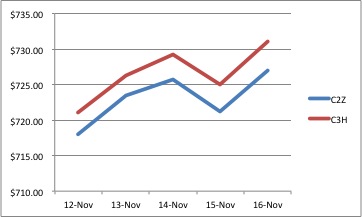
This week I was reminded again why I didn’t like the unpredictability of the corn markets. After trying to capitalize last week on what I thought was a weekly trend with an early week fall in corn prices, the Tradesim delays struck me, and I ended up instead observing different sorts of weekly trends.

Instead of falling at the beginning of the week, corn rose as the week went on.

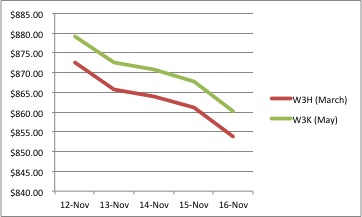
Wheat, on the other hand, refreshingly followed it’s slight downward trend, which was again reassuring after some recent choppiness.

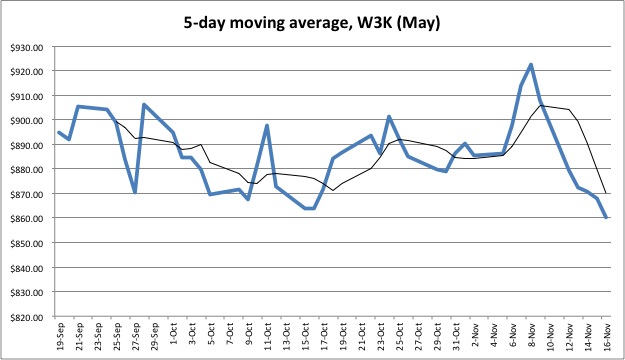
Since we learned last week about moving averages, I thought I’d take a look at the moving average of my longest-held contract, which makes me worry a bit about how that recent massive fall in prices will be responded to, if at all.


Categories
What Went Right/Wrong

Week in Review: Go Obama!

Politics made things very confusing this week. After Obama’s election Tuesday, and the promise of continued “status quo,” markets fell across the board. However, fears of what Reuters calls an impending “fiscal cliff” also injected fear into the markets [1]. This confusion was felt in the corn market, where prices shot in many direction. I looked to forecasts for ethanol production, which Obama is expected to cut [2], meaning demand will decrease. Unfortunately, that explanation ran counter to the skyrocketing prices in both corn and wheat, so we must look instead to bad weather in the US, Canada, and other major producing markets for a possible explanation.

I remained unsatisfied. Therefore, I kept my position in wheat and instead tried to capitalize on the large jump by re-entering the corn market at what I hope is its peak. “Expectations for a boost to official estimates of the US harvest when the US Agriculture Department releases its monthly supply and demand forecast on Friday added to the bearish tone…” [3] This “bearish tone” was reflected in the USDA report and I see no reason to expect it will change much in the near future.


[1] http://www.reuters.com/article/2012/11/07/markets-global-idAFL5E8M73RX20121107

[2]  http://www.bloomberg.com/news/2012-11-07/ethanol-going-ugly-turns-bush-plan-to-obama-test-energy-markets.html

[3]  http://www.brecorder.com/markets/commodities/america/89177-soybeans-drop-pull-corn-lower-while-wheat-steadies-.html

Categories
What Went Right/Wrong

A jump in wheat

My spread position this week didn’t see much action, since any difference between contracts was hugely overshadowed by Wednesday’s surge in prices due to Ukraine’s announcement they would stop exports in November. [1] In keeping with longer-term trends, wheat prices ended slightly lower than at the beginning of the week, meaning my combination of long and short positions ended without seeing any major shocks. (Hooray!) While this means I didn’t have any great revelations about my short position, it does mean my last couple of weeks of losing money fast slowed down.

Below is the graph of my contracts from the beginning of term, showing my slowly growing confidence in a long term short wheat contract.


[1] http://www.forexpros.com/news/commodities-news/grain-futures—weekly-outlook:-october-29—november-2-239990

Categories
What Went Right/Wrong

Week 5: Surprise!

Right when I thought I had these general trends under control – Surprise! All of our trading commodities suddenly hit bottom and rose last week, catching me completely unawares. I shouldn’t have been surprised, frankly, but it did cause me to panic a bit and get out of my short contracts quickly. This means I’m now only trading in wheat, which is less interesting but, since I’ve discovered I’m not a good day trader, is probably a better idea. I ended the week down $4,328.33 from the end of last week ($39,50,29 to $35,178.96), but more importantly, down $7,865.87 from my Monday ending balance of $43,044.83.

I am uncertain whether I should have kept my medium to long-term strategy that led me to enter those short corn contracts in the first place. Looking at longer term trends in the corn markets means I am looking at entering a spread this week, but that’s a subject for the next post.

Why did the prices rise, and why should I not have been surprised? As I said last week, I was looking at the Australian wheat harvest this week, and I anticipated a drop in prices because of an increase in supply. However, I failed to remember that it is the size of the harvest relative to expectations that is key, not today’s greater supply of wheat as compared with “yesterday’s.” So I went short on Tuesday when I should have gone long, and got out of it on Friday.

By early last week, predictions had come true, and prices had gone up. In a hasty move, because I didn’t have time to read up on the news, I noticed gathering disaster forming, and I got out of almost all of my contracts without entering the market any other ways.  I think I cut my losses, but it does mean I lost consistency with my longer-term strategy.

According to Bloomberg, “Wheat climbed 35 percent this year as dry weather in parts of the European Union and Russiacut global stockpiles to the lowest in four years, helping boost food costs 7.7 percent the past three months. The U.S. Department of Agriculture cut its estimate for Australian output 12 percent to 23 million tons on Oct. 11. That may be lowered a further 2 million tons in coming reports because of dry conditions, said Rabobank International.” [1]
[1] http://www.bloomberg.com/news/2012-10-22/wheat-harvest-in-australia-seen-slumping-to-lowest-in-five-years.html

Categories
What Went Right/Wrong

Lessons Learned – Week 4

I ended the week in not a bad position, despite the massive jump in prices after the USDA report was released on Thursday, but the progress I thought I’d made earlier this week on understanding what I’d convinced myself was a confusion about short and long trading was overturned. As it turns out, I hadn’t been confused at all before – I just convinced myself that my confused classmate was right.

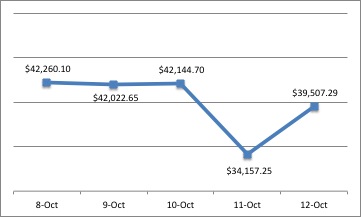
Nevertheless, I proceeded to lose nearly $10,000 in one day, only to rebound the following day by more than half of that loss.  I’m holding only short contracts, which seemed like a terrible idea at the end of the day on Thursday, but perhaps isn’t so bad in the medium to long-term.

(Above: Equity Balance for Week 4)

The prices jumped on October 11 because the USDA report saw smaller world supply. [1] However, this was offset quickly (seen in the recovery of prices on Friday) by a drop in demand for US exports, too. [2] According to Bloomberg, wheat is still overpriced, so I will stay in my short contracts and hope that drop was a short-term effect of the USDA report. After all, the CBOT reflects supply and demand on a global scale, and prices will likely recover after the USDA’s United States focused news and forecasts. Already, corn, wheat and soybeans prices are back down, with wheat and soybeans lower than they were before.


[1] http://www.bloomberg.com/news/2012-10-11/corn-surges-most-in-two-weeks-as-usda-sees-smaller-global-supply.html

[2] http://www.bloomberg.com/news/2012-10-12/wheat-tumbles-as-drop-in-u-s-exports-may-signal-slowing-demand.html)

Categories
What Went Right/Wrong

Lessons Learned – a reflective look

I learned a few things over the last few weeks, most notably that trading in speculation is really, really complicated to conceptualize.

After two crazy weeks of travel and work, I finally got a chance to look at what my various contracts had done over the last 3 weeks. Unfortunately, it didn’t look great. First, I think I misinterpreted my research and the markets in going long on corn last week. Compared to my classmates, I am not a very active trader.
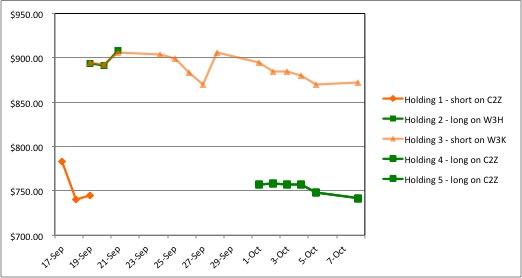
My research from last week clearly told me that the corn markets were not looking spectacular, but for some reason that meant I went long.

More importantly, though, I spent some time working through my fundamental understanding of the role of producers, buyers, and speculators in the market, thanks to my classmates. This is a completely foreign language to me, unlike many of my MBA colleagues. Therefore, the lessons learned below may seem very simple; but for me, they are valuable.

1. Both corn and wheat prices fell at the end of last week. This was good for my wheat contracts, because I was short, but not good for my corn contracts, because I was in a long position.

2. I would be a really bad day trader, and an even worse scalper. I am perfectly happy to check my balance at the end of the day and try to do better in the next few days, as opposed to making multiple trades in one day and track short price changes.  I don’t consider myself a risk-averse person, but I do consider myself patient, and I certainly feel overwhelmed by the huge number of influences on the markets.

3. I thought I would enjoy learning about agricultural markets because agriculture is an industry based in tangible production with tangible inputs and outputs. As it turns out, even agricultural futures markets aren’t real either. Everything in the markets is about trading and guessing about money that doesn’t really exist.  Determining value based on someone else’s estimation of your determination of value fundamentally makes no sense to me.
 

Categories
What Went Right/Wrong

Missed the boat on an active week in corn markets

This was a week away from market news, which made me appreciate my last strategy of getting out of the volatile corn markets and moving into the more stable wheat markets. I ended the first week up more than $2000 from being active in the corn market, but after a second weekend “playing” in the wheat market, my balance had only dropped $37.25.

Had I been keeping up with the markets, I could have followed the drop and subsequent rise toward another equilibrium in the corn market, because according to Bloomberg and Rabobank, the dynamics reflect the USDA predictions of stock and production levels and corresponding supply and demand effects. According to a Bloomberg article from September 27 titled Corn Retreats as USDA Reports Declining Export Sales, “U.S. exporters sold 368 metric tons in the week ended Sept. 20, compared with 69,578 tons a week earlier, the Department of Agriculture said today. Corn prices are down about 15 percent since the worst U.S. drought in half a century spurred a rally to a record $8.49 a bushel on Aug. 10. Wheat export sales at about 426,000 tons were 13 percent below a week earlier.” [1]

Meanwhile, I was short in the wheat market, which, as reported above, dropped from the previous week. Luckily, this market is less volatile, so my damage was minimal.

Categories
What Went Right/Wrong

Up in Corn, Split in Wheat

This week I experimented in hedging by going both long and short in the same commodity. I successfully spent a few days making money in a short corn contract, but I wanted to try something more complicated, so I took the advice of Andrew Bordern and “Sold High and Bought Low.” I got out of my corn contract and went long in a December wheat contract, with a plan to sell it on Friday. Reuters reported a “recent surge in wheat prices” in their September 18 article “OUTLOOK-India wheat seen stable after fall in global prices,” [1] so I expected prices to drop soon. Therefore, just in case Reuters was wrong, I decided to see what would happen to a long position for just a few days. By the end of trading on Thursday, I had – as predicted – lost just over $112.

My short corn contract, on the other hand, did quite well, as predicted. I was skeptical of judging my trades on the production in one country – India – but covered those hesitations with my split position.

This analysis did bring up a question, however – how quickly does it take for the market to respond to actions in one producing country? How long does it take the Law of One Price and Adam Smith’s promise of equilibrium to balance out prices for such a commodity?

“A sharp fall in U.S. wheat prices weighed on grain prices across the globe and its impact was felt in India as it could cut export demand for Indian wheat,” according to Reuters.  “Wheat futures in India, the world’s second-largest producer, are likely to remain stable for the rest of the week, after falling on Monday on global cues.”

The last two days of my held contracts fall in line with these observations and predictions, however, suggesting perhaps one major producer can effectively predict the market movements.


[1] http://in.reuters.com/article/2012/09/18/markets-india-wheat-idINL3E8KH59X20120918

Categories
What Went Right/Wrong

USDA trends and the resilience of corn influence a short position

I decided to start my trading with corn, since I am most familiar with the sight of expansive fields of it, as a former US Midwesterner. My few farmer friends are in the Midwest, and the drought this year has meant I am most comfortable with speculation in the media about its effect on corn and corn’s various food byproducts. A novice in the circles of options and futures trading, and the stock market, I let the experts at Bloomberg explain recent trends and expectations for me.

“Corn Bulls Retreat as Near-Record Costs Curb Demand” appeared to be a simple headline to guide my first trade [1]. It serves well to first understand that a bullish market is optimistic, and therefore invests more in the future at stake, and a bear market is pessimistic and therefore dominated by sales (short) of futures at hand. The 13 September Bloomberg article states that “the US government said the worst drought since 1956 will damage the crop less than analysts had expected and on speculation that near-record prices will curb demand.” This shrinking demand means prices will decrease, suggesting a short position is desirable. While Damien Courvalin, an analyst at Goldman Sachs, wrote that “Prices may have to rise further before consumption is constrained,” the argument that “The USDA lowered its estimate for U.S. exports by 3.8 percent from a month earlier to 31.75 million tons, down 19 percent from a year earlier” appeared on a more influential scale and with sufficient evidence to convince me to go short on my first corn future speculation.

I made the trade on Thursday, so one day of trading later, my decision looks good, as my marked to market balance has increased by approximately $37. I anticipate seeing what week opening patterns exist in this market before making my next trade.


[1] http://www.bloomberg.com/news/2012-09-13/corn-bulls-retreat-as-near-record-costs-curb-demand-commodities.html

Spam prevention powered by Akismet