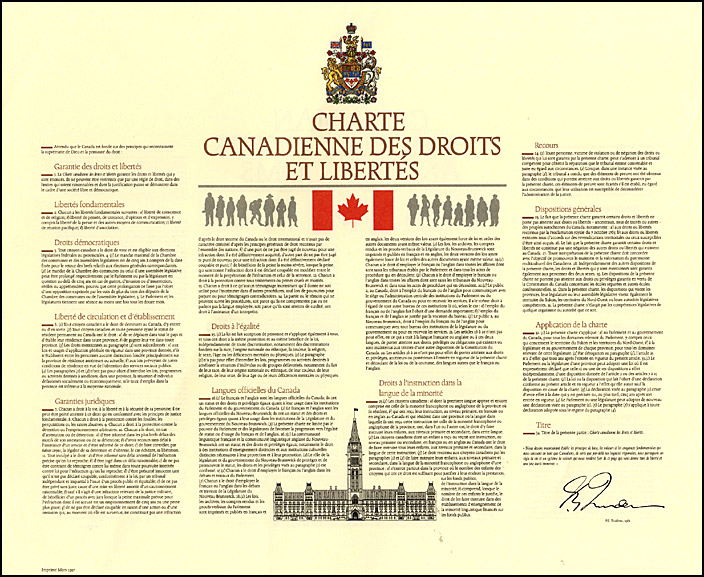
charter

Rights are mainly a matter of declarations. They are, in short, the product of a speech act. Undeclared rights are not rights at all. Hence the history of human rights is also a history of their repeated enunciation and articulation, from the Magna Carta on. But a declaration also implies an audience, and a process of interpretation. Hence, alongside this history of speech acts is a parallel (parasitical?) history of interpretation and commentary. Often the modus operandi of that commentary is the laborious process by which an event is reconstituted and reimagined: What exactly did the framers mean?

And if a declaration is an event, an irruption onto the scene of political discourse (dated: 1789, 1948...), then usually interpretation is the province of an institution (a Supreme Court or similar), whose judgments may or may not come to be seen as events and so new declarations, that have in turn to be interpreted in subsequent institutional deliberations. Such is the temporality of rights discourse: the violent irruption of the event is followed by the (quite literally) stately progress of deliberation and interpretation.

But some events are less eventful than others. The "Canadian Charter of Rights and Freedoms" is, frankly, a bit of a damp squib. It comes late to the scene of rights declarations (which were piling up thick and fast by the middle of the twentieth century). Belatedness is not itself a curse: the more recent a declaration, the more likely it is to declare a new right, and thus to up the ante of the game of eventful articulation. The Canadian Charter, however, manages to be both almost entirely derivative and singularly Canadian at the same time.

The derivativeness is in the first instance linguistic. And I don't merely mean the phrases (e.g. "the right not to be subjected to any cruel and unusual treatment or punishment") clearly lifted from other, similar documents. More to the point, and despite being described as a document that articulates the values around which the Canadian people can unify, the Charter's language is distinctly uninspiring.

It doesn't help that the document's very first clause is the famous "Limitations" clause that states that the rights that follow are "subject [. . .] to such reasonable limits prescribed by law as can be demonstrably justified in a free and democratic society." This may seem like an eminently sensible and pragmatic reminder that rights are mutually limiting: the right to free speech, for instance, is limited by the right to non-discrimination; hence bans on hate speech. But it sure takes the wind out of the Charter's rhetorical sails.

Imagine the crowds that surged on Parliament Hill, urged on by the slogan "Fight for your Rights! Subject only to Such Reasonable Limits Prescribed by Law as Can Be Demonstrably Justified..." Actually, you can almost imagine an Ottawa crowd moved by such a slogan. Hence the distinctively Canadian tone of the Charter: so very sensible and self-limiting. Quite unlike the US Bill of Rights, for instance. And the Canadians not only begin with a "Limitations" clause; they also end with a "Notwithstanding" clause, which basically means that the Parliament or a provincial legislature can suspend almost any of the Charter's provisions for (a renewable) five years.

In short, if every rights regime comes into being and operates between the twin pressures and temporalities of an insurgent event on the one hand, and that event's institutional interpretation and assimilation on the other, it's very clear to which of the two Canada's Charter leans: it's a tool of state management much more than it is the result of popular struggle. Its time is not that of revolution (still, by contrast, hard-wired into the US Bill of Rights or the French Declaration of the Rights of the Citizen) but of pacification.

And so no wonder that Harry Arthurs and Brent Arnold can conclude that the Charter is essentially useless:
Progress towards the vision of Canada inscribed in the Charter has generally been modest, halting, non-existent, and, in some cases, negative. What we claim is that the Charter does not much matter in the precise sense that it has not – for whatever reason – significantly altered the reality of life in Canada.

[. . .]

Canada’s political culture today is less vibrant, less democratic, than it was a generation ago.

[. . .]

The plight of Aboriginal peoples has not been much ameliorated, if at all. The project of multiculturalism, which is mentioned but not given prominence in the Charter, has seemingly gone off the boil. Immigrants – despite new guarantees of their legal and equality rights – seem to be having a tougher time integrating into society and the economy. ("Does the Charter Matter?" [Review of Constitutional Studies 11.1 (2005)]: 38, 111-112)
And why exactly has it had so little impact, or has what impact it has had been mostly negative? Essentially because it substitutes fictive abstract equality for real material differences. This, after all, is the fundamental move of all rights discourse, from the founding conceit of moving from natural to civil rights. Again, as Arthurs and Arnold put it:
If one were to establish a gradient that descends from the most affluent to the least affluent members of society, one would find at each point on that gradient not only lower living standards, but lower levels of educational attainment, health, personal safety and security, civic participation, political influence, and respect from police and other state officials. Moreover, as one descended the gradient, one would almost certainly encounter members of Charter-protected groups in ever-increasing numbers. [. . .] The best prospects for greater progress towards the equality values of the Charter would therefore be to redistribute wealth.

[. . .]

Of course, the Charter was not designed to transform Canada’s political economy. On the contrary, when it was adopted, its architects took considerable care neither to protect property nor to redistribute wealth. (113-114)
But is this not what all rights declarations do? It's not merely that the Canadian Charter happens to be one of the least interesting and least effective instances of such rights discourse. It also demonstrates to us something shared by all such discourse. For it always ultimately is a matter of replacing popular struggle with bureaucratic institutions.

First Introduction

So as part of any class the initial question always arises: who are you, what are you doing here and what do you hope to get out of this?

Such a simple question really, however as the professor of this specific course is down to try new things (a facebook group,imagine! Now aren’t I glad I decided to stay….) I have concluded to try to convey myself differently.

.

I am essentially this, nothing more than a dot on this huge white canvas,like everyone else.Who am I…? My name is Sarah, I am studying food systems in Latin America…I fall under different classifications; female,white,student,educated….

Which brings me to why I am here. A mixture out of coincidence(fate?), German bureaucracy and natural tendencies. Because of these things I ended up taking Spanish at high-school, having amazing Spanish teachers that were able to spark a strong interest in Latin America in me, take me to Nicaragua and Cuba and keep that interest strong enough that I was to later focus on that region when I entered University.

Which (again) brings me here, to this class. Why this class? Actually a really hard question. For me the answer is obvious…why the hell WOULDN’T you take this course? It focuses on basically all areas of interest for me…people,Latin America,justice,environmentalism and food(you might ask where food comes in here but trust me, food WILL be a topic in this course). On top of that, it is a seminar so that means lots of cool discussions and analysis, its at a great time for my schedule and it’s downtown so I am already half way home!

From a more academic and personal-gain point of view: I am in this course because I feel that it is a milestone for my understanding of the history,cultural fabric and feeling of Latin America. This continent is very unique in my eyes in that its people are very political in their actions,both publicly and personally. In that sense I think that grasping how the concept of “rights”,”justice” and “law” fits into this political ecology that has been created will open up new perspectives for me both on Latin America as well as the idea and manifestation of justice.

Hello!

Hi Everyone,

My name is Meredith and I’m currently a fourth year student in Human Geography. I’m very intrigued by the LAST 301 class on Human Rights in Latin America. Most of this intrigue stems from the time I’ve spent in Latin America. I had the wonderful opportunity to do two summer internships in Central America, one in Pespire, Honduras and the other in Rivas, Nicaragua. Additionally, I spent a year as a Rotary Exchange Student in Lujan, Argentina. While in Lujan, I studied Latin American History at the local university. With each experience I have learned so much about the intricate social situation of each local, and I have left realizing how much still I have left to learn. On that note, I do love learning. Therefore, I am very excited to see what I can learn from this class; both the course content and the perspectives of the other people in it.

To say a little more about me, I am from Carson City, Nevada (although I haven’t lived there for quite a while), and some of my favourite things are: being a student, rock climbing, skiing, politics, and great conversations.


A little bit about me.

My name is Rebecca Siguenza. I’m a 4th year Political Science student minoring in International Relations. 

I was born in Durango, Dgo. Mexico. Sharing a border with both Sinaloa and Chihuahua, Durango is riddled with drug-related activity and violence. I am hoping that through this course I may broaden my understanding of the relationship between drugs, politics and human and civil rights in Latin America — specifically Mexico. 

In the past two years I have attempted to focus my studies around political theory and Latin America. Taking this into consideration, registering for LAST 301 was a no-brainer. Also, this course will mesh well the rest of the courses I am taking this term. Ever since first year when I registered for the Coordinated Arts Program Global Citizens stream, I have done my best to continue to choose courses that share a common theme each year. This term I will be taking ANTH 470-Topics in Contemporary Theory [a course that draws heavily on political theory and Latin America], POLI 316- Global Indigenous Politics and POLI 461- Peace and Conflict Studies alongside this course. I am looking forward to seeing how these courses play off each other. I have a feeling it is going to be a great term!

Looking forward to meeting you all, 

rebecca. 

What Dana is thinking

I am a Venezuelan woman with an education in the fields of Psychology and Business and I am completing a master degree in Journalism at UBC. My colleagues have described me as intuitive, determined and strong-willed. I want to write compelling stories and educate the world one article at the time!

I was a market research annalist for over 7 years in Venezuela, researching human behavioral patterns and events affecting the population’s overall habits in the region. I have witnessed political and social turmoil for over 10 years in my home country and I am eager to have a more active role in the world now that I understand social inequalities better and I have faced human rights violations. I intend to pursue a career in public service and I believe this course will further prepare me for this goal.


Hello world!

Welcome to WordPress.com. After you read this, you should delete and write your own post, with a new title above. Or hit Add New on the left (of the admin dashboard) to start a fresh post.

Here are some suggestions for your first post.

  1. You can find new ideas for what to blog about by reading the Daily Post.
  2. Add PressThis to your browser. It creates a new blog post for you about any interesting  page you read on the web.
  3. Make some changes to this page, and then hit preview on the right. You can always preview any post or edit it before you share it to the world.

About Me

I am starting off my final year of a B.A. in Latin American Studies at the University of British Colombia.  While I have activated this blog for use in a course at UBC, Human and Civil Rights in Latin America, I hope it will blossom into a useful tool for posting my thoughts, analyses, general writing, published works in local news sources, articles of interest, etc.

In terms of this particular course, I have enrolled not only because it is a new (and important) requirement for the LAS major, but also because it will be an indispensable learning tool on the various institutional and administrative bodies that exist throughout the Americas.  I’ve just looked over some of the documents we will be reading, and many are from the UN, a major global player and financier in diplomacy and macro level development schemes that I have never analyzed in depth.  This is something I look forward to doing, and unpacking the documents together as a group.


An introduction

Hello everyone!

My name is Kyle Farquharson, and I’m a  journalist who is currently undertaking a Master’s degree in my field at the University of British Columbia. My next few blog posts will pertain to an undergraduate elective course in which I’m enrolled, which deals with Human and Civil Rights in Latin America.

The reason I chose LAST 301 is because I have an interest in civil rights, freedom of the press, international relations, and Latin American issues…all of which areas this course explores to some degree. To all of my classmates, I look forward very much to meeting you.

Considering the time and place in which we find ourselves, and despite the advances we have made in Canada over the last century in terms of respecting each others’ cultures and fundamental needs, the discussion of human rights remains complex and laden with both nuance and obstacles.

In some ways, this troubles me; for instance, if and when I eventually have children, I’d like them to live in a world in which pandering to countries (I won’t name names for now) with a questionable human rights record for the sake of trade agreements will no longer be necessary, because international standards of human rights will be universally upheld, but I acknowledge that this is probably an unrealistic vision.

On a more positive note, the fact that we’re having discussions of human rights in the first place in Canada, and that these discussions are leading us to a measure of controversy (as in the case of the CMHR), is a positive sign in many ways. It means we acknowledge the importance of basic freedoms and fundamental prerogatives for all people, and we realize the importance of learning from the past, even if we understand that fair treatment for all is more attainable in theory than in practice.

I’m looking forward to some excellent (and highly enlightening) conversations. As a journalist, there’s nothing I welcome more than having my eyes opened to other ways of thinking :)

All the best!

Kyle


Hello world!

Welcome to WordPress.com. After you read this, you should delete and write your own post, with a new title above. Or hit Add New on the left (of the admin dashboard) to start a fresh post.

Here are some suggestions for your first post.

  1. You can find new ideas for what to blog about by reading the Daily Post.
  2. Add PressThis to your browser. It creates a new blog post for you about any interesting  page you read on the web.
  3. Make some changes to this page, and then hit preview on the right. You can always preview any post or edit it before you share it to the world.

Introduction.

Hi! I’m Jonelle Aspa. I’m a fourth year history major that has been slowly making my way through my degree as I work full time as a dental technician. I decided to take this class after taking a few other Latin American studies courses at UBC. I have been somewhat involved in social justice activities in my community so the rise of left leaning political parties in Latin America is very intriguing for me. Hopefully this class will teach me a bit more about what is happening in the present day in Latin America as most of my studies have focused on the past.

Things that rock my boat: playing music (I try to jam at least once a week), gardening, my cute cat, and watching interesting documentaries, like this one:


about Ana

Hi LAST 301 class!
My name is Ana Robles, I was born in El Salvador but came to Canada when i was 6 months old, I am currently in my last year at ubc, I’m getting a double major in psychology and Spanish, I took this class because I am interested in knowing more about current events in Latin America, and since I’m really interested in Latin American literature, I think this class will give me more of a background of the conditions that Latin America has endured and currently has. Can’t wait to learn more about this topic and I will see you guys Monday.

About Me

Hey everyone,
My name is Petra Arnold-Bowen and I am fourth year International Relations student. I am taking this course because I am interested in human rights issues around the world. I grew up most of my life overseas in Germany, Russia, Saudi Arabia, and Switzerland. Consequently, I've had the opportunity to be immersed in many different cultures and witness different countries' stance on human and civil rights. Latin America is a region I know relatively little about and so I am looking forward to learning more about the area. In the future I hope to be employed in a human rights related field and so I hope this class will be a good starter course to send me in the right direction. See you all Monday--cheers.

About Me

Hey everyone,
My name is Petra Arnold-Bowen and I am fourth year International Relations student. I am taking this course because I am interested in human rights issues around the world. I grew up most of my life overseas in Germany, Russia, Saudi Arabia, and Switzerland. Consequently, I've had the opportunity to be immersed in many different cultures and witness different countries' stance on human and civil rights. Latin America is a region I know relatively little about and so I am looking forward to learning more about the area. In the future I hope to be employed in a human rights related field and so I hope this class will be a good starter course to send me in the right direction. See you all Monday--cheers.

Dear UBC,

My name is Laura Turner and I am a second year student at UBC! The focus of my undergraduate degree is Anthropology and African Studies. This year, however, I am looking to broaden my understanding of culture beyond the borders of Africa, which led me to this course in Latin American studies! I am from Toronto, Ontario but have always had a soft spot for the west coast. I am too, too happy to be a part of this course and am ready to expose myself to something new! My interest in human rights really began with my trip to Kenya in 2009. I discovered that a foundation of rights is crucial to a successful society and I can’t wait to learn where Latin America fits into this idea!


Notes before the first class (September 12)

Dear all:

Welcome to LAST301! We will be meeting for the first time on Monday evening at UBC Robson Square. Yes, Robson Square, downtown. It should be fun.

Here are a few things in advance of the class:

1. The course website, to which I am uploading the texts you will be reading this semester, is at http://last301.wordpress.com/.

2. There you will also find the syllabus.

3. And the program.

4. You will see that there is reading for Monday!

5. And here are some questions as you do that reading:

5a. What does or does not surprise you about the Canadian Charter? What should be in it that isn’t? Have you read it before? If not, why not? What use do you think it is? Are you happy with it? If so, why? If not, why not?

5b. What should be in a Museum of Human Rights? Do you agree with the choices made for the Canadian Museum in Winnipeg?

6. For this class, you will also have to start and write regularly in a blog.

6a. Please go to a site such as Blogger or WordPress (there are others), and open a blog. This will take you about five minutes.

6b. Write a brief post to introduce yourself: who are you? Why are you in this class? What rocks your boat?

6c. Then send me the address of your blog.

7. You will find that, as if by magic, what you write ends up on this very blog. This is the other website you will need for the class.

OK, that’s enough things for now. I’m looking forward to seeing you all on Monday!

Take care

Jon