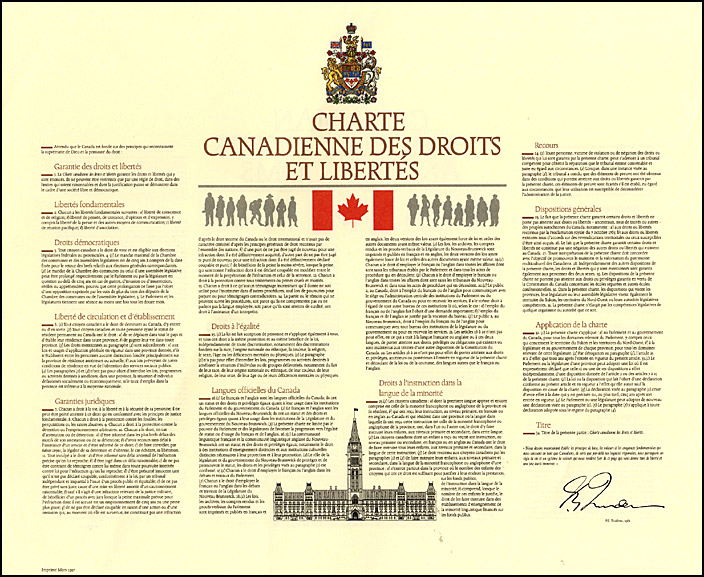
Charter

I have never read our Charter of Rights and Freedoms before. Why not? Well, I guess it never really occurred to me. This may be because I thought it was going to be 1000 pages long, but more likely because I have never questioned them or have been in a situation where those rights and freedoms are in question. In other words (and in my opinion) I am probably like most Canadians and take those rights and freedoms for granted.

I guess one of the things that surprised me about the Charter was the Official Languages of Canada section. I was pleased to read about the equality and importance the french language has. I’m sure it has something to do with the fact that I live on the west coast but I feel that learning french is something that is laughed at and considered irrelevant, similarly like learning cursive. I participated in a french exchange program a few years ago and was surprised at the ease with which eastern Canadians spoke french. 

I suppose the Charter serves use as a reminder to Canadian citizens that maybe in comparison we do have fundamental rights. I also think that it could serve as a reminder to individuals that as we all have the same fundamental rights one shouldn’t put themselves above others.

One of the things that I’m wondering is why and how the Charter came about and am actually surprised that this kind of document didn’t exist earlier. In thinking about the Canadian Charter, one aspect of The Globe&Mail article I found interesting was Paul Grod’s point regarding the Holodomer exhibit and its opportunity to teach people “…how a dictatorial state can use food, a basic human right, to control and destroy people” (P.5). The notion of food as a basic human right. I must have missed that in the Charter. But why not? Why shouldn’t it be in the charter?

It is hard to say what should be in the Canadian Museum of Human Rights. Because it’s a Canadian museum, I think human rights violations that occurred in Canada should be at the forefront. It is important to exhibit major genocides, and judging from the article I don’t have any major problems with the exhibit choices the museum is making. However, I’m not of Ukrainian heritage. Of course there will be a lot of controversy from the museum, but from the way the museum is portrayed in the article it appears as though they’re trying to be considerate. Although the attesting groups say it’s not a competition, it really feels like one.


Greetings


Hey, I’m Corbin. I just started the Latin American Studies MA Program at Simon Fraser University. I’m from Minneapolis, Minnesota and graduated with Bachelors of Arts degrees’ in Business Administration and Spanish from Pacific Union College in June 2010. I’m interested in studying social movements, human rights, social change and political/social conflict with particular interest in Argentina, Uruguay and Colombia.

My supervisor recommended I take this course. I find the subject matter fascinating and hope to be able to delve into the topic of human and civil rights more through this course.

I enjoy music, soccer, basketball, rock climbing, reading and badminton.  

Introduction!

Hi everyone :)

My name is Rachael Craigmyle and I'm a 3rd year student, with a major in Spanish and a minor in International Relations. I have actually never taken a class in Latin American Studies before so I hope I'm not too out of my depth here, but I am excited to give this a try! The course itself sounds like an amazing fusion of my two interests and studies here at UBC and I am interested to see how it develops and to learn new things (generic statement, I know, but very true!)
What else? I love exploring other cultures and learning about how other people live and comparing and contrasting different lifestyles, picking things up from others and teaching them about my lifestyle - I'm kind of like a cultural sponge in ways ;) I traveled to Ecuador this summer for one month and completely fell in love with the country, the lifestyle, the people and the culture... I hope to go back there after I have finished my degree and get back the very big piece of my heart I left behind there, and perhaps this time, stay even longer!
See you all this evening :)
Rachael

Introduction!

Hi everyone :)

My name is Rachael Craigmyle and I'm a 3rd year student, with a major in Spanish and a minor in International Relations. I have actually never taken a class in Latin American Studies before so I hope I'm not too out of my depth here, but I am excited to give this a try! The course itself sounds like an amazing fusion of my two interests and studies here at UBC and I am interested to see how it develops and to learn new things (generic statement, I know, but very true!)
What else? I love exploring other cultures and learning about how other people live and comparing and contrasting different lifestyles, picking things up from others and teaching them about my lifestyle - I'm kind of like a cultural sponge in ways ;) I traveled to Ecuador this summer for one month and completely fell in love with the country, the lifestyle, the people and the culture... I hope to go back there after I have finished my degree and get back the very big piece of my heart I left behind there, and perhaps this time, stay even longer!
See you all this evening :)
Rachael

Testing, testing

Hello,

This is literally a test for me. I am not what one calls “tech” savvy, so this whole blog thing is going to take me a while to sort out. What I find interesting about adding a blog aspect to the class is that on the one side I feel a sense of anonymity while at the same time typing things and then deleting them because I realize, well no, I’m not anonymous really because I am going to see these people (my classmates and instructor of Latin American Studies 301, or LAST 301) every Monday evening for 4 hours for 4 months. So I think I’ll save embarrassing myself in class only and not on the blog (which will be interesting to see how long that lasts for as I feel I have outdone myself already).

I’m in my fourth year at UBC and am a Latin American Studies major and will probably pick up a spanish minor once I figure out how to do so. I’m happy to finally be in LAST 301 as it is not only a class required by the department but will I’m sure enhance what I understand (or think I understand) about Latin America so far. I say what I “think I understand” because I am a Canadian who lives in a privilegded society obviously not having too many social injusticies done to me. I’m looking forward to learn about human rights and social justice.

-Katie-


Introducing…

Hello Latin American Studiers,

       I'm Anna, I'm a 4th year Latin American Studies student (minoring in Women and Gender Studies). This is my second year at UBC and so far I'm really enjoying it. I've spent time at various colleges and universities and changed programs several times before making my mind up. I got interested Latin American Studies after going to Ecuador with Canada World Youth where I had the opportunity to live with a home-stay and volunteer in the community.

       I'm in this class because it is one of the classes that counts towards my program that I have the pre-requisites for. I don't really know what to expect because every Latin American Studies class has a different take, a different set of skills and a different group of classmates.

       And now for the boat rocking,  I love growing and cooking food, reading books for fun, spending time with my fantastic family. I have directed a wilderness camp for kids for the past two summers and love hiking and canoeing. I have a passion for education and my favourite part of my job is working with our teenage volunteer counsellors as they develop their leadership skills. I guess that's about it.

       I've had a blog once before but it was poorly tended and is probably still floating about the internet. I hope I will learn how to use this blog and social media effectively.

The Canadian Charter and Human Rights Museum

http://laws-lois.justice.gc.ca/eng/charter/page-1.html#anchorbo-ga:l_Ihttp://www.theglobeandmail.com/news/national/memory-becomes-a-minefield-at-canadas-museum-for-human-rights/article2135961/page5/

> What does or does not surprise you about the Canadian Charter?  What should be in it that isn’t?  Have you read it before?  If not, why not?  What use do you think it is?  Are you happy with it?  If so, why?  If not, why not?

The Canadian Charter provides a fundamental basis for our formation of laws and our understanding of ourselves in society. I have briefly read the Canadian Charter before, skimmed over it to see if it entails anything different from the US or German equivalent (it doesn’t). Should I read it in more depth? Definitely. For two reasons: without knowledge of my rights and entitlement I would never stand up for them, fight for them. I would presume that my place in society is the way it is right now. That it is determined by external forces that I am not a part of. I would assume that those forces are right, have a right at least to exhibit force and would not contradict them.

Secondly, the charter of rights is really only then effective when you have a conscious, informed and educated society that uses the charter and knows the charter. Without that kind of a population it is just a piece of paper to be manipulated by whoever is in power.

What surprises me is that there is no specific reference to resources. There is a stated right to “life, liberty and security of person”, however that seems too vague. Are food, clean water and shelter not quintessential to life? To security? Arguably also to liberty? Are these not human rights or stated otherwise, is the absence of these things not a human rights abuse?

I think our Canadian Charter is a good start, however with increasing technology, shortage of resources etc it needs reviewing. I think people in this generation, in this lifetime need an edited edition of the Charter to feel the power that it contains and to feel ownership of it.

> What should be in a Museum of Human Rights?  Do you agree with the choices made for the Canadian Museum in Winnipeg?

A Museum of Human rights ideally should showcase the importance of human rights, focusing on what they are and the history of how they were developed as well as the history of abuse. I think it is easy to become a Museum of Human rights abuses without conveying what human rights are in the first place. Specifically for Canada, showing the evolution of human rights in this country would be a good step. The idea with showcasing the Holocaust or the Holodomer is that the abuse is shown and studied so it not be continued. I think for the Canadian Museum the focus should be closer to home. We ourselves could fill a whole gallery on “breaking the silence”. We should focus on Canada’s attempts to bury its own atrocities and focus on current human rights abuses,  right now that are going on and have been because of neglected care and structural violence.

The argument that the Holocaust should have larger area because it is most pedagogically useful is somewhat disturbing. I do not agree with that, I think focusing on it to such an extent and thereby limiting the focus on other human rights abuses has really negative consequences. If anything, we should broaden our knowledge on the thousands of other human rights abuses that have happened and are happening, as well as trying to understand what stops or limits them and how this can be and has been achieved.

Introduction

Hi. I'm Madison. I'm a fourth year student at UBC. I am majoring in Honors Political Science with International Relations. I am interested in political theory and immigration policy, specifically dealing with asylum seekers and refugee status determination. This year is exciting for me - I am writing my thesis, which will enable me to combine my interests and explore the literature on citizenship and the impact of membership on immigrants.

Introduction

Hi. I'm Madison. I'm a fourth year student at UBC. I am majoring in Honors Political Science with International Relations. I am interested in political theory and immigration policy, specifically dealing with asylum seekers and refugee status determination. This year is exciting for me - I am writing my thesis, which will enable me to combine my interests and explore the literature on citizenship and the impact of membership on immigrants.

Intro

Peace. My name is Esteban and I am many things: I am a full-time Sociology and Latin American Studies student at UBC (with a focus on immigration) starting my third year. I am a father and husband (Boy, 5 years old). I am Colombian by birth and Canadian by 'naturalization'. I am obsessed with music and books.

I am in LAST 301 because all things Latin American fascinate me. I moved out of Colombia at 15 and remain fascinated/amazed/ with the politics, culture, history and peoples of what we call "Latin America". Also as I mentioned, I am going for a Latin American Studies minor.

I grew up in a time when car bombs where the norm. This trend was then replaced by a kidnapping boom. Around that time, during the economic disaster that was the second half of the 90's in Colombia,
my family scattered to any country possible. Since '99 my family has been split up a hundred ways.

I've ended up in Vancouver. It is the 4 or 5 city I have lived in and the smallest one by far,
but I do love it so.

My boat gets rocked by discussions about ethnicity, class, gender, politics, oppression, justice, war, immigration, social movements, rap, hip hop, hard core punk, salsa, jazz, Latino popular culture, the Canucks, and anything Basketball.


PS: I am new to blogging...

Peace.

Intro

Peace. My name is Esteban and I am many things: I am a full-time Sociology and Latin American Studies student at UBC (with a focus on immigration) starting my third year. I am a father and husband (Boy, 5 years old). I am Colombian by birth and Canadian by 'naturalization'. I am obsessed with music and books.

I am in LAST 301 because all things Latin American fascinate me. I moved out of Colombia at 15 and remain fascinated/amazed/ with the politics, culture, history and peoples of what we call "Latin America". Also as I mentioned, I am going for a Latin American Studies minor.

I grew up in a time when car bombs where the norm. This trend was then replaced by a kidnapping boom. Around that time, during the economic disaster that was the second half of the 90's in Colombia,
my family scattered to any country possible. Since '99 my family has been split up a hundred ways.

I've ended up in Vancouver. It is the 4 or 5 city I have lived in and the smallest one by far,
but I do love it so.

My boat gets rocked by discussions about ethnicity, class, gender, politics, oppression, justice, war, immigration, social movements, rap, hip hop, hard core punk, salsa, jazz, Latino popular culture, the Canucks, and anything Basketball.


PS: I am new to blogging...

Peace.

Hello All!

Hi! 

My name is Linda Campbell and I am a fourth year student in my last semester at UBC.  I have always had a passion for Latin American history, politics and culture.  Being an International Relations major I have had some exposure to human rights and the UN and am looking forward to exploring their significance to Latin America.  I look forward to seeing you all in class!

charter

Rights are mainly a matter of declarations. They are, in short, the product of a speech act. Undeclared rights are not rights at all. Hence the history of human rights is also a history of their repeated enunciation and articulation, from the Magna Carta on. But a declaration also implies an audience, and a process of interpretation. Hence, alongside this history of speech acts is a parallel (parasitical?) history of interpretation and commentary. Often the modus operandi of that commentary is the laborious process by which an event is reconstituted and reimagined: What exactly did the framers mean?

And if a declaration is an event, an irruption onto the scene of political discourse (dated: 1789, 1948...), then usually interpretation is the province of an institution (a Supreme Court or similar), whose judgments may or may not come to be seen as events and so new declarations, that have in turn to be interpreted in subsequent institutional deliberations. Such is the temporality of rights discourse: the violent irruption of the event is followed by the (quite literally) stately progress of deliberation and interpretation.

But some events are less eventful than others. The "Canadian Charter of Rights and Freedoms" is, frankly, a bit of a damp squib. It comes late to the scene of rights declarations (which were piling up thick and fast by the middle of the twentieth century). Belatedness is not itself a curse: the more recent a declaration, the more likely it is to declare a new right, and thus to up the ante of the game of eventful articulation. The Canadian Charter, however, manages to be both almost entirely derivative and singularly Canadian at the same time.

The derivativeness is in the first instance linguistic. And I don't merely mean the phrases (e.g. "the right not to be subjected to any cruel and unusual treatment or punishment") clearly lifted from other, similar documents. More to the point, and despite being described as a document that articulates the values around which the Canadian people can unify, the Charter's language is distinctly uninspiring.

It doesn't help that the document's very first clause is the famous "Limitations" clause that states that the rights that follow are "subject [. . .] to such reasonable limits prescribed by law as can be demonstrably justified in a free and democratic society." This may seem like an eminently sensible and pragmatic reminder that rights are mutually limiting: the right to free speech, for instance, is limited by the right to non-discrimination; hence bans on hate speech. But it sure takes the wind out of the Charter's rhetorical sails.

Imagine the crowds that surged on Parliament Hill, urged on by the slogan "Fight for your Rights! Subject only to Such Reasonable Limits Prescribed by Law as Can Be Demonstrably Justified..." Actually, you can almost imagine an Ottawa crowd moved by such a slogan. Hence the distinctively Canadian tone of the Charter: so very sensible and self-limiting. Quite unlike the US Bill of Rights, for instance. And the Canadians not only begin with a "Limitations" clause; they also end with a "Notwithstanding" clause, which basically means that the Parliament or a provincial legislature can suspend almost any of the Charter's provisions for (a renewable) five years.

In short, if every rights regime comes into being and operates between the twin pressures and temporalities of an insurgent event on the one hand, and that event's institutional interpretation and assimilation on the other, it's very clear to which of the two Canada's Charter leans: it's a tool of state management much more than it is the result of popular struggle. Its time is not that of revolution (still, by contrast, hard-wired into the US Bill of Rights or the French Declaration of the Rights of the Citizen) but of pacification.

And so no wonder that Harry Arthurs and Brent Arnold can conclude that the Charter is essentially useless:
Progress towards the vision of Canada inscribed in the Charter has generally been modest, halting, non-existent, and, in some cases, negative. What we claim is that the Charter does not much matter in the precise sense that it has not – for whatever reason – significantly altered the reality of life in Canada.

[. . .]

Canada’s political culture today is less vibrant, less democratic, than it was a generation ago.

[. . .]

The plight of Aboriginal peoples has not been much ameliorated, if at all. The project of multiculturalism, which is mentioned but not given prominence in the Charter, has seemingly gone off the boil. Immigrants – despite new guarantees of their legal and equality rights – seem to be having a tougher time integrating into society and the economy. ("Does the Charter Matter?" [Review of Constitutional Studies 11.1 (2005)]: 38, 111-112)
And why exactly has it had so little impact, or has what impact it has had been mostly negative? Essentially because it substitutes fictive abstract equality for real material differences. This, after all, is the fundamental move of all rights discourse, from the founding conceit of moving from natural to civil rights. Again, as Arthurs and Arnold put it:
If one were to establish a gradient that descends from the most affluent to the least affluent members of society, one would find at each point on that gradient not only lower living standards, but lower levels of educational attainment, health, personal safety and security, civic participation, political influence, and respect from police and other state officials. Moreover, as one descended the gradient, one would almost certainly encounter members of Charter-protected groups in ever-increasing numbers. [. . .] The best prospects for greater progress towards the equality values of the Charter would therefore be to redistribute wealth.

[. . .]

Of course, the Charter was not designed to transform Canada’s political economy. On the contrary, when it was adopted, its architects took considerable care neither to protect property nor to redistribute wealth. (113-114)
But is this not what all rights declarations do? It's not merely that the Canadian Charter happens to be one of the least interesting and least effective instances of such rights discourse. It also demonstrates to us something shared by all such discourse. For it always ultimately is a matter of replacing popular struggle with bureaucratic institutions.