
Number of Apple Purchase vs Price
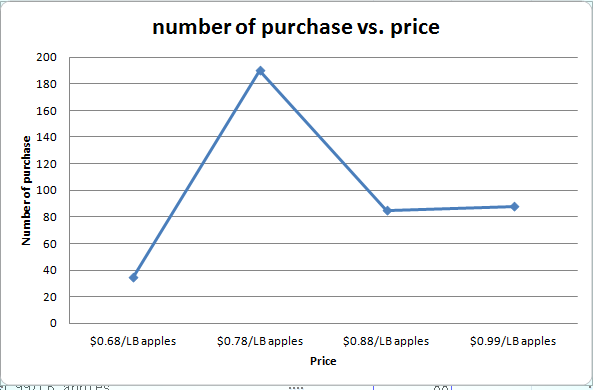
R=0.008, r^2=0
The data used in this calculation encompass apples at different price levels and with different origins. The coefficient of determination is zero for the entire data set. Therefore, there is no correlation between price and the number of apple purchased when all factors are included in the calculation. In other words, price is not the sole determinant for the consumers’ apple purchase behavior.
The above calculation does not reflect specific factors influencing consumers’ purchase behavior.As result, it is impossible to conclude which factors impact on the overall pattern using the above calculation. Thus, the below paragraphs are devoted to the discussion of different factors that may influence the overall result.
Relationship between apple purchase and price, when $0.68/lb apples are excluded.
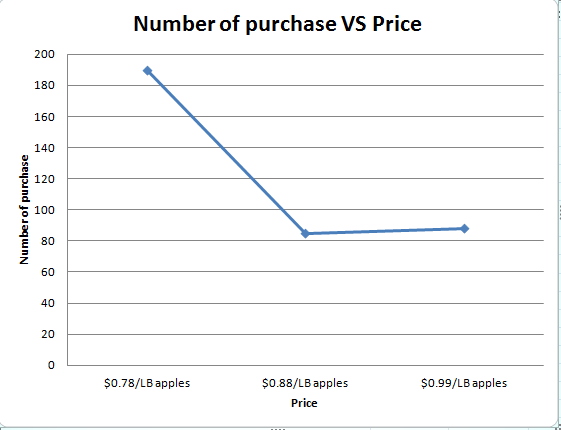
R= -0.897, r^2=0.8050
The graph above shows the apple purchase pattern while excluding apples at 0.68$/lb. The r and r^2 are re-calculated while excluding the Pacific Red Rose and Jazz apples ($0.68/lb). A r^2 value of 0.8050 indicates that lower price is associated with higher sale 80.5% of the time. This result contradicts with the previously found one, where the r^2 value shows no relationship between lower price and higher number of purchase. Therefore, it is legitimate to conclude that price may be partially related to the number of apple purchases.
The discussion below examines the apples at 0.68$/lb in more detail.
Varieties at 0.68$/lb are Pacific Rose and Jazz apples. The former is a relatively new variety and was first marketed in 2005 (Orange Pippin, 2010). It has a “unique colour” (Enza Foods, 2009) which distinguishes itself from other varieties. Thus, the visual appearance and reputation may be two extraneous factors that influence the low number of Pacific Rose purchases.
The Jazz apple is a flavourful variety (OrangePippin, 2011) which is gaining market in the recent years (McShane, 2009) This cultivar first enters the Washington market in 2004 (McShane, 2009), and there is only limited access to this apple because it is a very new variety (OrangePippin, 2011). As a result, Jazz’s presence
may be, again, unfamiliar to most consumers, therefore resulting in low sales.
Relationship between the number of local apple purchase and price
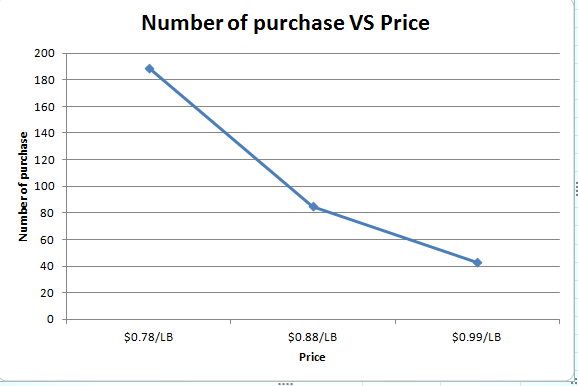
The above graph shows the relationship between the number of local apple purchase and price. The r^2 for this set of data is 0.9617, which indicates a very strong correlation between low price and high number of purchase. As a result, it is reasonable to conclude that there is a relationship between price and sale among local apples.
When different varieties with different origins are combined, however, the trend becomes difficult to interpret. For example, local McIntosh and Ambrosia are both 0.78$/lb, yet the sale for Ambrosia (182) is significantly higher than that of McIntosh (3). In terms of price, local apples at 0.78/lb gain more sale than imported apples at 0.68$/lb. A test for significance between these two data sets cannot be conducted because there is no expected sample mean. Hence, the only qualitative conclusion is that there are many factors, including apple varieties and origins, can influence consumers’ apple purchase behavior.
Consumer preference and current apple trend may significantly influence the apple sale. The consumer market has gradually shifted from the traditional Red Delicious to newer varieties such as Fuji and Gala (Lynch, 2010). In Canada, the planting trend for Ambrosia apple has been increasing (Ministry of Agriculture) likely due to the increasing popularity of this cultivar. Unlike the old varieties that consumers complain too “mushy” and “tart” (Beausoir, 2006), the new cultivars are “crisp and sweet” (Orange Pippin, 2011). These traits may be attractive to consumers, and some people may even wish to spend more money on varieties with these attractive traits.