
*WARNING: Contains some questionable language
*WARNING: Contains some questionable language

While I understand that the two fictional texts that I have assigned for reading can be classified in a number of ways, not necessarily Science Fiction (Feed as sci-fi or cyberpunk; Little Brother as dystopian or just disturbing realism), I would like you to consider Applebaum’s introduction as a guide that can apply to other texts outside of the sci-fi realm.
Perceptions of technology as a corrupting force, particularly in relation to young people’s use of it, are related to the prevailing myth of the innocent child, as explored by Jacqueline Rose (1984), Anne Higonnet (1998), Jack Zipes (2000) and Henry Giroux (2000), to name but a few, and result in fiction written for a young audience which endorses a technophobic agenda. (Applebaum 1)
Please read the two excerpts (from Doctorow and Anderson) and see how they relate to the introduction from Applebaum, using the following questions and the above quotation to guide you:
 Today I decided to try my hand at something slightly different, or at least different from Second Life, which I have come to abhor, but I’ll stop there so I don’t rant. So today I made an avatar for myself from Pixie Hollow. My name is Hale Rivercloud and I am a sparrow-man. I have an awesome little green suit and fancy-shmancy little wings that I can use to fly around and collect things like spider webs, berries, and flowers for trade. I will admit that I felt somewhat sleazy being in a virtual world for children much younger than myself. It is for this reason that I refrained form taking part in any chatting or “friendly” behaviour.
Once I had my fill of this fabulous fairy land, I logged out and went in search of privacy and security information for the site and the “virtual space” in which children take part. I ended up coming across parental information. The information provided for parents related to security and chat settings, since this seems to be the main way that children would be “preyed” upon while in Pixie Hollow. As Meyers et al. (2010) write:
The challenge in our current childhood landscape is that any risk is perceived as unacceptable. We appear to live in a risk-averse culture that works not just to reduce unnecessary risk, but also to eliminate the slightest possibility of harm to children (Byron, 2010).
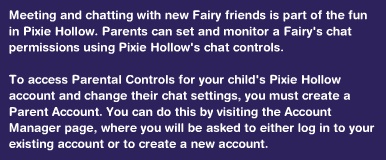 The information put forth by Disney seems to be sometimes overly protective in nature, bringing attention to their moderators and monitors a number of times. The chat is filtered through moderators at all times within the game, thus hindering the communication in some ways. Perhaps this is for safety of the children, but there are ways to monitor without necessarily interfering in word choice. Maybe I’ll just end up being a horrible parent, but I don’t think that monitoring children to such an extreme is always helpful.
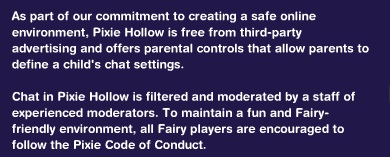
But it’s not only safety and security issues involved here. There are suddenly more limitations on children participating in the online environment. They lose control of their own behaviour because of parental and adult interference. I can’t help but feel that this is a bad thing. Perhaps I’m only saying this because I don’t have children or because I haven’t suffered from online issues of bullying or abuse, but I feel that limiting freedom is something that is complex and must be very, very carefully considered.
Meyers et al. also address the issue of what can happen to ideas of freedom when adults attempt to constantly monitor and inform online social behaviour of children and youth.
Efforts to eliminate exposure to risk may limit opportunities for young people to develop essential cognitive and metacognitive strategies (Livingstone, 2009). Donovan and Katz (2009) argue that children are informed social actors and that attempts by adults to monitor their online behavior and filter their websites has a chilling effect on children’s and youth’s privacy and free speech.
This post has been very limited in scope, but it’s my experience and my reactions so I obviously can’t cover everything that I would like from the article in the Journal of Virtual Worlds or in the Livingstone chapter. Perhaps I will make another small post or add some comments at a later time, but this is all for now. Thanks for listening!
 NOTE: I know this is a bit of a long post, but it’s because I’m not sure what to focus on specifically. There is so much STUFF out there! I figure because I’m working with YA literature a lot, I will incorporate some of what I have learned from fiction into this post. I hope that I don’t confuse too many people.
A lot of what Baym has to say can be seen reflected back from the pages of fiction. Currently, I am reading Cory Doctorow’s For the Win, in which a number of people meet, interact, and fight back the evil corporate world through online games and all sorts of other crazy technological things that I can barely follow. What made me think of this book is Baym’s discussion of the curious dynamics of online relationships and interaction. The cartoon that reads “On the internet, nobody knows you’re a dog,” is in both Baym and Doctorow and is relevant both in reality and in the slightly fictional world of the novel:
Although Steiner has said he didn’t know what the cartoon was about when he drew it, New Yorker cartoon editor Robert Mankoff said it “perfectly predicted both the Internet’s promise and its problems” (2004: 618). Whether this cartoon represents a dream or a nightmare depends on whether one is the dog or the fool unknowingly talking to the dog.
Pricewaterhouse Cooper just released a report entitled “Turning the Page: The Future of eBooks.” I just thought it might be an interesting read for anyone looking at eBook readers or the future of electronic reading. It’s got lots of charts and tables and graphs, which makes it that much more Awesome to read. Go Pricewaterhouse Cooper!
Of course I can’t comment on everything within these chapters, so I’ve just chosen a few points I found interesting. So I hope other people have taken some other stuff from later on in the chapters (like the section on working from home and entrepreneurship as opposed to office work… cool stuff!) Anyway, here goes:
I think, out of most of the reading, this was my favourite line put forward by Tapscott. And I think it’s very true. I’m honestly still unsure of what “generation” I am from, but I really don’t care for the purposes of this reading. I think a bit like Tapscott’s son, and I’m hoping to start thinking more like Tapscott. Indeed, his son was looking at Mars through the Hubble Telescope from his bedroom thinking how awesome Mars is, and completely forgetting how incredible the technology is that is letting him get such a great view of the planet. I am much the same way, and for the purposes of this course, I suppose that will need to change. This blog, for instance, to me, is a place where I put my words down through my keyboard, and then the computer amazingly does things and this all ends up in the ether for you all to read. I never think about the behind-the-scenes technological makeup of the internet, or the coding that went into creating WordPress. I can only hope that I will soon be starting to think a little bit more critically about the things that allow me do to do what it is that I do on a daily basis.
I think what I’m curious about is what other people think about some of the broad assumptions that go into Tapscott’s understanding of the Net Generation. I do believe that whatever generation I happen to be a part of is very involved in technology, and there are certainly some who I would consider to be overly-involved with their technological thingamajigs, but I hesitate to say that our use–and perhaps reliance on–technology has made us in any way less able to express ourselves or work or think critically. Of course, maybe that’s just me being defensive or something. Who knows? I like to think that it’s about how we utilize new technology that makes us different, and not that we are somehow lesser in any way. New Media just forces us to think about things more, and to consider what we used to do before these new bits and pieces showed up on the technology stage, as it were.
But what do you all think about some of the assumptions in the reading? Did you agree with the majority of what Tapscott had to say? Or do you think he went overboard with his theories?
Thanks for listening!
Every day the same dream is a game where you basically go through a day in the life of an avatar dude, but then at the end, you go right back to the beginning and do it over again. Not really a game per se. More like an art piece, but one that is interactive. Interesting in light of part of our discussion today, as brought up by Schuyler.
Just for some fun y’all!
 In case anyone is interested (and if you’re a geek for the CBC, like I am) here’s a link to a very relevant and enlightening podcast that just might spark some good discussion in this class or even in your other non-school life. You can use the information to become the most educated (sounding) person at any party!
The podcast in question (which I mentioned in my last post) is “Spark,” and you can find it here.
Enjoy!