(For the record, I am on Team Cake, and if my parents had given me pie on my birthday, I would’ve grown up wearing all black and spouting poetry about the deep anguish of my childhood and how my parents never really loved me. Also, I really like carrot cake.)
The question of online identities has always intrigued me. I was, or perhaps still am, Palfrey’s sixteen-year-old protagonist that had multiple online profiles and was constantly changing them to reflect who I had become, or who I thought others would find interesting, every day.
Palfrey writes that this constant creation of the self is simultaneously freeing and restrictive. While we have the ability to be whomever we’d like in cyberspace, we don’t have much control over who accesses the information and how they perceive it (34-5). Thomas adds that this continuing constructing of the self also leaves us fragmented. Quoting from Agger she writes:
“…the virtual self composes himself in daily email, web surfing, chatting, cell phoning, faxing. It is a postmodern self less stable and centred than the self of previous modernities.” (9)
I thought it would be interesting to talk about this idea of the fractured self, and if the multiple ways of representing oneself in different online “bodies” – which Thomas defines as any virtual text or visual construction that we use to represent ourselves in the online world – are indeed an essential part of our identities outside of cyberspace? Can we ever represent our real-life selves accurately online, or is that necessary or even the point?
Of course, there is so much in these readings that I invite you to address any other topic that strikes your fancy.
Note about the readings: In Thomas’ chapter, stop before you get to Lacan and Psychoanalytical theory. Who needs more phallic symbols in their lives, really?
Like Schuyler, I enjoyed this chapter, especially since it seemed to address the technological environment that we inhabit much more realistically than Tapscott.
What I found most compelling was Baym’s discussion of the implications that the internet and mobile phones have on social interactions and relationships. I am wishy-washy in that I waver back and forth between believing that online interactivity and our dependance on it completely destroys our ability to function with people in face-to-face scenarios. Following Rob’s lead, I’m also going to take an example from YA literature: M.T. Anderson’s book Feed is about a dystopian society that has advanced so far technologically that a computer chip is installed in everyone’s head and even when hanging out with friends, characters can “chat” each other from across the room in their own minds. The need for speech is essentially eradicated.
So while this is a legitimate fear, I also think it’ll never happen. At one point in Feed the characters lose their connection to the information feed. At first they’re completely lost, but then they easily resort back to life without constant connectivity and communicate without any problems. I also think people can easily resort to saying that someone is “socially inept” because of the internet, but the truth is there were socially awkward people before the internet, and their ineptitude was blamed on other things. Like Baym says, the internet quickly becomes a catch-all for all our problems.
I would be remiss not to point out the obvious point, however, that the internet, texting, and instant messaging is definitely changing the way we communicate in terms of language. Nouns are made verbs and vice versa, words are shortened to a grotesquely small syllable, and initialisms are everywhere. However, just as Aristotle’s prediction that the alphabet would ruin communication was laughably incorrect, it would be wrong of me to suggest that these technological changes to language are destroying English as we know it. Language is constantly evolving and developing, and although it pains me to see someone use “lol” unironically, I shouldn’t be so quick to devalue the way that technology has changed language.
I was surprised by this except from Topscott’s book, in that he wasn’t more critical of the Net Generation and the way use of technology, and specifically the internet, has completely changed the way we use our time. He repeatedly states that Net Geners are intelligent and can multitask unlike previous generations, but he barely broaches the subject of how technology, specifically the internet, and even more specifically Facebook, has become a vortex for procrastination and wasting time. He campaigns heavily for Facebook as a means of social connection, communication, and marketing; he notes the safety concerns of Facebook; he doesn’t mention that it, by and large, functions as a place to spend three hours a day refreshing your news feed and commenting on pictures (fact: I checked Facebook four times already when writing this post, countless times while reading the article, and probably will open it several more times before I’m done writing).
I think a key point that he is missing is that all of the technology that is readily available to us – smart phones, mp3 players, internet shopping and games – attracts our attention for such large amounts of time that the reason Net Geners work quickly is because they must fit more into their day than generations before, not all of it productive. A perfect example is the daily timeline of Rahaf, the independent new-media strategist. He writes that she charges her clients for 50hrs a week, but by my calculations, she doesn’t claim to work, on average, more than 5.5 hours a day. The remaining time (during which she is constantly multi-tasking) is spent reading blogs, Skyping, and generally gallivanting around the internet.
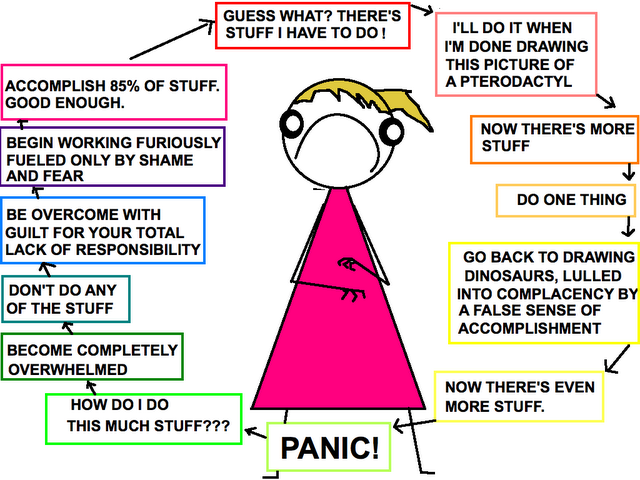
I’m not sure that this is a negative side-effect of technology, nor am I sure that it is positive. I know that, personally, I spend a lot more time texting, Tweeting, and YouTubing than I do finishing assignments or working. I am incredibly efficient when I have to be, but this is by and large because my pleasure romps around the internet suck up time and attention that should be given to time-consuming projects. I even complain about the lack of time I have in my life on social networking sites and my blog, fully aware of the irony, and this cycle increasingly stresses me out – and I know I am not alone in this trait.
I suppose I expected Topscott to comment on how stressed our generation seems to be about time, and how this trend can be attributed, at least in part, to how much time we spend using technology.