yeah yeah, class is over, but this still seemed highly relevant:
Apple facing class-action lawsuit over kids’ in-app purchases
yeah yeah, class is over, but this still seemed highly relevant:
Apple facing class-action lawsuit over kids’ in-app purchases
This article struck me as fairly interesting and pertinent to our discussions in this class in terms of the convergence of online and “real” worlds..
“The vaguely intimidating twentysomethings who prowl the corridors of the Austin Convention Centre, juggling coffee cups, iPad 2s and the festival’s 330-page schedule of events, are no longer content with transforming that part of your life you spend at your computer, or even on your smartphone. This is not just grandiosity on their part. Rather – and this is a technological point, but also a philosophical one – they herald the final disappearance of the boundary between “life online” and “real life”, between the physical and the virtual. It thus requires only a small (and hopefully permissible) amount of journalistic hyperbole to suggest that the days of “the internet” as an identifiably separate thing may be behind us.”
SXSW 2011: The internet is over (via The Guardian)
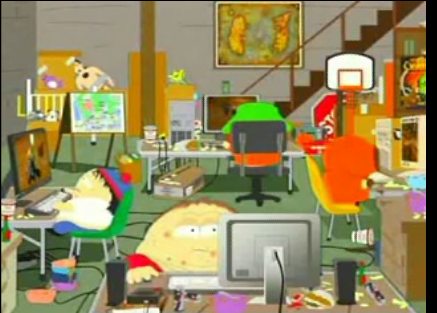
Despite their enormous popularity, video games tend to get a bad rap in mainstream media dialogues. If their shrill warnings are to be believed, these addictive and violent games are making our children into sociopathic loners; they ruin marriages and families and are to blame for obesity, ADD, poor eyesight, depression and are, above all, a colossal waste of time. Although a case might indeed be made to support some of these criticisms, video games are just a medium; one might as well accuse books or movies or “the web” of causing any number of social ills to the same effect.
That said, video games are a tremendously powerful medium that are distinct in many ways from traditional forms of media such as books, film, television and even most web-content. To illustrate this, I selected talks by David Perry and Jane McGonigal and the article “The Rhetoric of Video Games” by Ian Bogost for your consideration this week, and ask that you give the following questions some thought as you watch and read them.
What differentiates video games from other mediums?
How do these differences impact the way people are affected by video games?
Is “play” a waste of time?
I would recommend tackling these sources in the order listed, but it’s not strictly necessary.
1. David Perry: Are games better than life? (Video from TED.com). If you’re pressed for time, go ahead and skip to the 10-minute mark and focus on the student-video. Also, bear in mind, these examples are already five years old.
2. Ian Bogost, “The Rhetoric of Video Games” from The Ecology of Games: Connecting Youth, Games, and Learning.
3. Jane McGonigal: Gaming can make a better world. (Video from TED.com) She also outlines much the same ideas in this article if you’d prefer to read or want additional details; Be a Gamer, Save the World.
I look forward to reading and hearing your thoughts.
It’s not your friend; it’s a business: “Facebook To Share Users’ Home Addresses, Phone Numbers With External Sites”
Although, I suppose it’s somewhat relieving that they’re at least considering withholding the information for users under 18..
I’m not sure this brings anything new to our discussion on the topic, but this article from McSweeney’s caught my eye; “YOUNG ADULTS ARE READING MORE THAN YOU.”
The rise of screen-based media has not melted children’s brains, despite ardent warnings otherwise: “It does not appear that time spent using screen media (TV, video games and computers) displaces time spent with print media,” the report stated. Teens are not only reading more books, they’re involved in communities of like-minded book lovers.
I really enjoyed Nancy Baym’s introductory chapter on new media. My appreciation can perhaps be summed up by her statement that “the truth, as is so often the case, lies somewhere in between.” In almost direct juxtaposition to Tapscott’s largely one-sided presentation of the issues, I enjoyed the way that she laid out both the technological determinist and social constructivist viewpoints and was able to demonstrate the merits of each while attempted ultimately to reconcile the opposing views into what she described as “social shaping.” Excuse my pretense, but the concept of a culture’s relationship with technology as a continuum in which each influences the other strikes me as quite obvious, which led me to question the prevalence of such polarized viewpoints as technological determinism and social constructionism.
I began to question how so many of the discourses in our lives are characterized by these utopia/dystopia polarizations, and how rarely it seems that individuals on either side of an issue are willing to be swayed from their entrenched viewpoints. I was reminded of a recent This American Life podcast in which an expert on climate change attempted to convince a skeptical youth of the existence of global warming; despite her best arguments, the young girl remained unconvinced. Similar examples are endless, and it occurs to me that our culture and education (and technology?) encourage this type of thinking. I’ve written countless papers whose thesis I could have blasted apart a hundred different ways, but instead strengthened to meet the established expectations for an academic essay. The sheer volume of available resources makes it possible to back up almost any argument, no matter how suspect.
Similarly, modern media allows us to find the points of view on a given topic that match our own expectations and sources of news and information that come pre-tailored to fit our entrenched point of view. In this sense the Internet and the social communities it supports can be seen as a fractured and disparate collection of ‘islands’ rather than the utopian medium of global cultural exchange some had envisioned, but is it the cause, or merely a reflection of existing social structures? In all likelihood; both. Perhaps as Baym suggests, the ‘domestication’ of the internet may eventually make the technology so pervasively embedded in our lives that it is “barely worthy of remark,” but I suspect the polarization of viewpoints will persist.
/rant
link: http://thecreatorsproject.com/blog/the-newest-japanese-pop-star-is-a-hologram-video
This strikes me as another prime example of New Media moving out of the “box” (tv, computer ect) and blurring the lines between our digital and ‘real’ lives, but something about a huge crowd cheering on a computer animation is still deeply unsettling to me.
Also, I found it interesting to note that although the hologram tours with a live backing band, the singing is synthesized digitally.
(note: always the skeptic; I couldn’t actually find any mention (or pictures) of the hologram project on the Crypton Future Media website, so I’m sort of wondering if this is real.. but then again, I can’t read Japanese.)
I stumbled across this short piece on McSweeney’s turns the tables on the old “birds and bees” speech, and provides an amusing illustration of the generational divide that Tapscott describes:
Although Tapscott’s use of Bob Dylan lyrics to try to explain to Baby Boomer’s that they don’t get the “Net Generation” was amusingly ironic, and despite the fact that his positive outlook was a far cry from the angsty “kids these days are so lazy and self centered” articles crop up in the NYTimes and other old-media standards from time to time, I found it very difficult to relate to an article that refers to me as “they.”
Perhaps my negative gut-reaction pegs me into the very stereotype I’m resisting (and yes, the TV is on mute, MP3s are blasting and I have 12 tabs and 10 programs open across four virtual desktops), but I’d like to think that any member of a specific demographic is inclined to be skeptical of the generalizations of an outsider. I appreciate that Tapscott is painting my generation in a better light to his peers than many others are inclined to see, but the article strikes me as inescapably ‘by Boomers for Boomers.’ As such he spends a lot of time explaining behaviors that I live daily, and his generalizations of ‘our’ motivations come across as incomplete.
For example, he writes that “a twentysomething in the workforce wants the new BlackBerry, Palm or iPhone not because the old one is no longer cool, but because the new one does so much more.” Well, yes and no; it’s more complicated than that. Because it “does so much more,” the new phone is inherently more desirable than the old one, and therefore the old one is ‘no longer (as) cool.’ Some people will want it for the features, some people will want it to brag to their friends. It wouldn’t surprise me if these motivational differences correlated more closely with socioeconomic demographics or even personality types than generations.
That said, I found his breakdown of generational age groups by geographic location to be quite interesting, particularly in the context of North America as the primary cultural exporter. It will be interesting to see if this shifts to more accurately represent global populations as the traditional mediums of cultural transfer continue to change.
This Creator’s Project post on Generative Filmmaking provides some pretty cool examples of algorithm-based media objects that illustrate Manovich’s concept of “automation.” The blog is definitely worth browsing if you’re interested in this type of thing.
See also: Processing-based installation and video artwork by Quayola that invsigates the “improbable relationships between contemporary digital aesthetics and icons of classical art and architecture.” Link: http://www.quayola.com/index.php?/strata-1/
And for a more direct New Media deconstruction of physical architecture there are quite a few artists using sophisticated projection setups to develop visual sets tailored to specific buildings. ie: http://vimeo.com/15713774
Amazing Building Mapping – Vimeo Festival from Dan Ilic on Vimeo.