Categories
Uncategorized

Total World Domination: How A Different Kind of Invisible Hand is Running Our Economies

My classmate Cherry Chang wrote an enlightening piece on the ethical issues regarding  designer Kenneth Cole’s capitalization on the Syrian Civil War. Her discussion of the profitability of disaster reminded me of a book I once picked up: The Shock Doctrine .
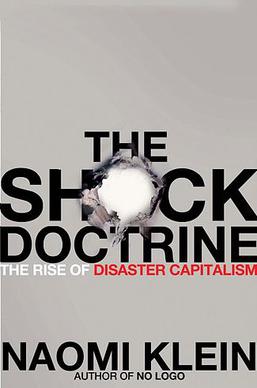
In it, Klein explains how she believes that governments (especially America’s) have long been using disasters (real or invented) to push through controversial policies and/or spread capitalism while citizens are still shocked by the crisis. The name for this method: Disaster Capitalism. The strongest case for her beliefs is The Iraq War where “at the most chaotic juncture in Iraq’s civil war, a new law is unveiled that would allow Shell and BP to claim the country’s vast oil reserves…. Immediately following September 11, the Bush Administration quietly out-sources the running of the “War on Terror” to Halliburton and Blackwater”. If true (and I personally think it is), this method shakes the commonly-held belief that free-market economies have triumphed because they are simply better; instead it would appear that our beloved capitalism needed a little help from some disastrous friends. Now I wonder, what would the world’s economies look like if it weren’t for the American government’s employment of shock doctrine tactics?

If the USA were a corporation, I would recommend that they re-evaluate their aggressive marketing strategy for their product, capitalism, before consumers are completely turned off and potential trading partners are scared away.


Sources:

Klein, Naomi. The Shock Doctrine: The Rise of Disaster Capitalism. London: Penguin, 2008. Print.

https://blogs.ubc.ca/cherrychang/2013/09/11/blog-1-business-ethics-using-disaster-to-sell/

Categories
Uncategorized

SECULAR SOCIETY: The High Cost of Implementing Quebec’s Charter of Values

A certain controversial charter has recently ignited national debate on religious tolerance in Canada. The Charter of Quebec Values seeks to prohibit public employees from wearing any religious attire like turbans and hijabs. Though most talk concerning the subject has centred on the blatant discrimination and social impact of the proposal, I have wondered what the economic effects would be.

A Cartoonist’s Take on the Economic Impact of The Charter


And I’m clearly not the only one. Canadian Business magazine conducted a poll to determine how Canadians would react to implementation of the Charter. Of the 49% who felt they would be affected, only 11% said they would comply willingly. This spells big trouble for Quebec employers; trouble that their economy really can’t afford. It may be the intention of Mme. Marois’ government to preserve the state’s secularity, but this may come at the cost of alienating immigrants and visible minorities who will gladly take their skills elsewhere. According to Supriya Dwivedi, the province which already “struggles to retain its immigrants, would […] face an even greater exodus of workers” if the Charter passes.” One would think that the PQ would have thought about all this before, but perhaps the economic cost of placating an alarmingly minority doesn’t seem too high to them.

Sources:                                                                                                                                                                                                                                                                                Evans. “Charter of Quebec Values; A Graphic Guide.” Cartoon. Northeastnews.ca. Northeast News, 18 Sept. 2013. Web. 6 Oct. 2013. <http://www.northeastnews.ca/charter-of-quebec-values/>.                                                                                                                                                                                                                                                                                                                                                                                            Melanson, Trevor. “If Quebec Charter Passes, Employees More Likely to Fight Back than Cave: Poll.” Canadian Business. Rogers Communications, 20 Sept. 2013. Web. 6 Oct. 2013. <http://www.canadianbusiness.com/economy/if-quebec-charter-passes-employees-more-likely-to-fight-back-than-cave-poll/>.

Words: 200


Spam prevention powered by Akismet