Categories
Uncategorized

Democracy in the News 7: Has democracy lost its ground in the Euro crsis?


“A riot police officers tries to extinguish flames from a petrol bomb thrown by protestors outside the Greek parliament, in Athens on Sunday, Feb. 12, 2012. (AP Photo/Thanassis Stavrakis)”   From  macleans.ca “Week in Pictures”

It is worth contemplating whether a democratic choice is the best choice for Greece, which has been spending profligately on economic and social welfare in the past decades. While austerity may be a practical and useful method to reduce the Greece’s deficit spending, it is opposed by the public, which took to the street after the austerity measures were proposed by the “unelected caretaker government” of Prime Minister Lucas Papademos this week. To make it more undemocratic, Papedemos dismissed members of his government who vetoed the austerity package after the package was passed.

In face of the urgent debt crisis, should the Greek government officials be more resolute in deciding what steps to take, or should they listen to the public before taking any step, given that they are just representatives of the public in a democracy? According to this article, the Greek government should have no hesitation in choosing the latter option. This is because, “there are no wrong answers in a democracy,” meaning that as long as the choice is chosen by the public, it is a right choice.

The article argues for a proper referendum, so the Greek public can decide whether Greece should bailout, default, or implement various levels of austerity measures. While a referendum would be the most democratic choice for Greece, it may not be realized given the opposition by foreign leaders and financiers. In fact, these foreign leaders may be the reason for the resignation of the former Prime Minister George Papandreou, who proposed to hold a referendum in November 2011. Given the tension between the interests of the public and of foreign powers, a question is therefore raised: How to avoid compromising a country’s democratic performance in a neo-liberal world?

Categories
Uncategorized

Elective 6: Before being a Global Citizen, become a Democratic National Citizen first!

“Global citizenship” has been a fashionable term for a while, despite its meaning and practicability are still debatable. According to Derek Heater, any global citizenship will have to be based on some version of “multiple citizenship” rather than one.  The basic building block will remain the local or provincial one, followed by that of the nation-state; above these might come the regional or continental level, with the world level capping the whole. The different poles of allegiance – personal, associational, ethnic, cultural, political – that shape us may also be laying the groundwork for more fluid sense of identity vis-à-vis the global system.(sorry the quote is from my note and I can no longer find the reference)

From this interpretation, I understand the term global citizenship as an idea derived between nationalism and cosmopolitanism. While nationalism stresses the love of one’s community/state, cosmopolitanism emphasizes universal experience and the abstract understanding of universal well-being. Both nationalism and cosmopolitanism can be extreme and therefore undesirable. This is because nationalism can produce enmity against other communities/states, and cosmopolitanism can encourage one to ignore the special ties and attachments within one community. In regard to how to promote international humanitarianism as a global citizen, I find Bhikhu Parekh’s argument quite insightful. Although he understands the term global citizen a citizen of “the whole world” and “has no political home”,[1] his definition of his preferred term “globally oriented citizenship” is indeed compatible with Heater and my understanding of global citizenship (which should be based on the foundation of local citizenship).  To promote humanitarianism or stop inhumane practices in other states, Parekh argues that as a global oriented citizen, one should strengthen their democratic engagement with their states and energize their national citizenship, because ones’ “universal duties to humankind can be best discharged through the mediating agency of the state”.[2]

Parekh’s understanding of global citizenship (or in his terms globally oriented citizenship) reminds us the interdependence between national and global institutions. Many times, global institutions are challenged because they are detracted from national institutions. This phenomenon needs to be addressed because without national solidarity and the collective support for these global institutions, these institutions lack the legitimacy to influence other states.

In sum, being a global citizen begins with being a democratic national citizen.


[1] Bhikhu Parekh, “Cosmopolitanism and Global Citizenship,” Review of International Studies 29, no. 01 (2003): 12, doi:10.1017/S0260210503000019.

[2] Parekh, 13.

Categories
Uncategorized

Democracy in the News 6: Taliban reveals political strategy for first time

Taliban revealed that they had talked with the U.S. but refused to negotiate with the Afghan government. It is apparent that the U.S. is a bargaining chip for the Taliban to maintain its bases in Afghanistan.

I wonder if successful negotiations between the U.S. and the Taliban will facilitate democratic transition in Afghanistan……when the role of the Afghan government is totally degraded and ignored by the Taliban……..it is worth seeing how this tug-of-war between the U.S. and the Taliban will evolve.

Categories
Uncategorized

(Mini Assign 6) Measure of Democracy in Southeast Asia

Conceptualization of Democracy

For the purpose of assessing the measures of democracy for the Southeast Asian countries (which include Cambodia, Indonesia, Malaysia, Singapore, Thailand and Vietnam), this report conceptualizes democracy according to two components of democracy, namely competitions and majority rule. As such, a country will be categorized as democratic if its governing body makes decisions based on the voting of more than half of the eligible and present voters, regardless of whether that majority is derived from an electorate, a parliament, a city council, a party caucus, or a committee”.[1] In terms of competition, the practices of election are used to attest the countries’ democratic practices.

Using the datasets of the Freedom House (FH) and the Political Regime Change (PRC), the report compares the two measures’ findings on the democratic performance of the countries during the period from 1990 to the present.

Summary of Major Measures

1.)    Freedom House Dataset (2012)[2]
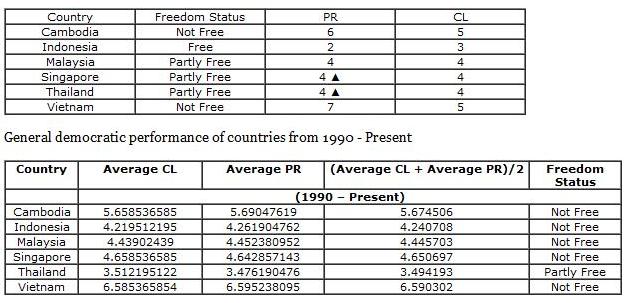
How a regime is categorized (also used in data analysis):[4]
NOTE:
The ratings reflect global events from January 1, 2011, through December 31, 2011.* ▲ ▼ up or down indicates an improvement or decline in ratings or status since the last survey.*”PR” stands for “Political Rights,” “CL” stands for “Civil Liberties,” and “Status” is the Freedom Status.

*************************************

To begin, Freedom House (FH) measures whether a country is a democracy or not by rating not the performance of the respective governments, but the degree of political rights and civil liberties enjoyed by its citizens (/residents). Then, political and civil rights are measured on a 1-7scale (with lower scores representing greater freedom); the average scores on both scales are then used by FH to classify countries into one of three categories, namely Free, Partly Free, and Not Free.[3]

Average score between 1 and 2.5 = ‘Free’ = Democratic

Average score between 3 and 4 = ‘Partly Free’ = Semi-democratic

Average score greater than 4 = ‘Not Free’ = Authoritarian


2.)    Political Regime Change Dataset

East and Southeast Asia (from 1953- 1998)

Cambodia: A, 11/1953–9/1955; S, 9/1955–9/1957; A, 9/1957–9/1993, S, 9/1993–12/1998.

Indonesia: D, 12/1949–3/1957; A, 3/1957–12/1998.

Malaysia: D, 8/1957–5/1969; A, 5/1969–2/1971; S, 2/1971–12/1998.

Singapore: S, 8/1965–12/1998.

Thailand: A, 1932–5/1946; S, 5/1946–11/1947; A, 11/1947–10/1973; T, 10/1973–2/1975; D, 2/1975–10/1976; A,10/1976–7/1986; S, 7/1986–2/1991; A, 2/1991–9/1992; D, 9/1992–12/1998. Vietnam, Republic of: A, 6/1954–4/1975.

Vietnam, Socialist Republic of: A, 6/1954–12/1998.


(……….)

Comparison between Measures

It is found that the annual coding of FH and PRC (during 1953- 1998) are highly correlated, as reflected by the high “rank correlation coefficient of 0.83 between the PRC regime value and the Freedom House average score”. Because of the inclusion of an intermediate category, “Partly Free”, in the FH data, PRC share more concordance with FH than with other datasets.[5] Similarly, for both PRC and FH datasets, values of 1, 2, and 3 were assigned, respectively, to authoritarian (Not Free), semi-democratic (Partly Free), and democratic (Free) regimes.[6]


(……….)


Assessment of the Usefulness of the Measures

The problem of the FH measures is that it does not offer a categorical measure for democracy. It follows that, others researches that use different criteria to measure democracy would find the FH dataset ambiguous.[7] For example, it is debatable whether a country with an average score of 2.5 or less in the FH dataset should be categorized as democratic, given such country often scores 3 out of 7 on the civil liberties scale, [8]  suggesting the lack of citizenship rights in the country. The shortcoming of the FH measures suggests the need for more intermediate categories (besides simply “Partly Free” in the FH case) in regime datasets. As such, the PRC dataset should be used to complement that of the FH, meanwhile to provide a measure compatible with the conceptualization of democracy in this report.

The merit of the PRC dataset is that its focus on election allows for “intercoder reliability”; accordingly, other researchers would be more able to classify observations in a coherent manner as the PRC because of the nature of elections (easily observable as they either present or absent). [9] On the other hand, although the reliability of a measure can be ensured by focusing on elections, it is pursued at the expense of validity, because in many contemporary regimes, authoritarian and democratic elements often co-exist. [10]


[1] Schmitter, Philippe C., and Terry Lynn Karl, “What Democracy Is… and Is Not,” Journal of Democracy 2, no. 3 (1991): 75-88.

[2] Freedom in the World 2012: The Arab Uprisings and Their Global Repercussions, report (2012), 16- 21.

[3] Reich, 14.

[4] Reich, 14.

[5] Reich, 17.

[6] Reich, 14.

[7] Reich, 3.

[8] Reich, 3.

[9] Reich, 4.

[10] Reich, 5.

Categories
Uncategorized

Mini assign 5: Ratings for Music Albums

This is a coincidence that I am also looking at MetaCritic as did Prof. Nyblade, and comparing its rating for music albums with that of NME. COM (New Musical Express), the official website of the British music publication NME.

On NME.COM, site visitors (who don’t need to register as members) can rate an album by simply scrolling their mouses. The resulting rating for the album would be the average of all the ratings received. Obviously, the rating method is quite arbitrary. I found this to be more true after I realized I can rate the album even when I am not a member (and have not listened to any songs from the album), and worse, I found that if I refresh the page, I can vote again.

> Scroll bar on NME.COM

So I believe the NME. COM rating is based on its belief that only people who are interested in music and/or know the NME magazine would browse the site and give ratings on a scale from 0 – 10 (0 being bad and 10 being good of course). While one may argue that, if NME.COM had an enough amount of reviewers, extreme ratings from random site visitors (who have not listened to the album) may balance off themselves, the problem is that there is no indication of how many reviews have been submitted. In sum, the NME. COM rating is apparently arbitrary and, unaccountable.

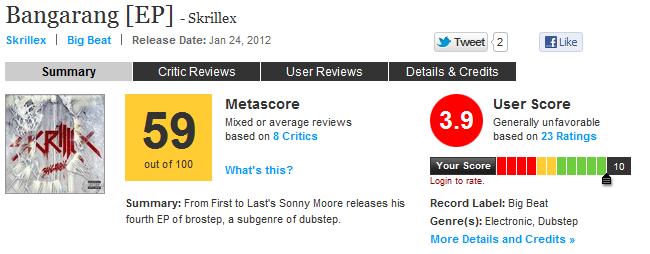
MetaCritic, on the other hand, shows the number of submitted reviews (by both professional critics and site members). MetaCritic shows at least four critics’ reviews, which are expressed in terms of a “weighted average” assigned by MetaCritic. This “weighted average” means that different amount of weight is given to the opinions of critics based on the critics’ quality and/or stature. The result is a score ranging from 0-100 (again, 100 being the best). In contrast to NME.COM, MetaCritic’s visitors must login in order to vote (on a 0-5 scale), reducing the possibility of random voting. By showing two separate scores from critics and members, site visitors are able to compare the professional and public opinions of the album, and make their own judgments. Needless to say, the extra work of the MetaCritic staff has made the reviews more creditable and professional.

> Critics’ and members’ ratings for (my beloved) Skrillex’s album (so low I have no idea………)


The conclusion is that the rating on MetaCritic is more creditable than that on NME. COM, mainly because of the former’s scope (and maybe standard) of reviewers and its method of calculating the rating. However, because critics on MetaCritic generally give a lower score than the members do, one may expect to have lower expectation of an album if he/she only looks at the critics’ scores.

Categories
Uncategorized

Elective 5: The Different Interpretations of Human Rights

“TAKE UP THE WHITE MAN’S BURDEN,
AND REAP HIS OLD REWARD.”

In another class, I am asked to use Aristotle’s thought to analyze Ignatieff’s “The Burden” – in which he justifies American invasion in Iraq as a means to restore orders in dysfunctional states. This gets me to think about the antinomy between individual and universal human rights, which are both guaranteed, or strongly associated with democracy. In Western democratic and the liberal tradition, there has long entrenched the idea of individualism, which advocates the right to self-determination.  On the other hand, universal human rights claim that, besides the right to self-determination, there is a more urgent need to safeguard fundamental human rights which simply include the right not be physically harmed.

The tension between individual and universal rights becomes more obvious in the debate of intervention, both in the cases of Iraq and Syria. While the aim of interventions is always to protect basic human rights (be it rhetoric or not), it seems apparent to everyone that, the protection of human rights require the construction of (democratic) institutions, which are mostly if not certainly modeled after the Western ones. In other words, to some extent, the individualist idea of human rights need to be sacrificed. Accordingly, there is the question about whether the imposition of Western political and social infrastructures, is merely an activity which claims to protect human rights, or is itself a protection of human rights.

I don’t have an answer to this question yet. However, I do have some thoughts on the issue. I believe that the tension raised by the question, is resulted from the different cultural interpretations of “human rights”. Again, in the case of either Iraq or Syria, I have no doubt that people there must have once yearned for Western interventions, which they conceived as catalysis for the creation of a democratic society. But I doubt if they want any Western powers to replicate Western institutions in their regions, because that can be a violation of sovereignty. In other words, people in intervened countries want the same kind of  right to self-determination exercised in Western democracies, whereas the interveners find it necessary to first infringe the intervened country’s sovereignty for the protection of universal human rights.

I am not sure how this tension can be solved, although I would say communication between (Western) democracy and (non- Western) non-democracy can facilitate mutual understanding of “human rights”. However, I can also see that such communication can hardly be productive unless the non-democratic side first gets inspired about how to develop their own democratic institutions. Thus, maybe the best approach for democracies to influence non-democracies is to be the latter’s role-models. Yet, this would raise another debate about whether contemporary democracies have done a good job in fulfilling democratic ideals.

Categories
Uncategorized

Democracy in the News 5: Censorship in India: A Fight that is Already Lost?

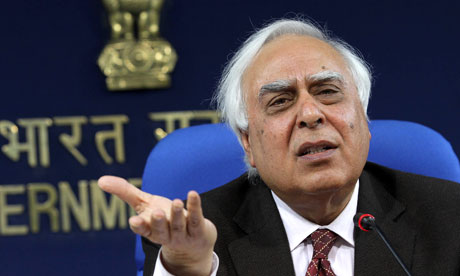
picture from The Guardian

This article mentions not only the response of the public, but also of the internet companies, to India’s recent internet censorship. The article suggests, given India’s lucrative market, internet companies like Google would probably “kowtow to the government than risk abandoning a cash cow like India. (This is because) taking down a few objectionable web pages now is the rational economic choice.”

To me, the implication for India is that, the “fight for freedom of speech” is partly lost as these internet companies choose to filter its information, depriving citizens of the rights to interpret this information. As one recalls how democracy advocates the freedom of discussion and exchange of thoughts, censorship is undoubtedly an obstruction of the development of Indian democratic regime as well as of its citizens. The argument that censorship is justified by its capability to avoid “defamation” of politicians or “religious violence” sounds unconvincing to me, because underlying such claim is the problematic idea that, the public is a defenseless, passive uniform group whose opinions are easily malleable. This is an outdated myth, as it has been increasingly recognized that the public is a diverse, active, and interpreting group which is able to discern the credibility of incoming information. By the same token, such justification for censorship (that it is needed to block hateful comments which are dangerous to the society), appears to me pretty much as politicians’ excuse to cover up their wrong-doings exposed on the internet, as the article suggests. As it follows, censorship is undemocratic not merely because it hinders communication between the citizens and their government, but also because it promotes an oligarchic government in which elites can deliberately decide what information can reach the public.

While I hope that other democracies won’t follow India’s path to adopt internet censorship, I also hope that the fallacy that the public is extremely susceptible to outside information will soon fade.

Categories
Uncategorized

Paper 1 – Southeast Asia

Hi guys, I am going to work on Southeast Asia, a region that is quite unfamiliar to me. I have plans to visit these countries through (particularly Cambodia), so I hope I can learn more about the region through this paper.

Categories
Uncategorized

Mini Assign 4: In answering my distant aunt’s question, “So what is democracy, anyway?”

While democracy can be simply defined by four words: “ruled by the people,” we all know it is more complex than that. I believe that such minimalistic definition of democracy is used to prevent contradictory interpretations of democracy resulted from different ways of conceptualization. As such, when we try to define democracy, we should keep in mind whether we are looking through the lenses of an ideal or doctrine, of certain kinds of behavior towards others, or of certain institutional and legal arrangements. [1]

In my view, democracy should neither be defined by certain kinds of behaviors nor institutional and legal arrangements, but by its ideal in protecting liberty and equality of citizens. Liberty, as Aristotle argues, includes the political liberty to participate in political decision-making and to speak freely in both public and private domains, as well as the private liberty to live more or less as one pleased. In terms of equality, which is the practical basis of liberty, people are expected to have an equal share of ruling. This means that democracy entails legal and political equality or even economic equality (if it can facilitate political equality).

My idea that democracy should be conceptualized by its ideal is derived from the fact that the practices of democracy have evolved over time from the classical Greek model to the contemporary ones. Yet, the principles of popular sovereignty, as well as of liberty and equality, have remained as the foundations of democracy along the time. I shall first introduce the basic practical differences between classical and contemporary democracy, so to illustrate that the ideal of democracy has remained constant.

To begin, classical democracy is defined by the Aristotelian idea that citizens should enjoy political equality in order to be free to rule and be ruled in turn. Classical democracy claims that all citizens could and indeed should participate in the creation and nurturing of common life. Thus, citizens are expected to commit to the principle of civil virtue, by dedicating themselves to their state and subordinating their private life to public affairs and the common good. This belief is confirmed by the fact that, in 510 B.C. ancient Greece, there was an assembly which was held every ten days in a room that could contain 6000 people, and that everyone could take part. To safeguard the principle of political equality, 500 citizens (50 x 10 tribes) were chosen by lot to be members of the Council, so that they could bring an idea to the Assembly, whose members would make the final decision. Because of the alternation of the Council’s membership, most citizens would have some time of governing in life.

Because of the expansion of the scale of ruled continent and the increased demand for citizens’ times in areas other than politics, contemporary democracy – in contrast with the classical one – is characterized by passive citizens’ role and representation. As citizens are supposed to delegate their political power to their representatives, their political participation is mostly defined by direct participation such as voting, and indirect such as protesting. Despite the minimalist idea of citizenship, the normative principle of political equality still entrenches to maintain equal formal political rights among citizens, as confirmed by the fact that each citizen would only accorded one vote in an election so to prevent wealth, power, or status from privileging any citizen.

From such comparison, we can see that although the practices of democracy have changed, its ideal has not. Furthermore, by conceptualizing democracy through its ideals rather than practices, we can also mediate the debate on the democratic deficit – that democracy has failed to function the way it should have. If we understand that at the outset democracy is an ideal which guides us toward more common goods, we will be more willing to seek ways to minimize the gap between reality and such ideal. Since minimizing the gap can be pursued by innovating institutional arrangements or other practices of democracy, conceptualizing democracy through practices is a constrained way to promote democracy.


[1] Crick, Bernard R. Democracy: a Very Short Introduction. Oxford: Oxford UP, 2002. Print. P.11

Categories
Uncategorized

Elective 4: Multiculturalism and Democracy

The functioning of democracy largely depends on the definition of citizenship, which has become vaguer as more western democracies become inclusive of different linguistic and cultural communities.

While democracy and multiculturalism themselves are not contradictory, their relationship can be complex.  In fact, little attention has been paid to the questions of whether democracy should support institutions that define and support multicultural identities, as well as how multicultural democracies should reinforce the core values of democracy, such constitutionalism, pluralism and tolerance.

Another issue raised by multiculturalism is representation. Should we adopt group representation or mirror representation in multicultural democracies? While mirror representation is highly impractical, group representation also fails to solve the problem that every group has sub-groups, which have different characteristics and hence different interests.

I recall John Rawls’s claim that self-perception of citizenship determines one’s perceptions of social and political obligations. I agree with this statement and believe that any confusion over one’s identity and responsibility as a full citizen is detrimental to social development. Therefore, to promote harmonious cultural pluralism and diverse opinions, it is my view that inclusive democracies should encourage its citizens to pursue their identities. For the second question, I don’t have an answer yet (and I may even support substantive representation). However, I believe that the first step to a harmonious multicultural society is to affirm respectfully the different linguist and cultural heritages of citizens. If communication could lead to mutual understanding between fellow citizens, the matter of representation would not be a big issue.

Spam prevention powered by Akismet