Categories
Uncategorized

Democracy in the News 11: “The city is dying” – My Hong Kong’s fellow citizens said

Leung Chun-ying and his wife Regina celebrating his victory Photo: AP

“Hong Kong’s election of a new chief executive Sunday was a mess — a travesty in which the 1,132 handpicked voters were outnumbered by demonstrators who were kept away from the assembly with pepper spray. The winner, Leung Chun-ying, was muscled through by pressure from Beijing despite his unpopularity with the local business elite. As for the general population, an online poll in which 220,000 people took part recorded 54 per cent for none of the candidates, followed by 17 per cent for Leung.” Read more…

***********************************

I guess I have started making my blog become on China rather than on democracy since last week (or earlier?)…but I cannot help….especially after last Sunday when the prime minister of Hong Kong (my home) was elected mostly because of his support from the CCP.

Hong Kong is a democracy, which “allows free speech and assembly but not free elections.” The 7millions citizens of Hong Kong not only have no right to vote, but also have no say in the election. This is because the election committee is composed of tycoons and business elites….Meanwhile, any candidates who wish to be on the ballot need to attain the CCP’s approval. What it means is that common citizens barely have the chance to run for PM, even if they have massive public support and impressive political skills.

Until now I am still so disheartening….as someone who really wants to do some good to my community, I have become more and more discouraged from dabbling in Hong Kong’s politics, which has appeared to be increasingly integrated into the CCP.

Although I believe that colonialism should end (in fact it should never have existed!) and I am a proud Chinese who is glad that China has got back its own territory – Hong Kong, sometimes I am reminiscent of those days when we were under British rule. Those days, our city was more elegant and vibrant both domestically and internationally…now everything seems to be falling apart………

I know, I am being ambivalent.

Categories
Uncategorized

Elective 11: China’s economy is being “sluggish” and may even crash?

Just as (almost) everyone says that China is going to rule the world economy with its fast-growing economy, there comes the proof that the economy is not only slowing down, but also being “sluggish”.

According to CNN.:

“The country’s manufacturing sector shrank for a fifth month in a row, according to HSBC’s latest China PMI survey Wednesday. That follows news of weaker industrial output from January to February.

This news shows that Beijing’s policies to slow down the economy are in fact working. But Premier Wen Jiabao – who’s been the champion of those measures – may now be asking whether they’re working a bit too well.”

***************************

I think it is smart of the government to slow down the economy. If you recall the Japanese economic miracle crash in the 1990s, you realize the risk of making another economic bubble. Although I am worried about potential of such crash, China’s successful (or accidental) socialist economic reform since 1987 has somehow assured me that China understands the art of gradualism when implementing reform strategies. In fact, I admire the first phase of China’s economic reform in the 1980s, in which the country applied the “dual-track” system by combing market and plan mechanisms. As such, the first phase had witnessed the scenario of “everyone wins” as the CCP’s power and resources were decentralized to local officials, who could implement better economic measures (than the CCP) in their locales, and as the labor sectors were given enough time to develop as the market was relatively shielded from international competition. The second phase of the economic reform that is happening now is less gradual than the first phase, thereby contributing to a widening income gap as the upper/middle-classes continue to prosper, while the lower-classes have marginal chance to elevate their socio-economic status. Despite I don’t think that China’s current economic control measures would help eliminate the income gap, I see them as having the potential to narrow the gap (a bit) by giving the society, and in particular the lower-classes, more time to adapt to the thriving economy while China is still able to maintain its growth rate of ~8%.

Categories
Uncategorized

For the sake of posting something

Something I have been working on (once a week). Guess who is this 🙂

Categories
Uncategorized

Mini Assign 10: Blogical Fallacies

I hope I am on the right track to doing this assignment; if I am not, please correct me!

Logical fallacy

So the new Chief Executive of Hong Kong, Leung Chun-ying, just got elected.

According to this NY article, which is titled “Hong Kong Elects Pro-Beijing Chief Executive,

“Mr. Leung won on the first ballot, receiving 689 votes, after Beijing’s representatives here put heavy pressure on electors in the final week of the race to support him.”

So yes, I have heard all these rumors that Mr. Leung has personal and professional ties with the CCP, but I have never heard him supporting the CCP publicly. Instead, he has always positioned himself as politically neutral (although some of his moves have betrayed him…..)

Anyways, although Mr. Leung may be really “pro-Beijing”, this article lacks justifications for such claim.  The article should acknowledge that, Beijing’s support for Leung ≠ Leung is “pro-Beijing”.


Rhetorical fallacy – Oversimplification

This editorial suggests that because of Latin American abundance of natural resources and of other countries’ (mostly China’s) increasing demand for such, Latin America will “own the century”.  Not only that, the editorial claims that because of the increasing Latino population in the U.S., the latter “will be so Hispanized that the Spanish language will rival English for predominance.”

This editorial seems to me has ignored the political dimension of the issue. In particular, it does not explore the very possibility that other countries would exploit Latin American resources with unfair prices or other negative conditions. Having abundant natural resources does not necessarily translate to economic or social prosperity (If Latin America will own the century, so will Africa).

Categories
Uncategorized

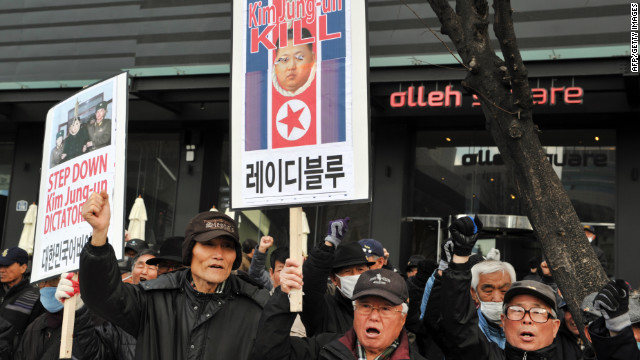
Democracy in the News 10: Please don’t happen: North Koreans bear costs of their government’s action….

“South Korean conservative activists chant slogans in Seoul on Saturday denouncing North Korea’s announcement of a planned satellite launch.” from CNN.

Last week, North Korea announced its plan to launch a rocket-powered satellite (similar to that used in its ballistic missile program) in April. This announcement has undoubtedly destroyed the hope arose from the bilateral agreement between North Korea and the U.S. on February 29. Along with other requirements, the agreement requires the country to freeze its uranium enrichment program in return for food aid.

Besides destroying the hope, the North Korean announcement has overshadowed the upcoming international nuclear security summit, which is hosted by South Korea.

While I am skeptical about the effectiveness of this summit in containing nuclear proliferation (but not in polarizing North Korea-South Korean relations), what disturbs me the most is that:

“South Korea has said it considers the satellite launch an attempt to develop a nuclear-armed missile, while the United States has warned the move would jeopardize a food-aid agreement reached with Pyongyang in early March.”


I understand the U.S. may have exhausted its solutions to contain North Korea’s potential nuclear programs, but it still upsets me that the people may need to bear the costs of their government’s actions….which they never have a say in.


Categories
Uncategorized

Elective 10: China’s internet users trying to outsmart the censorship system

So we just talked about different kinds of repression in class today. In the context of China, one of the most prevalent kinds is of course the political repression of freedom of expression…

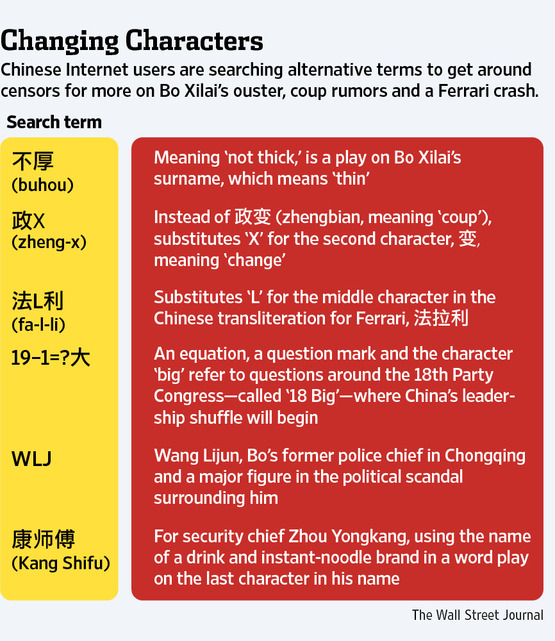
This Wall Street Journal’s article talks about how China’s social-media services have started cracking down on searches for anything in regard to Bo Xilai (who was removed from the CCP last Wednesday), as well as how Chinese Internet users have tried to outsmart the censorship system.

 “Chinese Internet users are searching alternative terms to get around censors for mroe on Bo Xilai’s ouster, coup rumors and a Ferrari crash.”

Seeing how innovative the Chinese can be in outsmarting the censorship system, my (/our) belief that in the long-run authoritarianism would not win is bolstered. As long as people have the will to participate politically, they will strive to organize collective actions despite all the restraints. While the success of outsmarting the censorship system is unknown at this point, we can see that many Chinese are not apolitical and are actively pursuing their freedom of expression. In sum, I believe that if grass-roots movements are persistent and adroit enough, they will have the potential to overthrow a repressive regime.

Meanwhile, stepping up the censorship system at this early stage appears to me that, the CCP is demonstrating its resolution to remain authoritarian.  The CCP’s overreaction to the issue seems to me as an irony. Given on the same day of Bo Xilai’s ouster, Premier Wen Jaibo gave a speech at the National People’s Congress annual session to (once again) express his endorsement for democratization of China (which he claimed needs to be implemented gradually because of China’s immature social and economic conditions). While I do not mean Mr. Wen was paying lip-service, I feel like we really need not take the claims of political leaders too seriously (and sadly I believe this acknowledgement may apply to democracies too….)

Categories
Uncategorized

Elective 10: The most expensive tea in the world: Panda POO tea!

As I was eating my breakfast, I was really worried that this video is about using panda POO to make tea (given the video’s name is “Panda poo tea goes for big bucks”)…..but thanks God…this is about using panda POO as fertilizer to plant tea leaves…..

So what is the selling-point of panda poo tea?

Scientifically, it is argued that  tea leaves fertilized by panda poo is good for your health because pandas digest less than 30% of the bamboo they eat,  and therefore their poo is a rich fertilizer.

To warm up myself for the next mini assign, I find two fallacies in this case of panda poo tea.   First, there is an untested assumption that nutrition from the panda poo fertilizer would be completely absorbed by the tea leaves. Second, the fact that food eaten cannot be totally digested applies to all animals including humans. Why is panda poo more valuable than other animals’ is just mysterious.

I think it is obvious that using panda poo as fertilizer is a “hype” (and please notice the company owner’s panda hoodie……) I believe there is only one difference between panda poo tea and normal tea: their prices.


*Talking about poo is so not lady-like, I am sorry.

Categories
Uncategorized

Mini Assign 9: Can new technologies help or hurt democracy around the world?

Definition of digital democracy: a “bottom-up” approach which concerns with the creation of new citizens’ discussion and deliberation, and sites for mobilization and action.

Question: Can new technologies help or hurt democracy around the world?

Answer: In my opinion, they would help democracy.

*****************************This is because************************

On the citizens’ side, digital democracy promotes

1)      Lower cost of deliberative participation and wider range of possible engagement

First, technologies make public participation more direct but expansive. For example, the convenience of electronic voting may encourage a wider scope of citizens to vote. Also, with its easily available and universally accessible nature (most of the time), technologies provide citizens with opportunities to place questions on the agenda of political issues. By the same token, such interactive systems of telecommunication make it possible for citizens to participate in discussion with experts, policymakers, and fellow citizens. The result is that democracy can be furthered by a greater scope of public political participation.

2)       Transparency of information

Second, technologies allow for more transparency in terms of information dissemination, thus providing a foundation for formal and productive political debates. The non-exclusionary nature of internet (again, most of the time) also promotes plurality of media. Consequently, transparent and wide-spread information dissemination enfeebles centralized monopoly by providing the public information for effective political participation.

3)       Sources of political mobilization

Finally, as citizens can now utilize the internet to form associational bonds (among themselves and with their governments) and to create open public spaces, they are enabled to mobilize their movements, and to communicate with better representatives.  In terms of the latter, incidents such as the Arab Spring prove to us the power of internet for political mobilization.

On the governments’ side, digital democracy promotes

1)       Responsiveness and accountability of democratic governments

While we often see technologies as beneficial to grass-roots political mobilization, technologies can also enhance responsiveness and accountability of democratic governments. For example, there have been many democratic government initiatives to put key documents online, as a means to improve understanding of social policy entitlements through the use of web-based information, and to seek voter opinion on a wide range of public questions.

Downsides of digital democracy 

Despite my endorsement for digital democracy, I recognize the concerns about the harm technologies (and in particular the internet) can do to democracy. As far as I know, these concerns include 1) the truth of the information on the internet is hard to be judged, 2) the media may be manipulated to perpetuate particular political messages, and 3) people with no access to these technologies will be marginalized. While these concerns are all valid, I believe that the democratic potential of technologies can counter-balance, and even outweigh, these problems. While in democracies, the universal nature of the internet has allowed people to evaluate various information they encounter on the internet, in non-democracies, people with technological know-how can often find their ways to use technologies for political mobilization. Again, the Arab Spring is an example.

Meanwhile, although the divide between people who have/ have no access to technologies still exists, it has become less extreme (especially when NGOs have been actively creating internet centers in developing countries). On the other hand, it is important to keep in mind that digital democracy should be used to complement, rather than to substitute the conventional ways of political participation (such as reading newspapers, going to conferences and voting). By considering digital democracy as a complement rather substitute for conventional political participation, one would reach the conclusion that it would help democracy.

Categories
Uncategorized

Democracy in the News 9: Lip-service or Sincere Comment? Chinese Premier Wen Jiabao: democracy in China is ‘inevitable’


In his last National People’s Congress, Mr Wen mentioned “the need for political reform in one-party, authoritarian China.” Once again, I wonder if these speeches, that China also aspires to be a democracy but it takes time, are just for reinforcing diplomatic ties with the Western powers (i.e. lip-service), especially when the authoritarian rule in China shows no sign to diminish. Besides, given Mr. Wen is retiring, it is questionable whether his speech represents the view of the CCP and bears any political influence.

Categories
Uncategorized

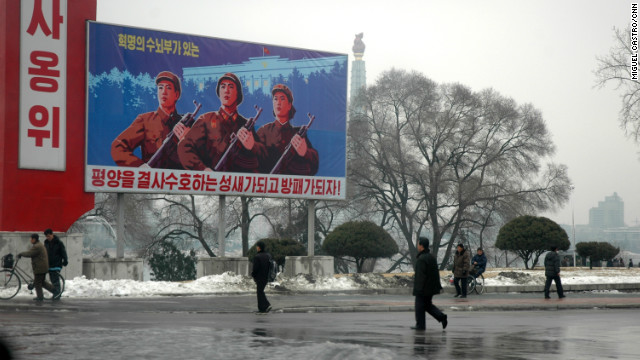
Elective 9: The Pyongyang Illusion: only Pyongyang is doing well.

Photo from CNN

Since the famine in the mid-1990s, North Koreans have been compelled to grow and sometimes illegally sell their own food. Accommodated by the lenient attitude of the government to restrict private enterprise’s activities, a free market has been made possible. As a result, a “new, relatively wealthy middle class” has been created.

Just as one think that the current improvement of socio-economic status of North Koreans would help create an environment more conducive to democratic transition, the term “the Pyongyang Illusion” suggests a less optimistic view.  The term claims that although Pyongyang is more prosperous than foreigners expect it to be, its “well-being may be inversely correlated with the fate of the rest of the country, as resources are poured into the city at the expense of everyone else.” Because of this uneven distribution of resources (which are often spent inefficiently as patronage), the country’s overall economy and living standards suffer.

Indeed, the idea of the Pyongyang illusion is consistent with the fact that provincial cities still show grim living standards in contrast to that in Pyongyang and that the overall North Korean economy shrank by 0.5% in 2010.

Despite the Pyongyang illusion’s pessimistic view on North Korean economic development, the prosperity in Pyongyang may allow the population, particularly the new middle-class, to gain a glimpse what prosperity means and be inspired by the freedom of choice in democratic countries. With their increased purchasing power and interactions with incoming cultures, it is expected that they will have a greater aspiration to take control of their own-life and hence the larger society. For the poor, who makes up the largest proportion of the population, representing themselves in politics is still a far future because of their lack of the financial capability and skills to mobilize movements. Nonetheless, it is hoped that by witnessing the unequal distribution of resources, the poor will be less submissive to the government than they were in the past, and be more aspired to organize themselves as a collective entity, whose interests need to be represented and respected.

Spam prevention powered by Akismet