Categories
Uncategorized

The last post for my Marketing Blog

Hey everyone, this term has been passing so quick and I can not believe it is the end of this semester now. In the last post I will help you to review what a marketing mix is and the 4Ps within it.
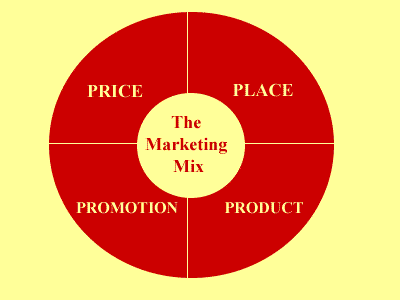
The marketing mix is probably the most famous marketing term. Its elements are the basic, tactical components of a marketing plan. Also known as the Four P’s, the marketing mix elements are price, place, product, and promotion.

Price:

There are many ways to price a product. We may look at some of them and try to understand the best policy/strategy in various situations.

Place:

Another element of Neil H.Borden’s Marketing Mix is Place. Place is also known as channel, distribution, or intermediary. It is the mechanism through which goods and/or services are moved from the manufacturer/ service provider to the user or consumer.

Product:

  • The Product Life Cycle (PLC) is based upon the biological life cycle. For example, a seed is planted (introduction); it begins to sprout (growth); it shoots out leaves and puts down roots as it becomes an adult (maturity); after a long period as an adult the plant begins to shrink and die out (decline).
  • The Customer Life Cycle (CLC) has obvious similarities with the Product Life Cycle (PLC). However, CLC focuses upon the creation of and delivery of lifetime value to the customer i.e. looks at the products or services that customers NEED throughout their lives.

Promotion:

Another one of the 4P’s is promotion. This includes all of the tools available to the marketer for ‘marketing communication’. As with Neil H.Borden’s marketing mix, marketing communications has its own ‘promotions mix.’ Think of it like a cake mix, the basic ingredients are always the same. However if you vary the amounts of one of the ingredients, the final outcome is different.

Finally, I wish all you guys enjoyed in learning Marketing and best luck on the final exams. 🙂

Mark Chen

Categories
Uncategorized

Co-branding

Here are some images of products that are co-branding with other products. I have provided these pictures because I want to make sure everybody has a clear mind of what a co-branding product is like. Good luck to all your final studies! 🙂

Categories
Uncategorized

The Sales Process

Step One: Prospecting & Qualifying 

  • Determine which products and services best suit particular prospects
  • Determine your sales approach and plan your sales calls
  • Uncover reasons why you should not pursue some prospects, saving you valuable time and resources


Step Two: Pre-approach

  • First, determine your objective and the purpose of your call. Your purpose may be to make an appointment, to inform, to question, to talk to a certain person, and to sell. Additionally, determine if you want to close the sale on the first call or simply pave the way for a later call or sales presentation.
  • Try to do a little homework before the call. If you know someone who may have insight or information about the prospect, call them.
  • Send a fax or mail some information prior to the cold call. Reference the information in the call, but don’t open with, “Did you get the information I sent?” This allows the prospect to simply say, “no,” just to get you off the phone. Instead, try something like, “I sent you some information by fax yesterday; I’m following up to provide additional information . . .”
  • When you’re ready to make the call, make sure you have all the materials you need at hand. For example, if the purpose of your call is to make an appointment, have your appointment book open and a working pen or pencil in front of you.
  • State your purpose quickly – within 15 seconds.
  • Get prospects interested by asking questions that make them think.
  • Make statements that build rapport and confidence.
  • Keep your eye on the prize – never lose sight of your objective, regardless of the outcome of the call.
  • Use humor – people love to laugh.
  • Be friendly – people like to buy from people they like.
  • Be sincere.


Step Three: Presentation & Handling Objections

  • Don’t be afraid to be excited about your product. Your enthusiasm carries a strong message about your personal investment in the product.
  • During presentations, focus on the benefits of your products and services. Benefits are different from features, which are characteristics such as size, color and functionality. Benefits answer the customer’s question: “Why would I want to own that product?” Benefits are what cause people to buy.
  • Set objectives for sales calls. Write the objectives on index cards and keep the cards handy to make notes as you think of items to add.
  • Be on time for sales appointments. If you are unavoidably delayed, call before the appointment to let the prospect know your estimated time of arrival.
  • Be prepared for your call. Have your sales brochures, demonstration materials, and other supplementary information available.
  • Be relaxed during sales calls. That often is easier said than done. It helps to give yourself plenty of time in transit so you don’t arrived frazzled from a rush through bad traffic. And, once you are there take a moment in the car to take a few deep breaths and review what you want to say.
  • Let prospects talk 90 percent of the time; they’ll tell you how to sell to them. You just need to listen.
  • Use testimonials. Your best selling tool is a reference from a satisfied customer.
  • Don’t be afraid to ask for their business.
  • Invite prospects to interact with products. For example, encourage customers to try a watch on, operate a device or smell the bubble bath.
  • Limit the choices during a sales presentation. Most experts advise sales people to show prospects only three options at a time. Too many options may prove overwhelming, resulting in them not choosing anything.
  • Adapt your sales presentation to your prospect. For example, a travel agent would provide different types of information about a cruise package to a couple going on their first cruise than to a couple that has been on dozens of cruises.
  • Rate yourself after sales calls. Determine what you did well and what you need to improve upon. Develop action steps for improvement.
  • Always follow through on promises.
  • Determine what your prospect seemed most interested in and work that into your follow-up plan.
  • Follow up, follow up, follow up. It often takes five to 10 exposures to get a sale.
  • Acknowledge your customers’ position and then offer them new information.
  • Question prospects when they make statements about why they won’t buy or what they don’t like about your product. Try to learn why they feel as they do; this will help you get to the root cause of their concerns.
  • Restate the objection so the customer can hear it. This tends to reduce the magnitude of an objection and allows prospects to modify your statement to more accurately express their true objection.
  • Tactfully respond directly to the customer’s statement. If you must contradict what they are saying because you honestly believe they are wrong, provide factual information that can help them see where they may have a misunderstanding


Step Four: Closing

  • Asking about availability
  • Asking specific questions about rates, prices or affordability
  • Asking about features, options, quality, guarantees or warranties
  • Asking positive questions about your business
  • Asking for something to be repeated
  • Making statements about problems with previous vendors; they may be seeking reassurance from you that you won’t pose the same problems
  • Asking about follow-up service or other products you carry
  • Requesting a sample or asking you to repeat a demonstration for them or for others in their company or family
  • Asking about other satisfied customers. You should have a list of satisfied customers ready to give to prospects who ask.


Step Five: Follow-up

  • Establish and maintain your good reputation
  • Build goodwill between you customers and your business
  • Generate repeat and referral business.
Categories
Uncategorized

Interesting and Innovative Marketing Ideas

It has been a stressful week for me. Quite frankly, people start to lose their buzz of making innovative ideas as life moves on so fast and busy. The ideas in this video are very creative and the pictures will speak for themselves.

YouTube Preview Image
Categories
Uncategorized

The up coming snowing season~

As I cruse through some other students’ blogs, I saw one blog from Buchan, Michael which is quite appealing to me. I like his blog because I am a fan of snowboarding myself. I used to go to the Cypress Mountain every week during winter season. And as soon as I saw that the price of the students’ season pass is unbelievably low, it makes me feel like to wax my board and get ready for snowboarding. The two videos he puts on his blog are very cool, and a matter of fact, I think it’s a very good way to advertise their season passes.

Here are some photos of me on Cypress Mountain. Hope you guys enjoy the up coming snowing season.

Categories
Uncategorized

Why Marketers Suck at Customer Service

Hey guys, as I look through other students’ blogs, there is one article from Chan, Nelson (Ka Chun)’s blog catches my eyes. It is about why marketers suck at customer service. I totally agree that sometimes or quite frankly I should say most of the times good customer service does not have a good product. Or vise versa a good product does not always have good customer service. For examples, there are so many restraints in Vancouver provide delicious food but don’t have good customer service. This is a very important concept to have within a Sustainable Competitive Environment. Overall, I like the formula Nelson has written there: Sustainable competitive advantage = Customer care + Product usage.

Categories
Uncategorized

Funny Advertising Pictures

Hi everyone because the mid-term exam week is over, I thought it would be a good idea to put up some funny but creative marketing advertisements. Some of this ads may be inappropriate to use in public. However, in my opinion, the common success these ads have achieved is that they are eye catching.

Just think about it, how many of ads do you see in a day, and how many can you actually remember by the end of the day? There are so many ads people may encounter in their lives that people are subconsciously excluding. Therefore these advertising pictures I would say is a “Counter Strike” towards those who never pay attention to business advertisements. Have an relaxing week guys~~~

Categories
Uncategorized

Five Deadly Sins of Corporate Social Media Marketing

Hey everyone, due to the midterm exams I have to post this week’s blog on Saturday instead of on Thursday. This week we are looking at the importance of Corporate Social Media Marketing. I took some resource information from an external marketing blog called “Top Rank-Online Marketing Blog“. There is an article written by Lee Odden on October 8th, 2010 and it is called “5 Deadly Sins of Corporate Social Media Marketing“. I totally agree with his analysis regarding to “Fear, Arrogance, Frugalism, Egocentric, and Pigeonholing.” In my opinion, a company’s success is partially build on its social media and it is extremely important for the managers to understand how to set up an efficient media network in order for the company to gain more advantage against its competitors.

 Here are some advises which I took from the actual article regarding the “Five Sins”:

1. Fear – “Of course we know fear is all in the mind and by the looks of it, there are some pretty vivid imaginations out there. Remember when companies feared putting up a blog with comments because, “What if someone says something bad about us?”.  In contrast, companies successful with social media are celebrating such criticism and showing how well they address customer concerns – in public.”

2. Arrogance – “There are quite a few big brands that have decided they’re too big and important to listen to customers via social channels or to create two-way communication and engagement opportunities.  More commonly, companies are arrogant or maybe oblivious to who their competition is.  In the “real world” a company might be competing against other similarly large businesses in their industry and category through traditional media, sales on the street and other forms of marketing.”

3. Frugalism – “Paying lip service to social participation and not allocating resources that can help it be successful is probably one of the most common sources for failure. Companies do this will all kinds of marketing where they don’t believe in the tactic, but throw money like spagetti against the wall and see if it sticks.”

4. Egocentric – “If you’re a parent, you might be familiar with the transition kids make from perceiving the world as toddlers, only as it affects them to being able to empathize and detach what’s important to things beyond themselves. Many companies that are new to the social web behave the same way.  Marketing and Sales react to pressures by customers and competitors to become active on the social web and subsequently, marketing and sales tries to do what they know best: Market and sell. Pushing corporate agendas and focusing solely on what the company can get out of social networks and media sharing isn’t being very customer centric.”

5. Pigeonholing – “If and when an outside consultant is engaged and paid for advice, but tasked only to look at certain aspects of a social media program, only use certain tactics, only use certain technologies regardless of objectives, audience, strategy or goals, then it can really be a waste for all. Companies that can afford and feel comfortable with paying outside consultants to substantiate internal projects will find that those projects will succeed not because they gained internal executive support due to some “expert from out of town”, but because the projects are done for the right reasons.”

 Finally, here is a hilarious video about what would happened if a marketing or sales person is being egocentric and pressuring his customers. Have a nice weekend and good luck with all your mid-term exams guys~!

YouTube Preview Image
Categories
Uncategorized

Marketing My Own Car~

Talking about American Muscle Cars, who wouldn’t love Ford Mustang. It has a pure Muscle Car pedigree and has continually improved through-out the times. Ford’s own 2011 Mustang GT is no slouch, rated at 412 horsepower and delivering every bit of it. Then there’s the Shelby GT500, with a massive supercharged 550 horsepower and 510 pound-feet of torque. But if simply ripping the rear tires’ tread from their carcasses isn’t enough for you, the 2011 Ford Shelby GT500 Super Snake is the answer, with up to 800 horsepower of face-stretching force on tap. Personally for me, I am an owner of a 2008 Shelby GT-500. And I’m actually on my way to upgrade this beast into a pure 750 HP Super Snake. Therefore, this week my goal is to market my vehicle. Here are some photos taken with two of my friends who also have passions in Muscle Cars.

Here is an article about Mustang’s top model-Super Snake. This article is taken from <http://jalopnik.com/cars/over-the-back-fence/the-725-hp-shelby-gt500-super-snake-can-be-yours-for-just-72000-265974.php> “The 725 HP Shelby GT500 Super Snake Can Be Yours For Just $72,000!”:

According to the folks at the site who always have the scoop on the next evolution of the Mustang, you’ll have to fork over some serious dough to make your GT500 slither. They’ve somehow managed to get pricing from the folks at Shelby on the Super Snake GT500 package that we’ve been told is capable of making your standard every-day 500 HP GT500 into a pony-car with (reportedly) over 725 HP, making it the highest horsepower street-legal warranty-carrying Mustang ever. The folks at Shelby will take your $45,000 GT500 and for just $27,995, they’ll boost the engine performance via a Shelby supercharger upgrade, a Borla cat-back exhaust system and a cold air intake and then they’ll work on the handling a bit by dropping in a Shelby/Eibach coil over suspension to lower the ‘stang a little over an inch-and-a-half and then by adding Shelby/Eibach sway bars to reduce the body roll. In addition to some Pirelli P-Zero Nero 255/35ZR20 front and 275/35ZR20 rear tires, Shelby will pretty up the exterior by slapping on some carbon fiber, a KR-like Super Snake hood and some super striping and badging, then call it a day. We’re even told they’ll throw in some satin door lock knobs and some Shelby floor mats at no extra charge, but we’re pretty sure they’ll charge you if you ask for a Cobra-Kai karate gi to wear out on the road while driving your “Snake.” – Ray Wert

YouTube Preview Image

Here you go~~The Video of Shelby GT 500 Super Snake~~Enjoy your long weekend~:)

Categories
Uncategorized

Kobe’s Marketing Video

This is Lakers’ basketball player Kobe Bryant jumping over a running vehicle. It’s not just a ordinary car but an Aston Martin. Obviously the video is not real because the Lakers would never allow Kobe to risk himself in any situation. Nevertheless, this is a very cool marketing video. Kobe Bryant did this video years ago in Hollywood. His purpose was to advertise his basketball shoes and to show everyone just how high can he jump when he is wearing this pair of shoes. Enjoy it~ and remember, do not try this at home!!~~

YouTube Preview Image

Here is an interview after Kobe did the ads and he admitted that what he did in the video was fake.

YouTube Preview Image

Here is a funny version of this video, which Kobe had failed to jump that car. Have a fun weekend guys!~~:)

YouTube Preview Image

Spam prevention powered by Akismet