Categories
Uncategorized

Insurers Strike Back

Each year in Canada, there are 40,000 lightning-related insurance claims, totalling between $500 million and $1 billion. Insurers find the need to verify past strikes from a trustworthy source instead of relying on the adjusters to “recreate events that literally happened in the blink of an eye”.

Here’s the good news to the insurers. The Weather Network is now monitoring a new data base that reflects the strikes record since 2007. Although the information about strike locations is not 100% accurate and precise, it help adjusters in determining the legitimacy of claims.

After learning about the basic financial concepts from Mr. Murray Carlson, I realized that insurance is a type of investment.  In simple words, to invest is to give up some current wealth to the counterparty in the investment contract in order to acquire future profit that may be safe or risky. In insurance, policyholders are investors who make regular payment to the insurers, so as to obtain possible payments in exchange to the risk of a loss. However, some people tend to make money by setting frauds. Thus, the insurers are always looking for ways to prevent frauds, just like the request of the strikes data.

Source of the article: Maclean’s

Categories
Uncategorized

One Earth Farms

Launched last year with initial $27.5-million-investment from Sprott Resource Corp., One Earth Farms now administrates 93,000 acres of farmland in Alberta, Saskatchewan and Manitoba. It aims at creating the biggest farms in the world by building stable long-term relationship with the First Nations who control 2 millions acres of land in three provinces.

Image 1

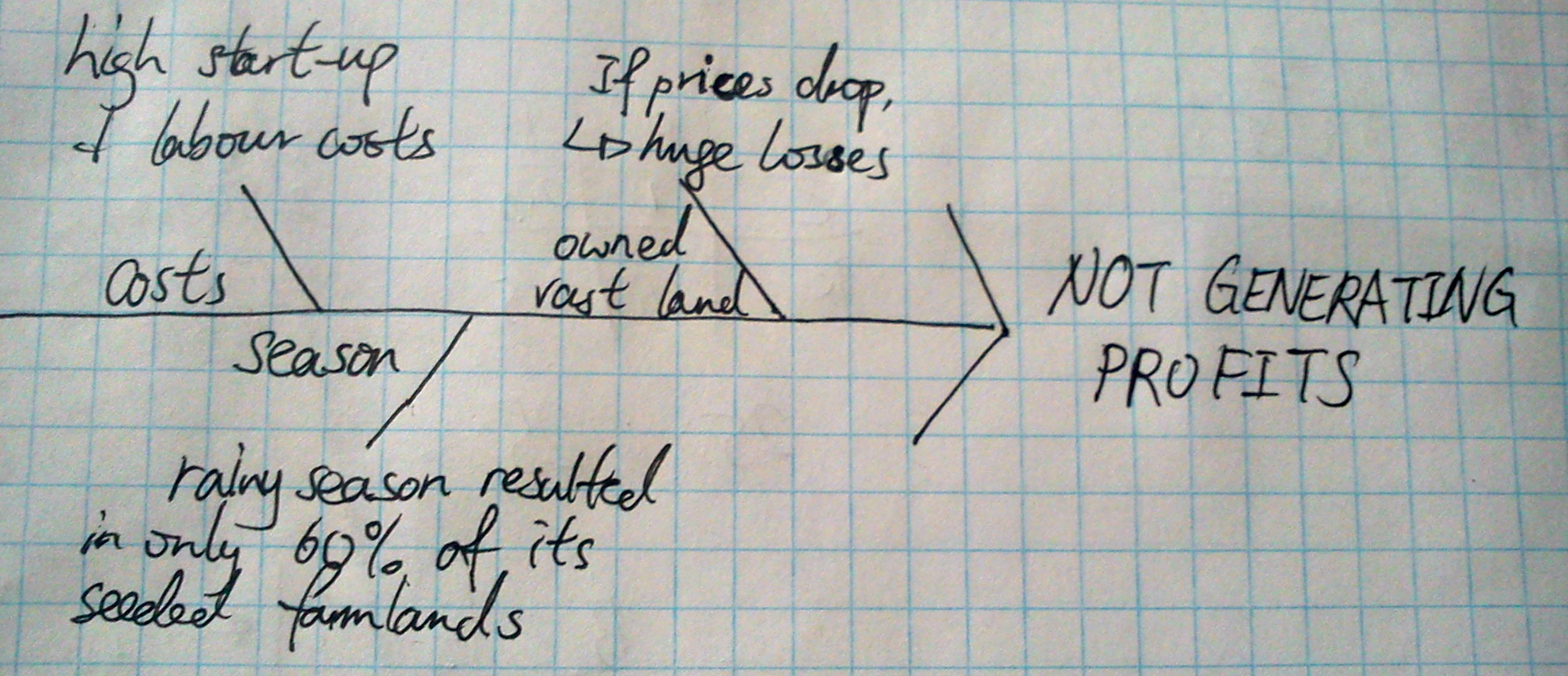
According to the Maclean’s article on 23th Sept, 2010, this second largest farm corporation is not yet profitable. Some critics point out that big farms are less flexible than smaller farms. The Fishbone diagram below summarizes the major issues that impact the early revenue of the corporation.

Image 2

However, based on the clarification made by an investor in Sprott Resource Corp, the One Earth Farms doesn’t actually own the land. Instead, it leases from the natives. Also, the labour costs and the input cost are reduced due to economies of scale. In addition, it have crop insurance and can even apply for government aid if needed. Therefore, it seems to me that One Earth Farms have the potential growth in the market.

Source of Image 1: http://www.oneearthfarms.net/

Spam prevention powered by Akismet