Categories
E-marketing

The Four Main Social Media Platforms and My Beef With One Of Them

With the prevalence of social media today, it only makes sense that more and more firms are jumping on the bandwagon and getting themselves Twitter and Facebook accounts. It’s virtually free, not considering employee time, and is what you’re “supposed to do”. According to PR firm Burson-Marsteller 25% of companies worldwide are using all four major social media platforms: Facebook, Twitter, YouTube and blogs and 84% are on at least one platform.

As companies are becoming more active on these sites, it is important to consider the following:

  • Integrating social media with other corporate activities is fundamental to long-term success.
  • Social media should be assessed in the early planning stages of planning rather than tagged on at the end.
  • At least TRY to measure ROI. Nearly all companies who have used some form of social media report it as successful; however, if they are not monitoring their ROI they likely do not fully understand the impact of their social media marketing programs.

As a consumer who actively uses all four major social media platforms I have many opinions regarding the matter. My main beef is with companies on Twitter. I find that the majority of firms either tweet too little or WAY too much. Sure you might have thousands of followers on your Twitter account but if you tweet once every 2 weeks what good does having all those followers do? Maybe you don’t have much to announce. In that case try retweeting, responding to tweets, and even just tweeting random fun facts/findings to mix things up a bit. On the other end of the spectrum are the businesses that tweet way too often and usually result in a swift click of the “unfollow”. Yes, you have lots to say and so many promotions but do you really need to tweet 10 times per hour? Filter! Equally as bad are those who post countless tweets of the same type with no variety. The article 50 Ideas on Using Twitter for Business has lots of great tips for avoiding the pitfalls of Twitter and mastering the art of the tweet.

Reference: Marketers Spending More on Social Media for All the Wrong Reasons

Categories
E-marketing

Word of Mouth: Who Do You Trust?

Word of mouth is widely regarded as one of the most valuable, and often hardest to do well, forms of marketing. In order to be successful at word of mouth marketing it is important to consider which recommendations are deemed most credible by consumers. Not surprisingly, over the years the human element has remained key in creating trust. As the use of social networks like Facebook increases around the world, this human element can be conveyed through an online medium. The supporting findings below have important implications for marketers. Rather than allocating dollars to radio or TV advertisements, in many situations it may be more effective to create online content which can then be tweeted, posted on a blog, or linked to on Facebook by a consumer. A friend who sees this content is more likely to trust it than if it were presented to them by a business with a motive.

This information shows how lucrative it can be for firms to identify those influential people out there on Twitter, Facebook, LinkedIn, etc. and harness them to spread the relevant buzz. Prompt your fans to talk about your brand ex. “Today we launched _____ product, tell us what you think about it!”. Or offer them discounts and deals that they can then spread the word about.  Ideally you ultimately create customer evangelists who advocate the brand at no cost!

Reference: Who Gives the Most Trusted Recommendations?

Categories
E-marketing

Mobile Social Media: Location Based Marketing

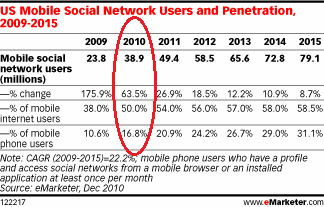
Now that social media – which not too long ago was brand new to the marketing world – has moved onto the phone, marketers have a whole other marketing channel to concern themselves with: mobile social media. With the increasing popularity of smart phones the percentage of mobile phone users accessing social network sites from their phone increased to 16.8% this past year, the equivalent of 38.9 million people (US). This number is forecast to continue to increase greatly over the next few years; therefore, firms should be taking a critical look at whether mobile social media is something they can take advantage of.

Location based marketing seems to the way of the future with companies like foursquare pioneering the way with mobile “check-in”. After perusing the foursquare website for a while, it became evident that the mobile app has a lot to offer businesses and consumers. By downloading the app consumers can be alerted to businesses in their area, see if their friends are nearby, provide/access reviews, and get badges/points to unlock rewards. As a business, all this interactivity can be done with YOUR brand which is pretty great, assuming of course that your brand offering is valuable and doesn’t let customers down and lead to negative reviews. Ultimately, foursquare has the potential to greatly improve the customer engagement factor and create loyal consumers. Naturally Facebook (among others) has followed suit with their Facebook Places feature, it will be interesting to see which prevails.

Reference: Beyond the Check-In: best Practices for Location-Based Marketing

Spam prevention powered by Akismet