Categories
E-marketing

The Four Main Social Media Platforms and My Beef With One Of Them

With the prevalence of social media today, it only makes sense that more and more firms are jumping on the bandwagon and getting themselves Twitter and Facebook accounts. It’s virtually free, not considering employee time, and is what you’re “supposed to do”. According to PR firm Burson-Marsteller 25% of companies worldwide are using all four major social media platforms: Facebook, Twitter, YouTube and blogs and 84% are on at least one platform.

As companies are becoming more active on these sites, it is important to consider the following:

  • Integrating social media with other corporate activities is fundamental to long-term success.
  • Social media should be assessed in the early planning stages of planning rather than tagged on at the end.
  • At least TRY to measure ROI. Nearly all companies who have used some form of social media report it as successful; however, if they are not monitoring their ROI they likely do not fully understand the impact of their social media marketing programs.

As a consumer who actively uses all four major social media platforms I have many opinions regarding the matter. My main beef is with companies on Twitter. I find that the majority of firms either tweet too little or WAY too much. Sure you might have thousands of followers on your Twitter account but if you tweet once every 2 weeks what good does having all those followers do? Maybe you don’t have much to announce. In that case try retweeting, responding to tweets, and even just tweeting random fun facts/findings to mix things up a bit. On the other end of the spectrum are the businesses that tweet way too often and usually result in a swift click of the “unfollow”. Yes, you have lots to say and so many promotions but do you really need to tweet 10 times per hour? Filter! Equally as bad are those who post countless tweets of the same type with no variety. The article 50 Ideas on Using Twitter for Business has lots of great tips for avoiding the pitfalls of Twitter and mastering the art of the tweet.

Reference: Marketers Spending More on Social Media for All the Wrong Reasons
Categories
E-marketing

Mobile Social Media: Location Based Marketing

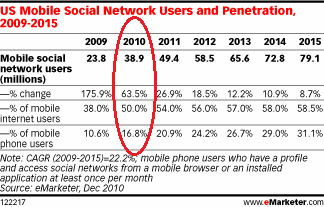
Now that social media – which not too long ago was brand new to the marketing world – has moved onto the phone, marketers have a whole other marketing channel to concern themselves with: mobile social media. With the increasing popularity of smart phones the percentage of mobile phone users accessing social network sites from their phone increased to 16.8% this past year, the equivalent of 38.9 million people (US). This number is forecast to continue to increase greatly over the next few years; therefore, firms should be taking a critical look at whether mobile social media is something they can take advantage of.

Location based marketing seems to the way of the future with companies like foursquare pioneering the way with mobile “check-in”. After perusing the foursquare website for a while, it became evident that the mobile app has a lot to offer businesses and consumers. By downloading the app consumers can be alerted to businesses in their area, see if their friends are nearby, provide/access reviews, and get badges/points to unlock rewards. As a business, all this interactivity can be done with YOUR brand which is pretty great, assuming of course that your brand offering is valuable and doesn’t let customers down and lead to negative reviews. Ultimately, foursquare has the potential to greatly improve the customer engagement factor and create loyal consumers. Naturally Facebook (among others) has followed suit with their Facebook Places feature, it will be interesting to see which prevails.

Reference: Beyond the Check-In: best Practices for Location-Based Marketing

Categories
E-marketing

What Makes a Great Blog?

For the Google Online Marketing Challenge my group is working on a local Vancouver based clothing company Plenty (or Plen+y) with a flagship store in Kitsilano. Because their website does not currently offer online sales, their blog is the highlight of the website. This got me thinking, what makes a great blog?

According to the CMOs at Fortune 1,000 companies the #1 factor is that the blog postings always get comments. Keeping up-to-date with regular postings was also regarded as very important. What surprised me was how much lower in importance pictures/video ranked on the list…mostly because in my opinion it’s what makes a blog posting readable. Who wants to read a page full of text with no visuals to break up the monotony?

I definitely agree that regular postings are a must (I get disappointed when the blogs I follow don’t update at least every few days) but why is it necessary to have comments on the posts? According to the CMOs polled, blogs are generally more effective when they “produce a lively discussion rather than just pushing content out into the world”. Interesting perspective that I hadn’t thought of and it makes sense I just didn’t realize commentary was so highly regarded, but who am I to question the successful CMOs of the USA?

Bringing it back to Plenty, I thought their blog was pretty good with lots of pictures and links and semi-regular concise posts. However, they do seem to lack the engaged community that the CMOs deem so important. This poses yet another question: how do you engage the community?

Reference: What Makes for a Compelling Corporate Blog?

Categories
E-marketing

Social Media and Super Bowl XLV

Each year marketers and non-marketers alike eagerly await the arrival of Super Bowl Sunday to watch what are supposed to be the best of the best in commercials. (Oh and apparently some people watch it for football…) And they better be good, because companies are willing to pay upwards of 3 million of dollars to show you these ads for often only 30 seconds. However, as the as the percentage of total ad spending that goes towards online advertising continues to increase with more and more people active online, the way many firms go about Super Bowl advertising changes.


This year Audi managed to secure one of the coveted Super Bowl spots before they sold out in October. Their ad will contain a hashtag so that it can reach beyond TV and on to Twitter. If the ad resonates with enough viewers it could create an online buzz as well, making those millions of dollars even more worthwhile. Audi is not alone, “more than ever, marketers who enter the Super Bowl are taking part in a multi-week buzz contest rather than a onetime showing of their ad”. Surprisingly, this was not a popular idea in 2009 or 2010 when E-Trade was the only Super Bowl advertiser to even mention Facebook or Twitter in its ad. However, I think there is potential for integrating social media with Super Bowl ads to be greatly effective, especially since according to a recent survey from Lightspeed Research, nearly 2/3 of viewers 18-34 who plan to watch the Super Bowl will also make use of a smartphone. With smartphone in hand a hashtag on the screen may prompt us to tweet when we may not otherwise think to do so.

Reference: Marketers Suit up With Twitter, Facebook for ‘Social Bowl’

As an aside, remember how perfect that Google ad was last year? YouTube Preview Image

Spam prevention powered by Akismet