Several years in a row there are conversations about the transition from the desktop era to the mobile era. Someone calls it “Web 3.0: Mobile”, which came after the “Web 2.0: Social”. And it’s really so. Look around: with abundance of offers from different brands, everyone now owns a smartphone or a tablet, or electronic book with wireless connector, or all of that…
Recent research of Pew Research Center (PEJ) showed that half of all U.S. adults have a mobile connection to the web through different devices.
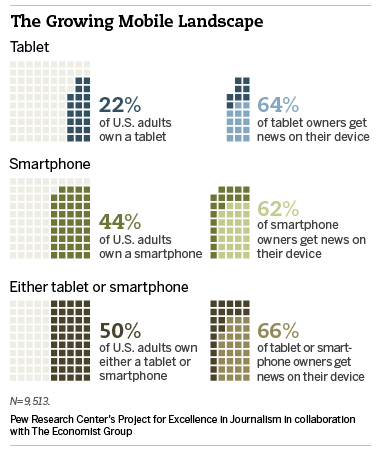
Impressive! So many opportunities for the business! With mobile there is a possibility to keep in touch with the client constantly. Why? Because mobile device gives a chance to reach the customer in real-time regime, anywhere, in easy way. More and more brands nowadays are using mobile approach, offering entertainment, location-based services, news delivery, electronic commerce, almost everything you can do using desktop. Mobile environment is a new field for marketing information gathering, advertising and involvement.
Everything is so great… Where is the “but”? It’s right here. And not the only one. Let’s consider some difficulties before we go down to mobile stream:
1) First of all, there is a problem to go smaller. Majority of leading businesses created entered Web world with PC-based approach, that’s why the web-pages contain so many elements. It’s different with small mobile phone screen. So now it’s a challenge for most of the companies to make a good mobile design, to tailor their web-pages for new micro environment, reduce amount of elements, but still be informative enough and attractive in usage.
2) Measurement is another issue. Recent Forrester research reveals that many marketers still use desktop metrics to measure mobile performance, instead of using new, tailored ones. For example, popular metrics are traditional advertising engagement metrics like website traffic and visitor number or click-through rates to measure mobile ad campaigns. But these are desktop metrics and they are not effective for mobile devices, where the “fat-finger” effect is quite popular occurrence.
3) Third point to consider is cultural or even economic. Some local brands should be careful in mobile ad campaigns financing, because mobile era has arrived, but mostly to developed word. Though many users in developing countries having the smartphone or tablet, it is still expensive to afford mobile Internet access. So research on such kind of market can show huge amount of mobile devices in use, but on-line marketing results won’t be so impressive.
4) And the last point to mention. There are various types of “mobile devices”, not talking about the brands or platforms, it’s important to separate smartphones and a tablets. Time of usage, content consumed, the environments and user behaviors are wildly different. This point should also be considered by marketers, going mobile.
Anyway, mobile era is what’s going on now. It behaves like an adult in Japan and North America, is still a teenager in Europe and just knocking to the developing countries’ door, but it has already arrived, so get prepared.
 This new appeared issue created the background for so-called micro-social networks. These are services, which provide the possibility to share the information among people in small circle. The sharing therefore is becoming more intimate by nature. For now there are several platforms of such a kind. Pair, Path, FamilyLeaf, Kibits and newcomer Kidfolio are some of them. They are much more smaller then Facebook, Vkontakte (huge social network for Russian-speaking users around the world), Odnoklassniki etc. Path, for example, has a limitation of 150 friends. FamilyLeaf cover just close relatives and Pair is just for 2 users. Kidfolio is a service for parents to share the photos of kids, which can be organized in scrapbook timelines in chronological order.