Categories
Uncategorized

T-shirts again. What a great tool of making money!

In this article 12 Top community managers shared several secrets of better engagement. And one of them was “to go offline” and try to attach your on-line fans to something physical and tangible. What should it be? Flashmob downtown? Free cup of coffee or painting contest?

Social networks decided for clothes. Why not? What can be more physical than a thing you can feel with your skin?

That is why Facebook has recently opened the company shop on its campus in Menlo Park, SF. According to TechCrunch, shop is called “Store” (without “the”) and sells T-shirts, hoodies, jackets and hats with company logo and name.
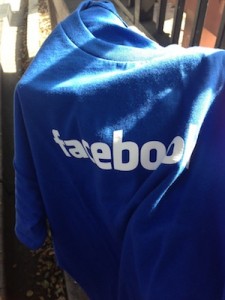
Strange that it took so much time for Facebook to open its store, because, for example, Foursquare has done that almost two years ago. A lot of similar swag can be found on their store website.

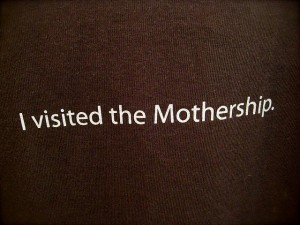
The same did Apple in its “Company Store” on Apple campus. Its t-shirts “I visited the Mothership” and “I visited the Apple campus. But that’s all I’m allowed to say” were must-have for all the Apple  geeks the last several years.
Why do they do it? First of all it’s a form of publicity for the brands, but it’s not the only reason. If these shops exist for several years already, there is a demand for this products, it means that these stuff helps loyal customers to express their love to the brand. Moreover, now employees of these companies can show how proud they are of what they do and whom they work with. And, of course, in the end it’s all about building the community, because you probably think about common interests, tastes or way of life being geek, when see someone in the same T-shirt as yourself. So, brand evangelists, that’s you whom they are trying so hard for.

Categories
Uncategorized

It’s all about self-monitoring

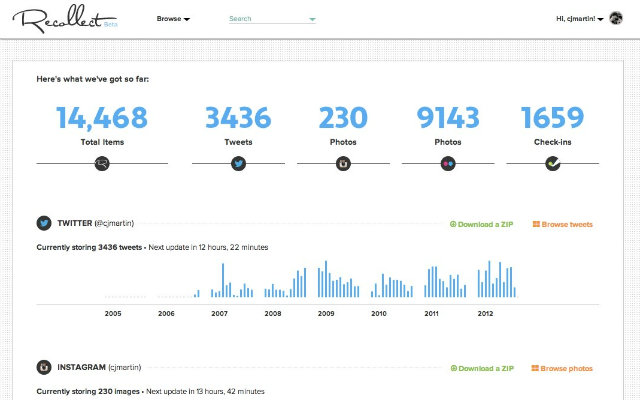
Not just individuals, but each company now tries to be presented in as many social networks as possible. Facebook, Twitter, Instagram, Foursquare, Flickr, Printerest…you name it. Thousands of posts, pictures, tags… Human memory is short even if you post your life on-line by your own, but company profile is managed by bunch of employees. How not to get lost in informational ocean of changeable data and still remember all the traces you left to cover them in case of emergency? There is a new great solution for such a purpose called Recollect.

This is a tool, which helps to archive all the up-dates, photos, comments and other information related to the profile from the several social networks and gives a possibility to download it to the computer like a zip-file. Another interesting feature of this service is the ability to search through the data you downloaded. Though, there are some other tools, maintaining this function, as, for example, CloudMagic, discussed in this my post. For now there are four supported social networks: Twitter, Instagram, Foursquare and Flickr, but developers will expand this list adding some more, Facebook being the first in the line.

This is a paid service, price is charging per month and varies according the amount of data downloaded. Three monthly plans are available (from $6 till $24/month), first month being free. Combining with HootSuite, this service can be a good addition to keep the on-line life of the company under control.

Categories
Uncategorized

The brave new world of future election campaigns

President election is the huge event in the life of nation, isn’t it? Especially now, when there are so many opportunities to follow and to get involved. 2012 elections in the U.S. are intensively discussed on the news portals, in social networks, blogs etc. New media give so many possibilities! At the beginning of the year Google launched the elections hub for people to watch, learn and discuss the upcoming event, President Obama runs his own twitter under @BarackObama,  Mashable discusses the possibility of voting on-line in its report , while U.S. government is already implementing this option for military or overseas voters.

Technologies create the brave new world of inexhaustible opportunities. According to Techcrunch, the 2008 election was about Facebook, while this year elections shifted to Twitter. What will come next? And how will new media change the nature of election campaign? Another article of Mashable is discussing the possible portrait of the candidate to the President in digital world of 2040.  Let’s have a look at the problems he might face:

According to the video, if any potential candidate to 2040 presidential race uses Facebook as a place to socialize and share his thoughts, he automatically becomes unelectable. Because each careless comment or status post, each easy-going photo of his/her students’ years entertainment activities will be found and brought to the light during the possible election campaign of the future. Does it mean that everyone should be really attentive to the content he shares in the web, that it is important to carefully monitor all the digital movements of yourself. Well…it would certainly do no harm. But apparently Facebook and Twitter won’t have such a great influence in 28 years? First of all, they can simply retire till that time, or people will become social-media averse and sick of sharing. Another scenario, proposed by Mashable, is a new hypersocial media, where all the data (from foot size till real-time pulse rate) would be available. Also social norms and value can change completely, and things unacceptable nowadays will become usual in future.

No doubts, world is changing. And this digital “improvements” will touch every side of our life, including politics and election campaigns. There is no chance to control the information anymore, but smart political engineers will find the way to convert the danger of new media influence into the benefits for their candidates. For sure, on-line political campaigns will replace the more expensive TV advertising. Possibly, we will be able to watch the reality show describing the life of candidate in all the detail.  Or, maybe, politicians will seek for the funds for their campaigns through projects like Kickstarter. Electorate is getting smarter. So who will win in 2040? The one who can provide the proper and up-to date communication.

Categories
Uncategorized

Facebook new ad: is it shouting or talking?

It’s not a secret that relationship between customers and companies during recent years shifted significantly from companies’ dictatorship to customer control power. “Groundswell” the book made by Forrester Research describes a bunch of new methods, which are supposed to involve the company in qualitative relationship with customer. Talking is one of them.  According to it, companies, instead of advertising, should use creative ways to approach the clients and to involve them into the communication. One of the popular approaches can be posting to blogs, creating videos or participation in social networks. But what if the social network itself needs to talk to the users? What method of communication should it use? And is it possible nowadays to convert a simple advertasing message into the instrument of two-sides communication? Through this post I want to show a bit different approach to Talking as one of the tactics of “new communication”.

Recently Facebook started the advertising campaign to approach the target market in 13 countries (Brazil, India, Indonesia, Mexico, Philippines etc), where it is not popular because of the technology gap or existence of local powerful social networks (for example, “Vkontakte” in Russia). Facebook released the video ad, aimed to show the things connecting people throughout the world. What can it be?

Chairs…Strange choice, isn’t it? But it actually works. Just a week passed, but Facebook already got feedbacks of different kinds, starting from the Are Chairs Like Facebook? web-page  till the parody reply ad of the following content:

One could say that the original ad is just a shouting, unpopular technics of the past, which is aimed to deliver the message to as many people as possible. Nevertheless, though it is just an advertising video, it seems to be talking method, because talking creates conversation. And these re-posting, web-page response creations, video parodies are the conversation. Is it the good one – this is a question. But people talk about, people exchange the information and express opinion, though for now mostly negative.
Next step should be made by Facebook. It is interesting to see how it will respond to continue this conversation or to turn it to another, more favorable way.

Categories
Uncategorized

Micro-social networks

Several years ago you could hear the question “Are you on Facebook?”. Today it probably is “How can I find you on Facebook?”. Do you have an account there or not is not a question anymore.  Facebook nowadays is the “must have” for everyone. It’s the biggest contact book with 955 million users (June 2012) throughout the word and this amount continues to increase. Such a fast growth changed the character of this social platform, turning it from the small network for friends into the public library or inquiry office for long-lost relatives, random acquaintance or even strangers surfing around.

Why do we have an account on Facebook? “Sharing, giving and receiving”, isn’t it? And “sharing” – the major option of Facebook – is so easy. Just push the “post” button or tag a face. With such an amount of “friends” one needs to be careful of what to share. Of course, there are limitations of access, but it seems really time consuming to monitor your activity all day long. That is why many users of Facebook are decreasing their activity and switching to another way of sharing.

This new appeared issue created the background for so-called micro-social networks. These are services, which provide the possibility to share the information among people in small circle. The sharing therefore is becoming more intimate by nature. For now there are several platforms of such a kind. Pair, Path, FamilyLeaf, Kibits and newcomer Kidfolio are some of them. They are much more smaller then Facebook, Vkontakte (huge social network for Russian-speaking users around the world), Odnoklassniki  etc. Path, for example, has a limitation of 150 friends. FamilyLeaf cover just close relatives and Pair is just for 2 users. Kidfolio is a service for parents to share the photos of kids, which can be organized in scrapbook timelines in chronological order.

What are advantages of these small social networks? Of course, it’s simplicity. There are no complicated privacy settings, the interface is understandable and quite easy to use. What else? To my mind, using such an app, one won’t be overloaded with any kind of unnecessary and unrelated information from around.  And the major advantage: you will never share the private things with wrong people.

I think these small social networks can become an attractive option for people who are sick of easy sharing and want to protect their personal space in the world where nothing is hidden anymore. Will these startups become successful? The time will show. It can be just a new toy, but who knows? Maybe the post-Facebook era is starting right now…

Spam prevention powered by Akismet