
- RESULTS
Poster presented at the BC Quality Forum 2017
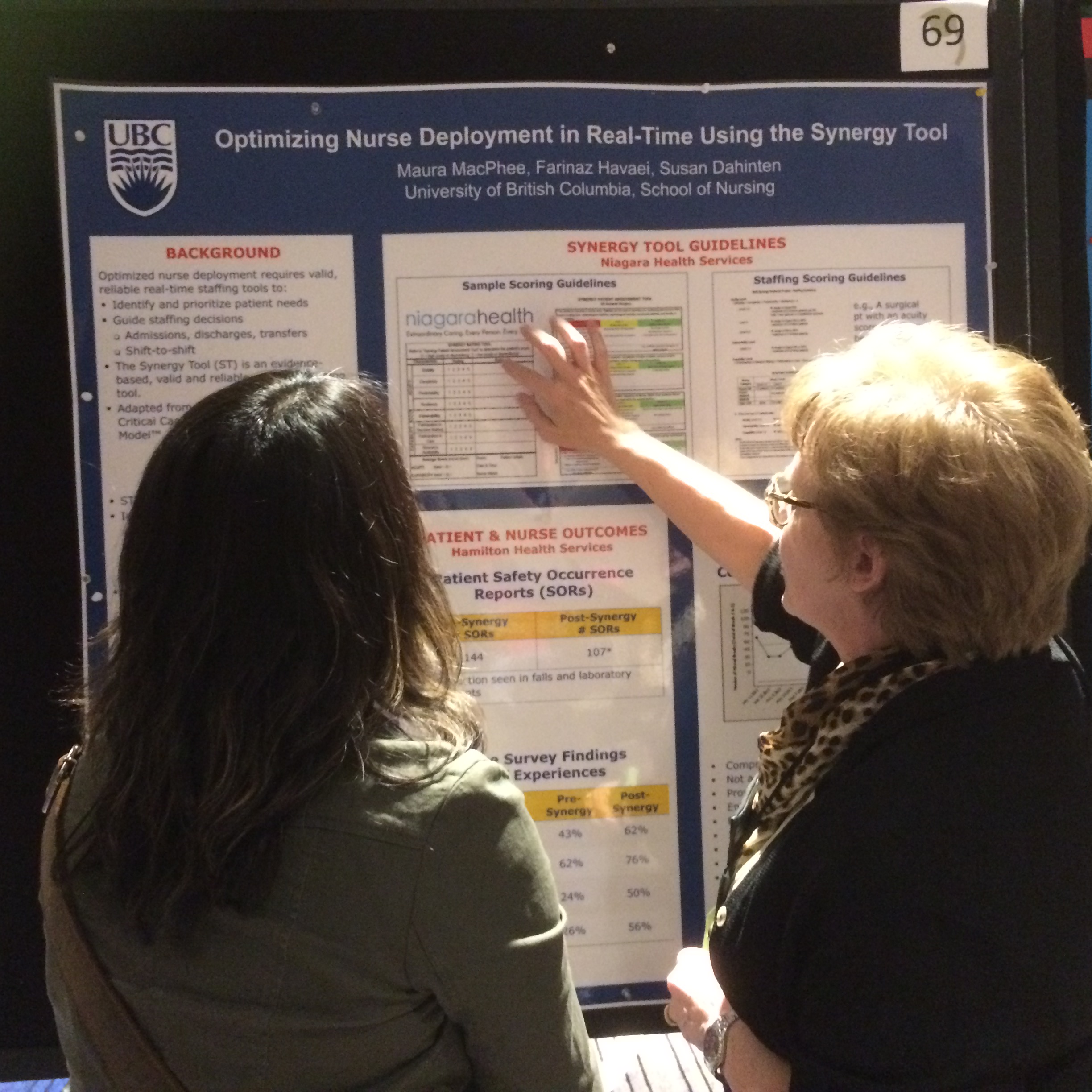


Dr. Maura MacPhee, Principal Investigator and Professor, UBC School of Nursing. (Photo by Khristine Carino)
Poster presented at the
Canadian Health Workforce Conference 2016, Ottawa
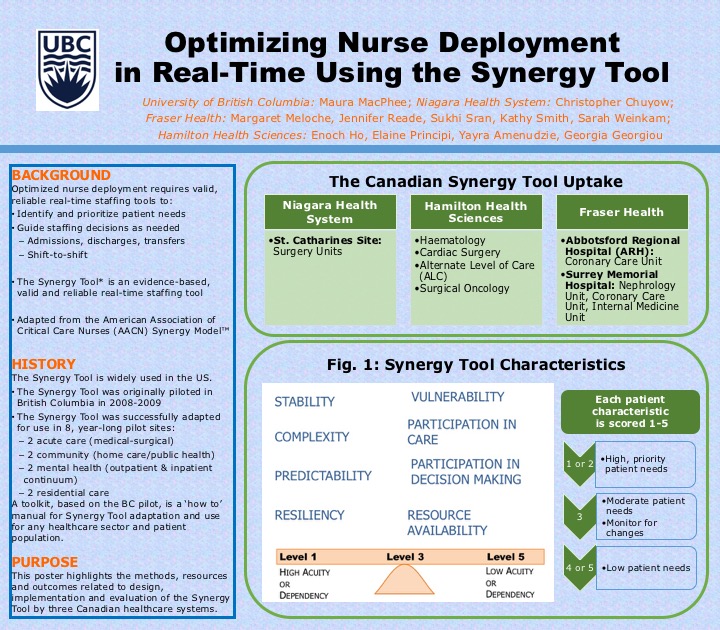

University of British Columbia: Maura MacPhee; Niagara Health System: Christopher Chuyow; Fraser Health: Margaret Meloche, Jennifer Reade, Sukhi Sran, Kathy Smith, Sarah Weinkam; Hamilton Health Sciences: Enoch Ho, Elaine Principi, Yayra Amenudzie, Georgia Georgiou
Nurse shortages compromise quality, safe patient care. Staffing tools optimize the deployment of nurses. This presentation provides an overview of a valid, reliable, real-time safe staffing tool, the Synergy tool, which ensures a ‘fit’ between priority patient needs and nurse competencies. The tool is in use in BC, Ontario, Saskatchewan.
Background/Rationale: At the front-line, micro level, nurses and management need real-time staffing tools to identify and prioritize patient needs and guide staffing decisions on an as-needed basis (e.g., shift to shift, admissions). The Synergy tool is a real-time staffing tool that can be easily adapted to specific populations (e.g., acute, residential, community, mental health). The tool covers eight patient characteristics on a 1-5 scale. Staffing guidelines, collaboratively developed by nurses and management, are based on a fit between patient synergy scores and nurse competencies and experience. Synergy scores can be used for internal/external benchmarking, quality improvement, program evaluation and research. Examples of tool use will be provided from acute and critical care services in BC and Ontario.
Objectives:
- Demonstrate how the synergy tool makes safe, effective, real-time staffing decisions
- Provide examples of applications and outcomes from the acute care sector in BC and Ontario
- Describe tool use implications for nurse workforce planning, quality improvement and research
Methodology: In Hamilton, Ontario a pilot project was conducted to examine the adaptability, applicability, and effectiveness of the Synergy Model in a Canadian inpatient hematology/HSCT setting. The synergy tool was adapted to a hematology inpatient unit and the adapted tool was tested to ensure validity. In addition, pre/post-survey tools were used to measure the usefulness and impact of synergy tool use on staff and patient care. Administrative and human resource data were used to track patient safety occurrences and nurse resource utilization since synergy tool introduction. In Niagara, Ontario pre/post-survey tools are measuring nurse perceptions of workload and the work environment. A time series design is being used to track quality indicators and human resource data for 12 months before and 12 months after synergy tool introduction. In BC, interviews and focus groups have been used with nurses/management.
Findings/Impact: The results of the pilot demonstrated that the Synergy model can be adapted to an acute hematology population and that it is feasible to use the model in an acute Canadian inpatient setting. The processes that were developed for scoring patients and using the scores to make the nursing assignment and decisions about staffing adjustments, proved feasible to implement in a Canadian acute inpatient setting
The impact of the model on work environment and nursing practice was assessed through pre and post survey . Pre/post surveys with direct care nurses found significant improvements in nurse reports of clinical autonomy and engagement. Nurses also reported decreased stress at work. Nurse overtime decreased by an average of 40% per month. The impact on patient was assessed by comparing safety occurrence reports pre and post implementation. There were significant reductions in patient falls and laboratory incidents.
Data from Niagara are still being collected and analyzed.
In BC, qualitative findings corroborate Hamilton nurse survey results. Synergy tool use: enhances shared decision-making between nurses and management; promotes autonomy over practice; builds collaborative teamwork and communications; maximizes scopes of practice among skill mix; and reduces gaps and overlap in patient care delivery. Nurses and management value the synergy tool for its flexibility and its capacity to guide informed, effective real-time staffing decisions.
Conclusions: The synergy Tool supports safe staffing by maximizing nurses’ scope of practice and ensuring ‘fit’ between priority patient needs and nurse competencies and experience. Qualitative/quantitative organizational data support the tool’s use as an “enabler” of workforce optimization. The synergy tool allows health care administrators and nurses to make more informed, effective, real time decisions about resource utilization and allocation in response to changes in patient acuity.
Take Home Messages for Policy Relevance: The synergy tool is a reliable, valid real-time staffing tool that can be easily adapted to different patient populations and sectors (acute, community, residential, mental health). The tool has proven efficacy in reducing patient adverse events and improving nurse utilization.