Category Archives: Favorite Articles

Favorite Articles: Appearances of Hepatobiliary Contrast Agents in the Liver

Hepatobiliary Contrast Agents are an incredibly important tool in liver imaging due to their ability to allow us to differentiate the different types of lesions that can occur in the liver.

But due to the huge number of types of lesions that can occur in the liver, and even the varied appearances of lesions in a single category, it’s not always straightforward in figuring out what is what, even with a good clinical history and lab data when it’s available.

That’s where this article comes in; it contains a great explanation of expected appearances, and even a handy chart of what these lesions look like during the different phases of imaging (e.g. arterial vs portal venous vs delayed).  It has a super-helpful ‘quick reference diagram’ that shows the expected appearance of the different lesion types under the different imaging phases, as shown below (reference for the image is here):
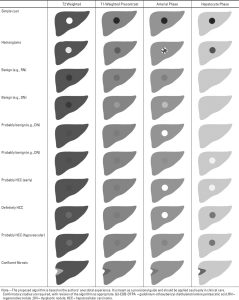
Expected appearance of different lesion types under different imaging phases using hepatobiliary contrast agents.

Expected appearance of different lesion types under different imaging phases using hepatobiliary contrast agents.

The article also contains numerous MRI images of different lesion types under different imaging phases, and is well worth a read.  The reference for the article is:

Cruite, I., Schroeder, M., Merkle, E. M., & Sirlin, C. B. (2010). Gadoxetate Disodium–Enhanced MRI of the Liver: Part 2, Protocol Optimization and Lesion Appearance in the Cirrhotic Liver. In American Journal of Roentgenology (Vol. 195, Issue 1, pp. 29–41). American Roentgen Ray Society. https://doi.org/10.2214/ajr.10.4538

Favorite Articles: Brachial Plexus Anatomy / Thoracic Outlet Syndrome

While I think we all remember ‘roots, trunks, divisions, cords, and branches’ from medical school anatomy class, actually reading brachial plexus MRI – due to the complex anatomy and the complexity of the imaging sequences/appearances layered on top of it – is very difficult.

One of my ‘go-to’ articles for reading these cases is from RadioGraphics:

Demondion, X., Herbinet, P., Van Sint Jan, S., Boutry, N., Chantelot, C., & Cotten, A. (2006). Imaging assessment of thoracic outlet Syndrome. Radiographics, 26(6), 1735–1750. https://doi.org/10.1148/rg.266055079

It has wonderful anatomic dissection images as well as labeled CT and MRI images that help explain the complex anatomy of the brachial plexus and thoracic outlet. Definitely an aid when reading these often difficult cases. Below is one of the images from the article.

Figure 3c.  Assessment of the interscalene triangle with different imaging modalities. Sagittal gross anatomic section (a), computed tomographic (CT) image (b), T1-weighted magnetic resonance (MR) image (c), and sonogram (d) show the anterior scalene muscle (AS), clavicle (C), fifth cervical nerve root (C5), sixth cervical nerve root (C6), seventh cervical nerve root (C7), eighth cervical nerve root (C8), first rib (FR), middle and posterior scalene muscles (MS), subclavian artery (SA), subclavian vein (SV), and first thoracic nerve root (T1).

Figure 3c.  Assessment of the interscalene triangle with different imaging modalities. Sagittal gross anatomic section (a), computed tomographic (CT) image (b), T1-weighted magnetic resonance (MR) image (c), and sonogram (d) show the anterior scalene muscle (AS), clavicle (C), fifth cervical nerve root (C5), sixth cervical nerve root (C6), seventh cervical nerve root (C7), eighth cervical nerve root (C8), first rib (FR), middle and posterior scalene muscles (MS), subclavian artery (SA), subclavian vein (SV), and first thoracic nerve root (T1).

Favorite Articles: Pulsatile Tinnitus

Pulsatile Tinnitus is a complex condition with symptoms that can range from annoying to highly disruptive.

It has various causes and can be quite difficult to diagnose both clinically and on imaging; a common radiology test ordered for its diagnosis is a CT angiogram of the head & neck.

I found this article in the EJR a while ago and it’s great; it discusses not only an optimal CT protocol for assessing this condition, but also a pictorial guide of the causes and things to check when reading these studies.

Fig. 2 Dominant sigmoid sinus and internal jugular vein A 30 year old female patient presented with right sided PT. CT A-V axial (A,C) and coronal (B, D) images demonstrate a dominant right sigmoid sinus (A, long arrow) draining into a dominant right internal jugular vein (IJV) (C, short arrow). The contralateral non-dominant left sigmoid sinus (B, long dashed arrow) and left IJV (D, short dashed arrow) are smaller in calibre.

Figure 2 from the article showing a dominant sigmoid sinus.

The Citation for the article is:

Detecting causes of pulsatile tinnitus on CT arteriography-venography: A pictorial review
Kumar, Raekha et al.
European Journal of Radiology, Volume 139, 109722